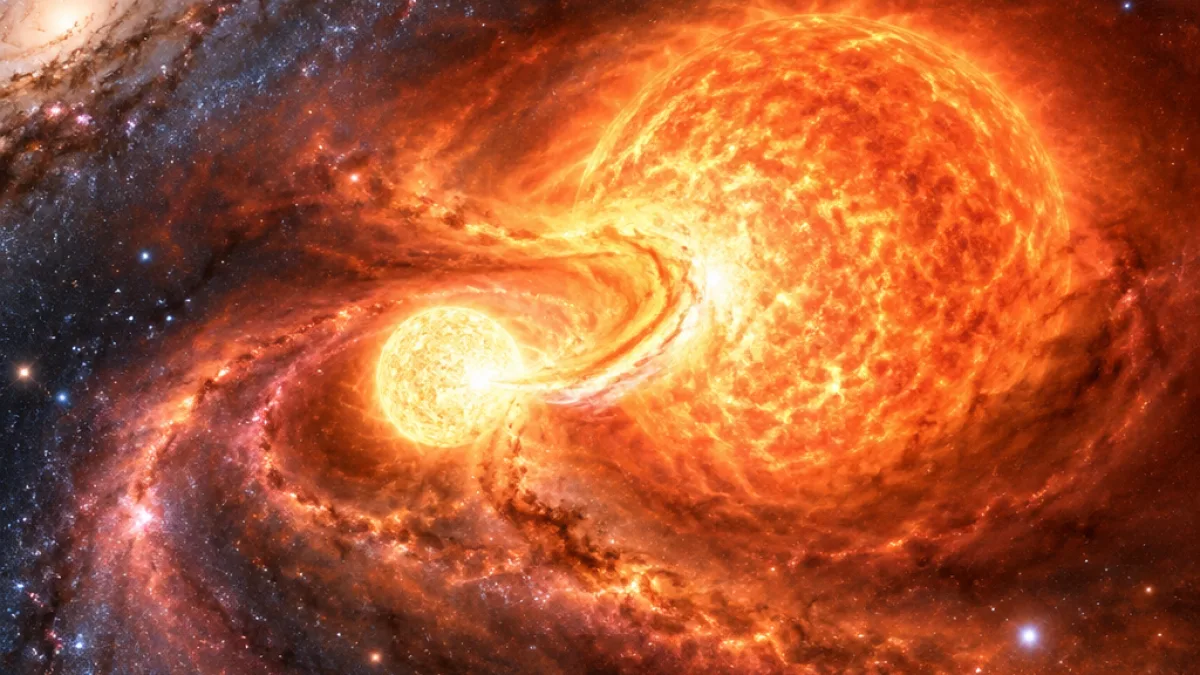
Astronomers have recorded two stars merging in the Andromeda galaxy from the beginning of the process to its apparent conclusion, offering the first detailed view of a stellar collision as it unfolds. The event involved a supergiant and a companion only slightly smaller than the Sun, which had circled one another for thousands of years before their final interaction took less than seven years.
The system, formally designated AT 2025abao and nicknamed Bao by the research team, did not produce the dramatic explosion that might be expected from such a violent event. Instead, observations indicate that the two bodies settled into a single, more massive star. The findings were published in Nature on 18 November.
A long orbital relationship reaches its end
The observations provide a timeline for a process that is normally difficult to see because stellar mergers are unpredictable and occur over astronomical distances. In 2018, the smaller star made contact with the surface of its much larger companion. The pair then entered a phase known as common-envelope evolution, during which material was exchanged between them.
As the gas moved between the stars, the supergiant’s gravity drew its companion progressively closer. The smaller object was eventually pulled towards, and then into, the larger star’s core. This generated a substantial release of energy inside the surviving stellar body, while the system also began producing and expelling dust.
| Date | Observation |
|---|---|
| 2018 | The smaller star reached the surface of the supergiant and gas exchange began. |
| 2023 | A previously steady binary system was detected brightening. |
| December 2025 | Observations were supported by the James Webb Space Telescope. |
| 18 November | The study was published in Nature. |
How the event was detected
The first signs of the impending merger were identified in 2023 by NASA’s now-retired Near-Earth Object Wide-Field Infrared Survey Explorer. Although the spacecraft was built to detect asteroids, its observations revealed that the formerly stable binary system had started to brighten.
Further monitoring using the Wide-Field Infrared Transient Explorer, a near-infrared instrument at the Palomar Observatory in California, showed that the surrounding galaxy had also begun releasing dust. The research team later strengthened its interpretation with data collected by the James Webb Space Telescope in December 2025.
- The system lies in Andromeda, the closest major galaxy to the Milky Way.
- The stars were in orbit for thousands of years before their merger phase began.
- The final interaction unfolded quickly enough for scientists to observe its progression.
- The apparent outcome was one massive star, rather than an explosion that destroyed the system.
A rare view of stellar evolution
Kishalay De, an astronomer at Columbia University and a co-author of the study, compared the energy release to an internal explosion within a living star. The description highlights the unusual nature of the event: the energy was enormous, but it did not tear the system apart in the manner associated with a conventional stellar explosion.
“Almost like a bomb exploding inside a living star.”
Viraj Karambelkar, an astrophysicist at Columbia University and the study’s first author, said stellar mergers are particularly difficult to observe in real time because there is no reliable way to predict when they will occur. In this case, the team noticed the system’s unusual behaviour in 2023 and continued observing it as the brightening and dust production developed.
The significance of Bao lies not only in the final object but in the sequence of evidence leading to it. Astronomers could compare the system’s earlier state with changes in brightness, gas exchange and dust production before using newer observations to support the merger interpretation. That combination gives researchers a rare opportunity to examine how a binary system changes as one star is gradually absorbed by the other.
Because the event occurred in Andromeda, it also demonstrates the value of instruments capable of detecting changes across other galaxies. The observations do not merely show the aftermath of a stellar merger; they trace the transition from an orbiting pair to a single massive star. For scientists studying how stars evolve, that progression provides an unusually direct account of a process that is normally inferred only from before-and-after evidence.