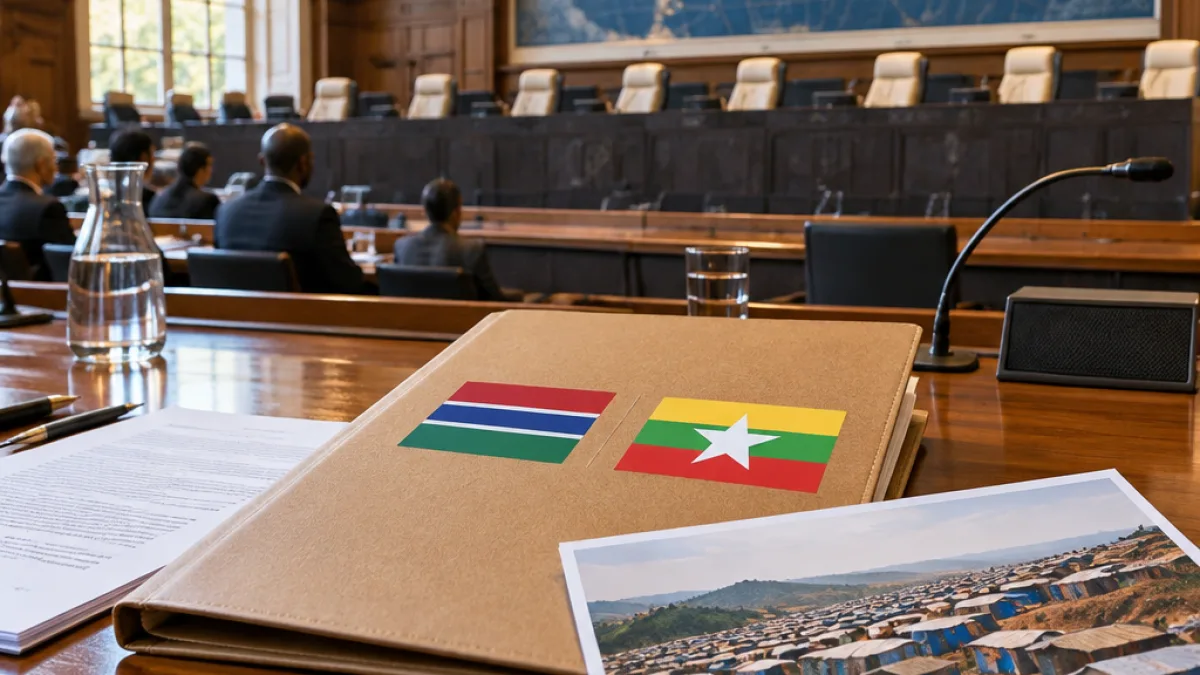
The Gambia has emerged as an unlikely leading voice on the Rohingya crisis after the International Court of Justice agreed with Banjul that Myanmar had committed genocide against the Muslim minority. The decision places a small West African country at the centre of one of the most serious international legal disputes involving mass persecution and displacement.
The development is notable because The Gambia has no obvious historical or geographical connection to Myanmar. It is a narrow country shaped by the Gambia River and surrounded on most sides by Senegal. Beyond being a Muslim-majority state, it had limited relations with the people of Myanmar, according to the report. Its intervention has nevertheless given the Rohingya issue a prominent platform before the world’s principal court for disputes between states.
A case with international consequences
The ICJ’s finding gives formal weight to allegations concerning the treatment of the Rohingya in Myanmar. The ruling, as reported, accepts Banjul’s position that Myanmar committed genocide against the group. That is a significant outcome because the dispute has moved beyond political condemnation and into the framework of international law.
The case also illustrates how states with limited economic and military power can use international institutions to pursue accountability. The Gambia’s role has challenged the assumption that proceedings of this scale must be led by major powers. Its success has instead connected a West African government with a community whose immediate humanitarian needs are being felt far from both countries.
| Key issue | What the report establishes |
|---|---|
| Applicant | The Gambia, acting through Banjul |
| Respondent | Myanmar |
| Community affected | The Rohingya |
| International body | International Court of Justice |
| Finding reported | Myanmar committed genocide |
The human reality behind the ruling
The legal development comes against the backdrop of the Rohingya refugee crisis in Bangladesh. An image accompanying the report showed Rohingya refugees collecting water from a tap at a camp in Cox’s Bazar on 20 November 2026. The scene underlines the distance between a court ruling in an international forum and the daily realities of people living in displacement.
Access to water is a basic necessity, but the photograph also serves as a reminder that the Rohingya remain dependent on camp infrastructure while the wider dispute is addressed through legal and diplomatic channels. The ruling may strengthen the international record of what happened, but it does not by itself describe an immediate change in the conditions of refugees in Cox’s Bazar.
Why The Gambia’s role matters
The Gambia’s involvement carries a wider political message for African states. Banjul has used its position to place the conduct of a government in Asia before an international court, demonstrating that the pursuit of justice can cross regions, cultures and levels of national power. The case has also made The Gambia an important voice on behalf of a population with no state of its own in the account provided.
Its intervention is especially significant because the Rohingya crisis might otherwise be treated primarily as a regional matter involving Myanmar and Bangladesh. The ICJ proceedings have instead reinforced the principle that alleged genocide is a matter of international concern. The Gambia’s victory therefore extends beyond its bilateral relationship, or lack of one, with Myanmar.
- The ICJ has accepted Banjul’s position that Myanmar committed genocide against the Rohingya.
- The Gambia’s case gives an African state a central role in an international accountability process.
- The humanitarian crisis continues in Bangladesh, where Rohingya refugees remain in camps such as Cox’s Bazar.
For the Rohingya, the significance of the decision lies in the recognition of their suffering at the highest level of international adjudication. For The Gambia, it marks a moment in which its legal action has produced a result with global implications. And for the international community, the case keeps alive a question that cannot be separated from the refugee camps: how the legal recognition of genocide will translate into accountability and a meaningful improvement in the lives of those who were forced to flee.