
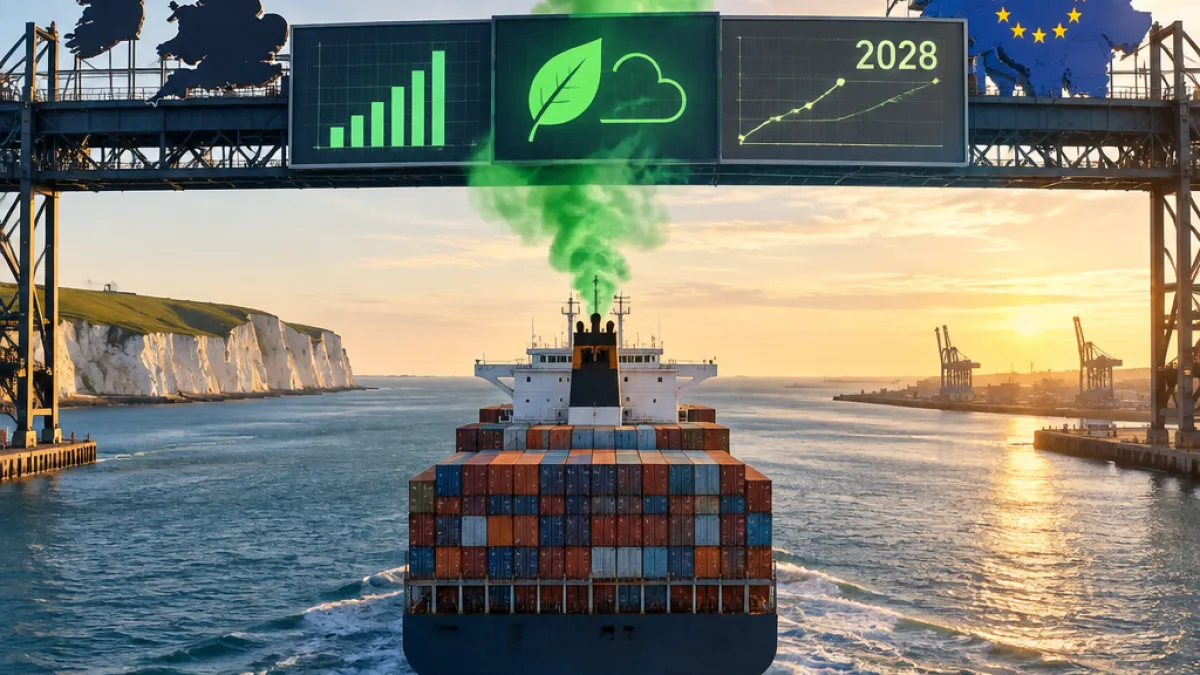
A new link between the United Kingdom and European Union carbon markets will bring international shipping into the UK Emissions Trading Scheme from 2028, extending carbon compliance obligations beyond domestic maritime activity. The arrangement is intended to cover 50% of emissions on international voyages, according to the available details.
The development places shipping at the centre of a widening regulatory effort to reduce greenhouse-gas emissions from international transport. For shipowners, the change will mean that voyages covered by the UK system will have to be assessed under carbon-market rules, adding a new layer to the way emissions are monitored and managed. The available information does not specify which routes, vessels or ports will fall within the arrangement.
A wider compliance net
The UK-EU linkage is significant because it connects two major regulatory systems while applying only to a defined share of emissions from international voyages. The 50% coverage means the arrangement will not, on the information available, treat all emissions from a qualifying voyage in the same way. That partial approach could make the calculation of obligations more complex for shipping companies operating across different routes and jurisdictions.
It also means that the practical effect of the agreement will depend on how the rules are administered. Shipowners will need to identify which emissions are covered, determine how those emissions are allocated, and ensure that their compliance arrangements match the requirements of the UK scheme. The details released so far do not set out the precise reporting, verification or payment procedures.
| Measure | Timing | Potential effect |
|---|---|---|
| UK ETS coverage of international shipping | From 2028 | 50% of emissions on international voyages to be covered |
| UK fuel rules | Planned for 2030 | Rules broadly modelled on the EU’s FuelEU Maritime regime |
Risk of parallel systems
The more immediate concern for the industry is that the carbon-market linkage may be accompanied by a separate UK fuel regime. The planned 2030 fuel rules are described as broadly mirroring the EU’s FuelEU Maritime system, but they would remain UK-specific rather than forming one fully interoperable framework.
That distinction matters. Similar rules do not necessarily remove duplication. If the two systems use different compliance processes, thresholds or administrative requirements, operators could face parallel obligations for the same broad environmental objective. The result could be a compliance landscape in which companies must manage comparable but separate regimes, rather than relying on one shared system.
- The UK ETS is expected to cover part of emissions from international voyages from 2028.
- The stated coverage is 50% of those emissions.
- Separate UK fuel rules are planned for 2030 and are expected to resemble the EU’s FuelEU Maritime regime.
- Shipowners could therefore face two similar but distinct compliance systems.
Implications for global shipping
For international shipping, the measures illustrate the difficulty of coordinating climate policy across borders. The sector operates through routes that connect multiple jurisdictions, while emissions rules may be set by individual governments or regional blocs. A system that is aligned in principle but separate in administration can still increase the work required from operators and may make compliance planning more difficult.
The UK-EU arrangement therefore carries two messages. First, carbon-market cooperation is expanding into international shipping, with implementation beginning in 2028. Second, cooperation does not automatically guarantee regulatory uniformity. Unless the planned UK fuel rules are made fully compatible with the EU regime, shipowners may have to navigate overlapping requirements when planning voyages, managing fuel choices and documenting emissions.
Further detail will be needed on the scope of the covered voyages, the treatment of emissions and the relationship between the UK and EU systems. Until those provisions are clarified, the central issue for maritime operators will be whether the new framework simplifies carbon compliance or adds another layer to an already divided international regulatory environment.