South Africa’s water polo power struggle has moved into the political arena, with Sport, Arts and Culture Minister Gayton McKenzie publicly backing South Africa Water Polo (SAWP) as an investigation into Swimming South Africa (SSA) gets under way.
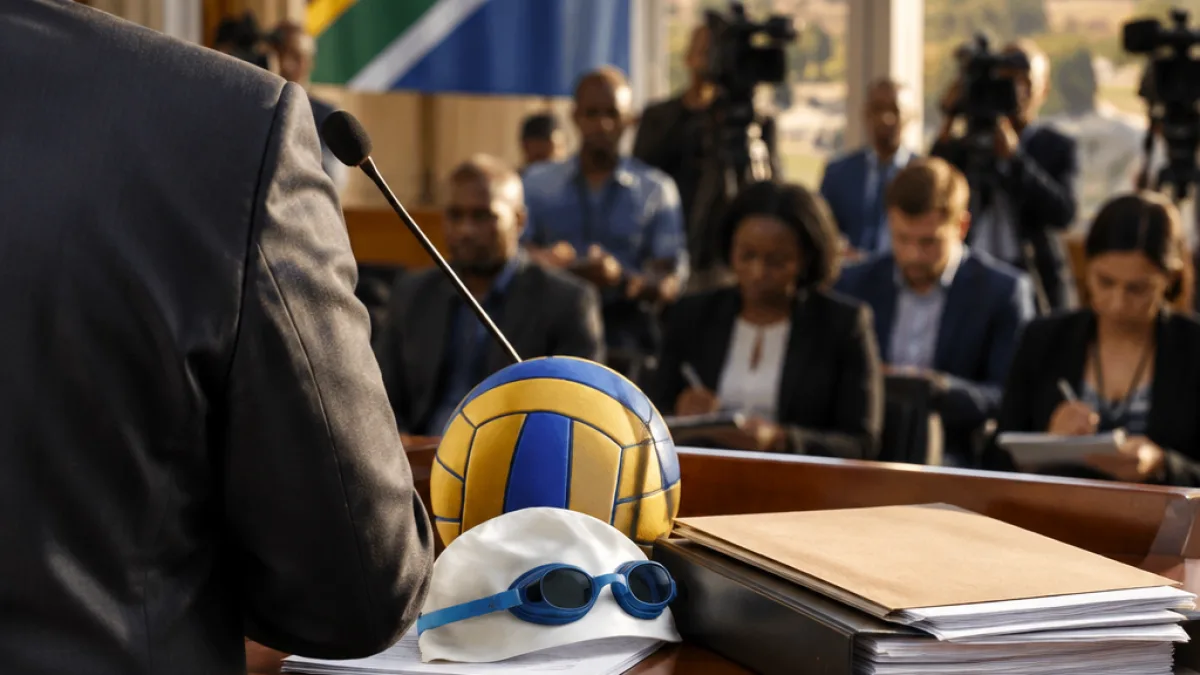
McKenzie made the commitment during a media briefing in Parliament on 17 November 2026, where he also announced that SSA would be investigated. SAWP is an independent organisation challenging SSA’s control of water polo in South Africa, and the minister said he intended to help it secure formal recognition.
“Water polo, I just want to give you guys the assurance: I support you 100%.”
The minister said he had initially been advised not to support SAWP, but chose to meet its representatives and consider their position. After those discussions, he said he had decided to back the organisation and assist with its recognition. The intervention places the dispute over the sport’s administration firmly before the national sporting authorities, while also raising questions about how South Africa’s federations are governed and held accountable.
Investigation follows Smith dispute
The investigation into SSA was prompted by the case of Tatjana Smith, South Africa’s most decorated Olympian. Smith announced that she would represent the Netherlands after a prolonged dispute with the federation. One of the issues involved prize money from the 2023 World Championships, which was withheld because she had not worn the federation’s sponsor-branded kit.
McKenzie apologised to Smith and said she had been treated “like an enemy of this country”. He then asked the South African Sports Confederation and Olympic Committee (SASCOC) to conduct a full investigation and establish a task team to help stabilise SSA. The minister described the federation as being “in ICU”, a stark assessment of an organisation responsible for a broad range of swimming and aquatic sport activities.
The probe is expected to examine several areas of SSA’s operations. These include:
- the federation’s sponsorship agreement with Arena and the penalties connected to it;
- spending at the Franschhoek High Performance Centre; and
- possible weaknesses in SSA’s constitution.
SASCOC has committed to providing monthly reports and producing a diagnosis, with preliminary findings expected within 90 days. The process is intended to establish what went wrong and identify measures that could restore stability, rather than allowing the dispute to remain confined to competing statements from the organisations involved.
Government intervention carries risks
Although McKenzie has expressed strong support for SAWP, he said he could not simply remove SSA’s leadership. Direct government interference in the running of a sporting federation could expose South Africa to the risk of suspension by World Aquatics, the international governing body for aquatic sports.
That limitation leaves the minister supporting change while relying on the country’s recognised sporting structures to handle the formal process. SASCOC’s task team will therefore be central to determining whether the concerns surrounding SSA amount to failures of governance, financial management or constitutional procedure, and what steps should follow.
SAWP chief executive Robbie Taylor has offered the organisation’s operational and legal cooperation to the Department of Sport, Arts and Culture. That offer could become significant as the investigation examines the competing claims over who should administer water polo and how athletes’ interests should be protected.
For South African water polo, the immediate contest is about recognition. The wider issue is the credibility of the system governing elite sport. With the investigation now linked to the treatment of a leading Olympian, the handling of commercial agreements and the future administration of water polo, the next 90 days will test whether the country’s sporting authorities can resolve the dispute without triggering an international consequence.