Sweden’s government-formation deadlock has deepened after Social Democratic leader Magdalena Andersson told the parliamentary Speaker she could no longer assemble a Cabinet with enough support to govern.
Andersson’s decision followed a week of discussions involving the Social Democrats, the Centre Party, the Green Party and the Left Party. She said the talks had been constructive, but had not developed into substantive negotiations because the Left Party had refused to take part. The move leaves Sweden without a settled government following an election in which neither political bloc secured an outright majority.
“Since the Left Party has chosen not to negotiate, there are now no conditions for me to form a government that is tolerated by the parliament,” Andersson said.
A narrow election result
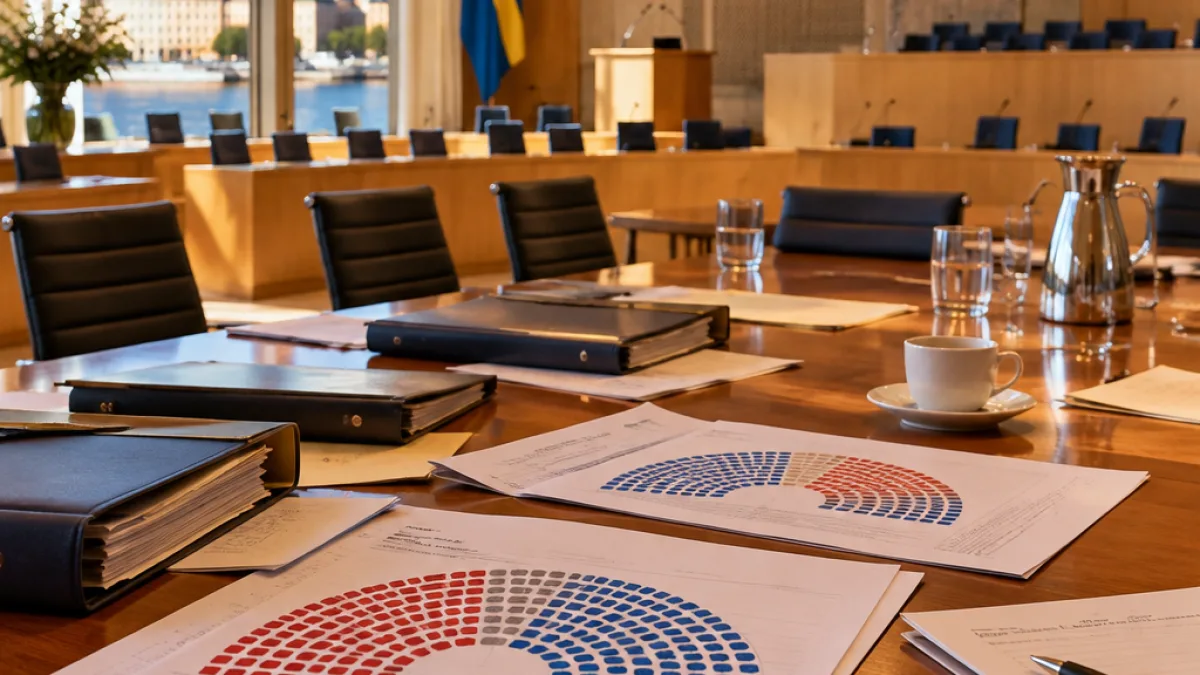
The centre-left bloc led by Andersson narrowly won the September election, taking 176 seats compared with 173 seats for the right-wing coalition. That advantage has not translated into a functioning governing arrangement, however, because the parties on Andersson’s side remain divided over both the composition of a Cabinet and the political terms on which it would operate.
The parliamentary arithmetic has made cooperation between several parties essential. Andersson’s position was further complicated by the Centre Party’s decision to resume discussions with Moderate Party leader Ulf Kristersson, who is seeking to lead a four-party centre-right government. Andersson said she would vote against Kristersson in a parliamentary vote on the premiership.
She also warned that a minority administration led by the centre-right bloc would ultimately rely on support from the right-wing Sweden Democrats. Her objection places the question of parliamentary support at the centre of the dispute, rather than simply the identity of the next prime minister.
Kristersson prepares alternative bid
Kristersson said he remained ready to attempt to form a government when Speaker Andreas Norlen considered the conditions suitable. He confirmed that discussions with the Centre Party would continue, although he did not disclose the details of those talks.
He also rejected the idea that allowing more time would necessarily resolve the impasse. According to Kristersson, the election took place 72 days earlier, and the issue was no longer simply one of extending negotiations.
“I would not have tried it if I did not believe the conditions were there,” Kristersson said.
What happens next
The immediate focus now shifts to the Speaker’s assessment of whether Kristersson has a credible path to forming a government. Andersson’s announcement means that the centre-right bloc has an opportunity to test whether its renewed engagement with the Centre Party can produce enough parliamentary support.
At the same time, the election result shows why the next administration may face continuing pressure from parties outside its formal governing group. The centre-left bloc holds the larger number of seats, but its failure to negotiate across its own parties has prevented Andersson from converting that advantage into a government. The centre-right bloc has fewer seats, yet may still seek office if it can secure the necessary support in Parliament.
The main developments are:
- Andersson’s bid has ended after the Left Party declined to participate in negotiations.
- Kristersson is preparing an alternative attempt to form a four-party centre-right government.
- The Centre Party remains pivotal because it is in talks with both sides of the political divide.
- The Sweden Democrats’ potential support is a central concern in the debate over a minority centre-right administration.
| Bloc or party | Position in the current impasse |
|---|---|
| Centre-left bloc | 176 seats; divided over forming a government |
| Right-wing coalition | 173 seats; seeking an alternative government |
| Centre Party | Holding talks with Kristersson after discussions with centre-left parties |
| Left Party | Refused to participate in substantive negotiations |
Until a premiership vote produces a viable governing arrangement, Sweden’s political direction will remain uncertain. The competing blocs must now demonstrate not only that they can win support in Parliament, but also that their agreements can hold despite the sharp differences over coalition partners and reliance on outside backing.