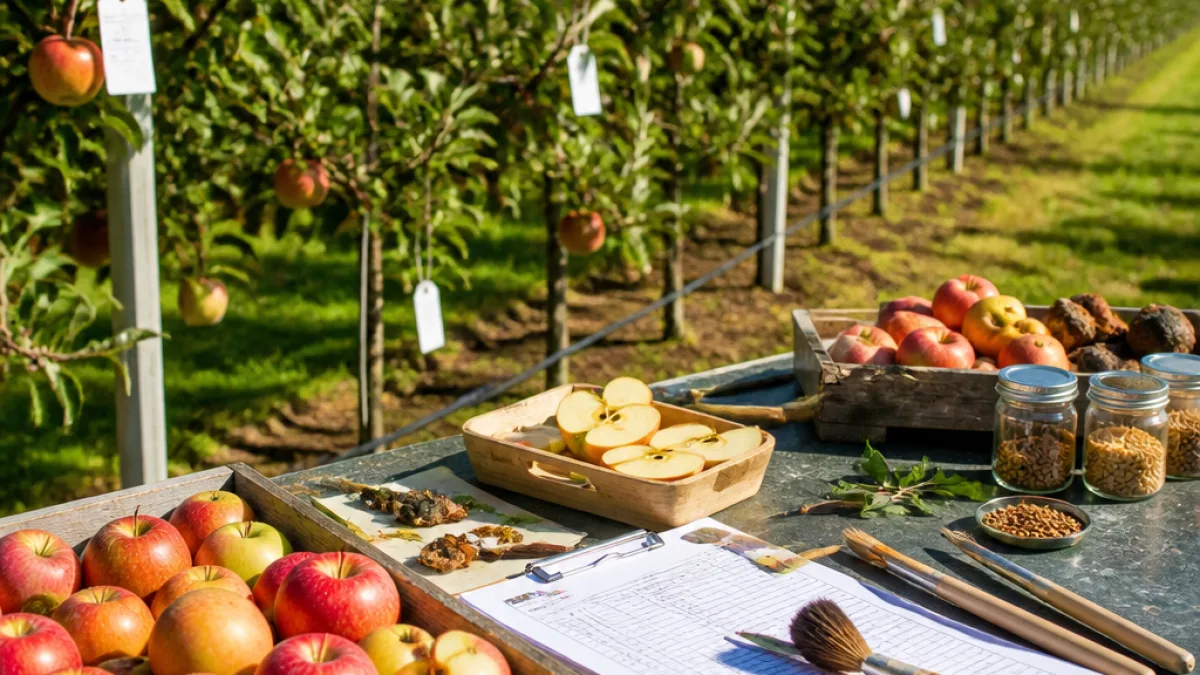
Creating a commercially successful apple is a long process of genetic selection, accelerated testing and repeated rejection. At the University of Minnesota, breeders make about 10,000 crosses a year, yet only one or two of the resulting selections may eventually be considered suitable for release.
The programme is associated with varieties including Honeycrisp, Zestar, Rave, also known as First Kiss, and SweeTango. Honeycrisp is regarded by senior research fellow and apple breeder David Bedford as a particularly significant release because it raised expectations across the industry. Its success also forced the programme to reassess other candidates that had previously appeared promising.
“It changed our world,” Bedford said.
From pollination to a possible release
The starting point is a deliberate cross between two apple varieties. Breeders transfer chosen pollen to the flower of another variety, harvest the resulting seeds and raise the seedlings. The trees must then grow sufficiently to produce fruit before their qualities can be assessed. For ordinary woody plants, that juvenile phase can delay evaluation for many years.
The Minnesota programme shortens the wait by grafting young seedlings on to dwarf rootstock instead of allowing them to grow on their own roots. This method brings the first fruit closer to the four-to-six-year stage, compared with a period that can sometimes extend to eight or 10 years when trees are grown without the same intervention.
| Stage | What happens |
|---|---|
| Crossing | Pollen from one variety is placed on the flower of another. |
| Early growth | Seeds are harvested and seedlings are raised. |
| First assessment | Grafted trees are brought to fruit sooner for evaluation. |
| Selection | Thousands of candidates are reduced to one or two possible releases. |
Why most candidates are rejected
Fruit breeding is not simply a search for one desirable characteristic. A candidate must perform well across several measures, including texture and flavour. Bedford described the work as a marathon, with progress depending on decisions made over an extended period rather than on a single successful cross.
That approach has also changed during his career. Earlier in the programme, he gave a weak selection several opportunities to prove itself. He later reduced the allowance to two chances and now applies a much stricter standard: a candidate that fails once is generally removed. The reasoning is that an apple may have a poor season, but it should still show acceptable texture and flavour if it is to remain in consideration.
- About 10,000 crosses are made each year.
- The first fruit may be assessed after roughly four to six years using grafting techniques.
- Only one or two selections from the larger pool may reach commercial-release consideration.
- Dwarf rootstock also allows more trees to be grown in the same orchard space.
Space, time and human judgement
Grafting has a second advantage beyond shortening the wait for fruit. It enables the programme to use orchard space more intensively, with roughly 2,000 trees in an area that would otherwise accommodate about 400 trees under the system described by the breeders. More trees in the available space mean that a larger number of seedlings can be observed and compared during the selection process.
Even with that efficiency, the science cannot remove uncertainty from breeding. Biology determines which traits appear in each seedling, while seasonal performance can affect what breeders see. The final decision therefore combines the results of the growing process with practical human assessment of eating qualities. The programme’s experience shows that technology can make testing faster and more space-efficient, but it cannot eliminate the need for patience or careful judgement.
The history of Honeycrisp and the other Minnesota releases illustrates the narrow path from experimentation to a recognised variety. Thousands of combinations may be attempted, but commercial success depends on identifying the rare selection that consistently meets the required standard. In that sense, apple breeding is both a modern scientific programme and a disciplined exercise in deciding which possibilities are worth pursuing.