A team of physicists at Northwestern University has successfully trapped a single antimatter particle — a positron — for several months in a device that allows repeated, non-destructive measurements of its quantum behaviour. The experiment, published in Physical Review Letters, represents a step change in how researchers can study differences between matter and antimatter.
How the particle was kept alive
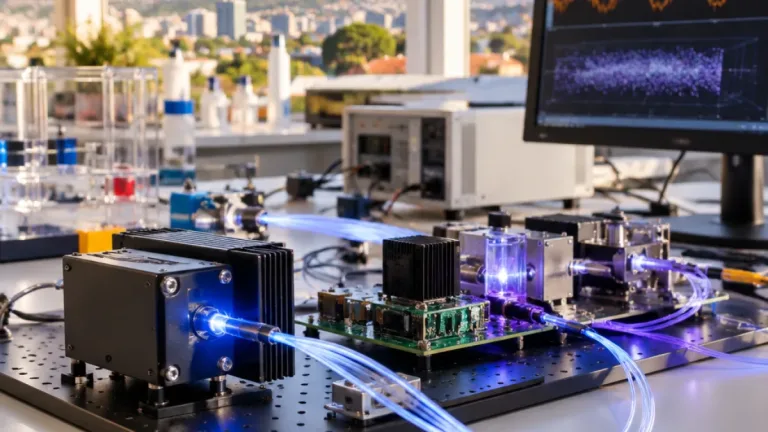
Antimatter particles annihilate on contact with ordinary matter, so laboratories use vacuum chambers and electromagnetic fields to suspend antiparticles in isolation. The Northwestern team, led by Gerald Gabrielse, developed a specialised apparatus called a single-positron quantum cyclotron. Using precisely controlled electric and magnetic fields and cooling the system to temperatures close to absolute zero, they reduced the particle to its lowest energy state. That low-energy state made it possible to control and probe the particle's quantum states without destroying it.
The key breakthrough is that the approach did not require destroying the antiparticle as part of measurement. Because the positron remained intact, researchers were able to retain the same single antiparticle in the trap for months, repeating experiments and improving statistical precision — a capability that had previously been out of reach.
- Particle: positron (antiparticle of the electron)
- Device: single-positron quantum cyclotron
- Environment: vacuum and temperatures near absolute zero
- Duration: trapped for months allowing repeated measurements
| Parameter | Detail |
|---|---|
| Particle | Positron |
| Apparatus | Single-positron quantum cyclotron |
| Temperature | Near absolute zero |
| Observation time | Months |
Why keeping one antiparticle matters
In theory, every particle of matter has a corresponding antiparticle. Yet the observable universe is overwhelmingly composed of ordinary matter, and the reason for that asymmetry remains one of the deepest open questions in physics. Producing antiparticles in laboratories is possible, but experiments have been limited by the short lifetimes and the destructive nature of some measurement techniques.
By holding a single positron in a controllable, low-energy state for a prolonged period, researchers can perform high-precision measurements of its quantum properties and compare them directly with those of electrons. Such comparisons test fundamental symmetries of nature and may reveal tiny differences that point to new physics beyond the current theoretical framework.
The experiment therefore opens new experimental pathways. Repetition of measurements on the same antiparticle increases precision and reduces systematic uncertainties that arise when experiments must produce and measure many different antiparticles under varying conditions. Over time, this could enable more stringent tests of the similarities and differences between matter and antimatter.
Implications for the scientific community
While the experiment was carried out at Northwestern, its implications are international. Precision control of singled-out antiparticles reduces one barrier to studying antimatter and could influence the design of future experiments worldwide that seek to probe the foundations of quantum mechanics and particle physics. For research policymakers and funders, the result underscores the value of specialised apparatus and sustained laboratory investments to tackle fundamental questions about the universe.
As the technique is refined, it may complement other experimental programmes that study antiparticles in traps, neutral antimatter atoms or in high-energy collisions. Together, these efforts aim to build a more complete experimental picture that could help explain why matter dominates our cosmos.
For now, the trapping of a positron for months is a demonstration that highly controlled, long-duration antimatter experiments are feasible — and that precision studies of antimatter properties without destruction are within reach.