Five trees reach their new home
Five protected baobabs have been replanted in the Timbavati Nature Reserve, concluding a months-long relocation that took the trees on a roughly 900-kilometre journey across South Africa before returning them to Limpopo.
The operation followed the removal of the trees from their original location, an event that raised concern among conservationists and members of the public. Their movement became a matter of wider public interest as the trees were transported between provinces and conservation teams worked to secure a permanent new site.
For now, the baobabs are back in the soil. The next phase will focus on their recovery and their ability to survive after spending months out of the ground, according to the Timbavati Nature Reserve.
A carefully managed transport operation
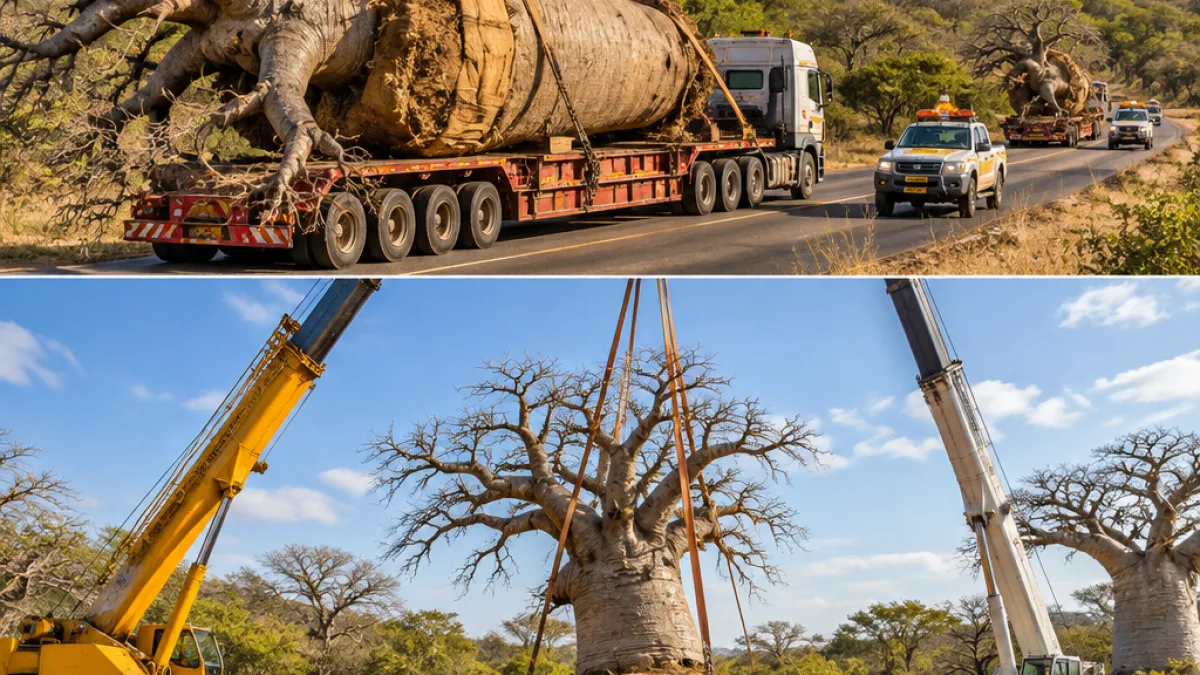
The trees arrived in Hoedspruit as part of a highly specialised transport effort. Five low-bed trucks were used for the convoy, accompanied by an abnormal-load escort because of the size and weight of the baobabs.
The convoy’s passage through Hoedspruit attracted attention from people along the roadside. Farm Watch members assisted with the movement of the vehicles, adding a local support element to an operation that required careful coordination as the trees made their way towards the reserve.
Getting the baobabs to the reserve was not the end of the logistical challenge. The final route included dirt roads that could not accommodate the same combination of heavy vehicles and oversized loads used for the longer journey.
Road infrastructure had to be changed
According to the reserve, six speed humps on Avoca road had to be removed to create sufficient clearance for the enormous trucks. The work illustrates the practical difficulties involved in moving mature trees weighing many tonnes through an area where ordinary road infrastructure was not designed for such a load.
Once the convoy reached the transfer point, two cranes were brought in to lift the baobabs from the large transport vehicles. Each tree weighed between 17 and 30 tonnes, requiring the lifting process to be handled with precision before the trees could be placed on smaller trucks.
| Part of the operation | Recorded detail |
|---|---|
| Distance travelled | About 900km |
| Baobabs relocated | Five |
| Transport vehicles | Five low-bed trucks |
| Weight of each tree | 17 to 30 tonnes |
| Road humps removed | Six |
The final leg into the reserve
The smaller trucks were needed for the last section of the journey, where the route towards the planting locations included dirt roads. Transport crews, crane operators and conservation teams worked together in demanding conditions to move each baobab into position without further disruption to the trees.
The planting process marked the end of the transport phase, but not the end of the conservation responsibility. With all five trees now planted, attention will turn to monitoring their condition and supporting their recovery over time. The source material does not provide a timetable for that process or make any prediction about the trees’ long-term survival.
- All five baobabs have been planted in the Timbavati Nature Reserve.
- The trees travelled about 900km before reaching their new location.
- The operation involved heavy transport vehicles, two cranes and alterations to part of the route.
A conservation effort watched across the province
The journey connected communities and conservation workers across Limpopo and other parts of South Africa. In Hoedspruit, the arrival of the convoy gave members of the public an opportunity to see the scale of the trees and the unusual demands of moving them by road.
The relocation also placed the practical realities of conservation in view: protecting a tree can involve transport planning, road access, heavy-lifting equipment and cooperation between people working far from one another. In this case, the final destination was selected within the Timbavati, where the baobabs can now begin a new phase in their history.
The trees’ earlier removal had prompted questions about how protected baobabs should be safeguarded and moved when their original location is no longer available. Their return to Limpopo does not resolve every issue surrounding the relocation, but it provides a clear outcome to the immediate transport effort.
For the teams involved, the successful planting of the five baobabs represents the completion of a difficult operation. For the public, it is the latest chapter in a story that began with uncertainty and ended with the trees being placed in a new home in one of Limpopo’s recognised conservation areas.