
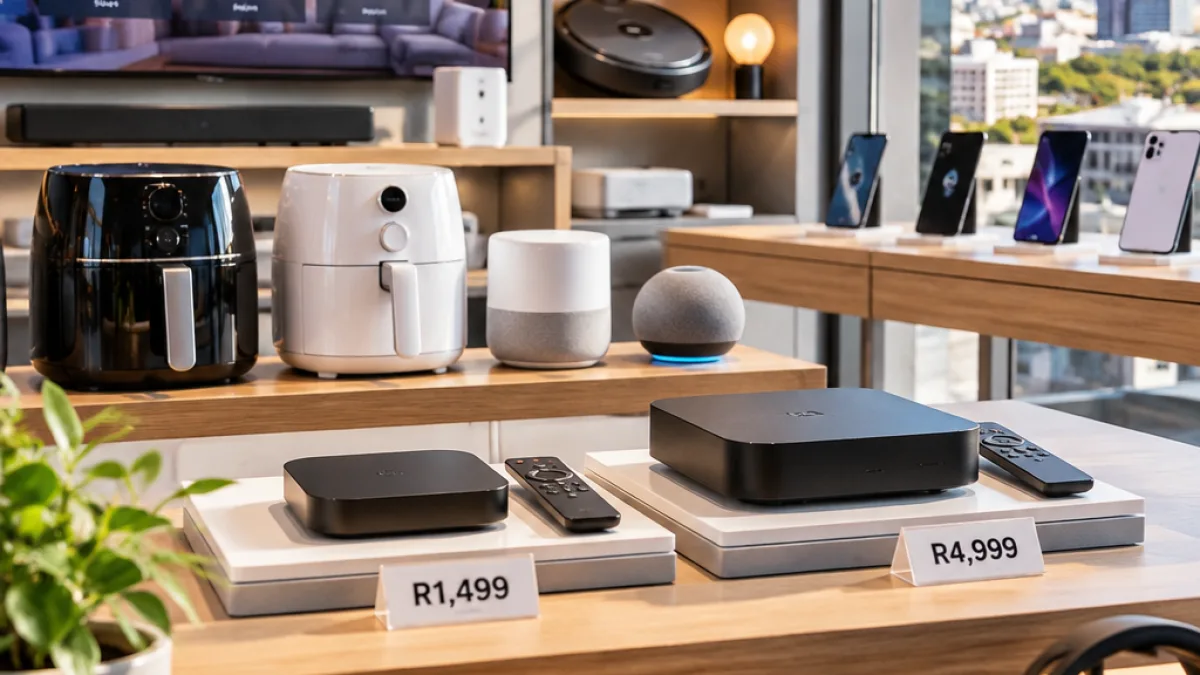
Xiaomi is positioning itself as a lower-cost alternative across South Africa’s technology market, extending its ambitions beyond smartphones as global demand for memory and storage pushes up the prices of consumer devices.
The company’s local strategy combines a wide range of connected products with hardware and battery development aimed at delivering higher-end features at more accessible prices. Its portfolio includes smartphones, smart-home appliances, wearables, streaming devices and air fryers, forming what the company describes as an Artificial Intelligence of Things (AIoT) ecosystem.
A wider technology ecosystem
Xiaomi remains best known to many South African consumers as a smartphone brand. Globally, however, it is described as the third-largest smartphone company, while its product range reaches into several parts of the home and personal technology market.
Tianshi Lv, Xiaomi South Africa’s country manager, said the company viewed South Africa as an important market even though its local operation was still small compared with the group’s international business. The strategy is to build recognition by offering alternatives in categories where premium technology has become increasingly expensive.
“Our mission is ‘innovation for everyone’—relentlessly building amazing products with honest prices so people can enjoy a better life.”
That approach is particularly visible in entertainment hardware. A new Apple TV 4K is priced at R6,299, according to the report, while Xiaomi’s TV Box S (3rd Gen) sells for about R1,500. Both products are media-streaming devices, but the large difference in price illustrates the segment Xiaomi is targeting: consumers who want streaming functionality without paying the price associated with premium brands.
Why device prices are under pressure
The pricing challenge is not limited to South Africa. Consumers worldwide are facing higher costs for technology upgrades, while the rapid expansion of artificial intelligence has increased demand for memory and storage components. The resulting global pressure, referred to in the report as the “Rampocalypse”, is affecting smartphones, laptops and streaming boxes.
For South African consumers, this creates a practical trade-off. Replacing a device may be necessary when an older product no longer supports current applications or services, but higher component costs can make premium models less attainable. Xiaomi’s response is to compete through a combination of product scale, engineering and pricing rather than relying only on its smartphone range.
| Product | Reported price | Market position |
|---|---|---|
| Apple TV 4K | R6,299 | Premium streaming device |
| Xiaomi TV Box S (3rd Gen) | About R1,500 | Lower-priced streaming alternative |
What the strategy means for consumers
The company’s broader product range could make it possible for customers to remain within one brand’s ecosystem as they add devices over time. Instead of buying only a phone, a consumer may also consider a wearable, streaming box or smart-home appliance from the same manufacturer. That gives Xiaomi more opportunities to compete for household technology spending, especially as buyers become more cautious about the cost of individual upgrades.
The approach also changes how Xiaomi presents itself in South Africa. It is not simply seeking to be an alternative handset supplier, but a technology company with products across everyday categories. Jared Ferns, Xiaomi South Africa’s national training manager, was part of the discussion about the company’s local plans, which focus on showing consumers the breadth of its portfolio.
Its challenge will be to turn that international scale into stronger local recognition. Xiaomi’s leadership acknowledges that the South African business is still small compared with the global group, while identifying the country as strategically important. The immediate proposition is clear: as technology becomes more expensive, the company wants consumers to compare not only specifications, but also the value delivered by each device.
- Beyond phones: Xiaomi’s local portfolio includes smart-home products, wearables and streaming equipment.
- Affordability: Its TV Box S is priced at roughly one-quarter of the reported Apple TV 4K price.
- Global pressure: Artificial intelligence demand is contributing to higher memory and storage costs.