A new approach to training reservoir computing systems could simplify the development of unconventional artificial intelligence hardware by removing two requirements traditionally associated with the process: access to intermediate system states and coupling between the system’s nodes.
The framework, described by researchers affiliated with the Integrated Systems Laboratory at ETH Zurich, was shown to support efficient learning both in simulation and on optoelectronic hardware. The finding is significant because it addresses not only how a reservoir-computing system learns, but also how its physical implementation can be made less complicated.
Training without monitoring the system’s interior
Reservoir computing is an approach to machine learning in which a computational system processes information through a network of connected elements, or nodes. The system’s internal activity provides a changing representation of the input, while a learning procedure is used to produce the required output. In the framework reported here, training does not require access to the system’s intermediate states.
That change is paired with the elimination of coupling between the nodes. In other words, the proposed method removes the need for the nodes to be linked to one another during the physical learning process. The result is a simplified training strategy that can be applied in a computational simulation as well as in an optoelectronic device.
- Internal-state access: the method trains the reservoir without requiring information from its intermediate stages.
- Node coupling: connections between the nodes are eliminated in the proposed framework.
- Demonstration: the approach achieved efficient learning in simulation and on optoelectronic hardware.
Why the hardware demonstration matters
Computing systems based on physical processes can be difficult to train because their internal behaviour may not be as readily observable or adjustable as that of a conventional software model. A method that does not depend on access to intermediate states could therefore reduce the information that must be collected from the device during training.
Likewise, removing node-to-node coupling could simplify the architecture required to build and operate a reservoir. The source does not provide a performance comparison, energy figure, device specification or task-by-task result, so the advance should be understood as a demonstration of a training framework rather than as evidence that this approach has surpassed established computing systems in every application.
| Aspect | Reported result |
|---|---|
| Learning environment | Simulation and optoelectronic hardware |
| Intermediate states | Not required for training |
| Node architecture | Coupling between nodes eliminated |
| Research area | Unconventional computing |
A step towards more accessible physical learning systems
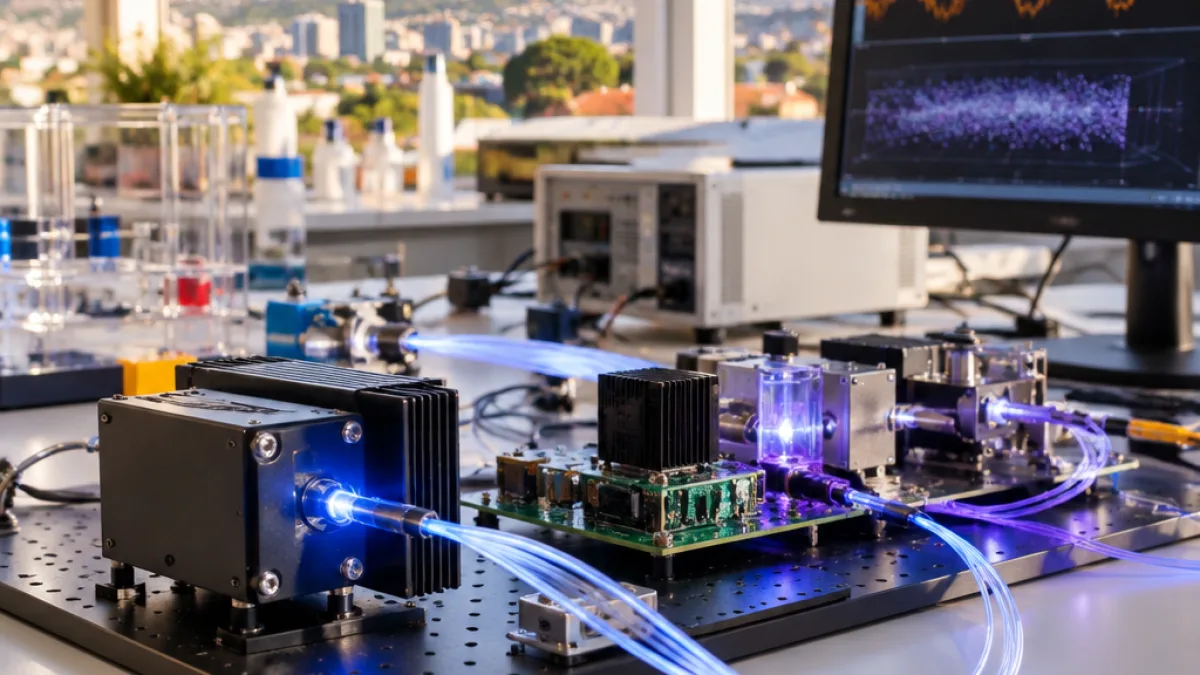
The work sits within a broader effort to use physical systems for computation rather than treating hardware only as a platform on which software runs. Optoelectronic hardware combines optical and electronic processes, and its inclusion in the demonstration indicates that the proposed training strategy is not limited to an abstract mathematical model.
However, the reported result does not by itself establish how the framework would perform at larger scales, across different physical designs or in real-world deployments. Questions about reliability, generalisation, manufacturing complexity and the types of tasks the system can handle would require further testing. None of those measures is provided in the available report.
The researchers are Hanglin He and Alexandros Emboras, both associated with ETH Zurich’s Integrated Systems Laboratory in Zurich, Switzerland. Their work is presented as a simplification of the training process for reservoir computing, with the key result being that efficient learning was achieved without monitoring intermediate states and without coupling the nodes. That combination could help make physical learning architectures easier to design and train, while leaving their ultimate practical scope to be established by subsequent research.