South Korea’s Education Minister Choi Kyo-jin has resigned after a backlash over emergency measures introduced to prevent artificial intelligence-assisted cheating in the country’s high-stakes university entrance examination. President Lee Jae-myung accepted the resignation on 22 November 2026, three days after the College Scholastic Ability Test, known as the Suneung, was written.
The resignation places examination security and ministerial accountability at the centre of a national education controversy. In South Korea, performance in the university entrance examination can have a major influence on students’ access to higher education and their future career opportunities. That pressure has made concerns about the use of concealed electronic devices and artificial intelligence particularly sensitive for students, parents, schools and examination officials.
Emergency response before the examination
The immediate concern arose after a candidate in a separate professional examination admitted using a concealed camera and artificial intelligence to obtain answers. The disclosure prompted fears that similar technology could be used during the national university examination, which was scheduled for 19 November 2026.
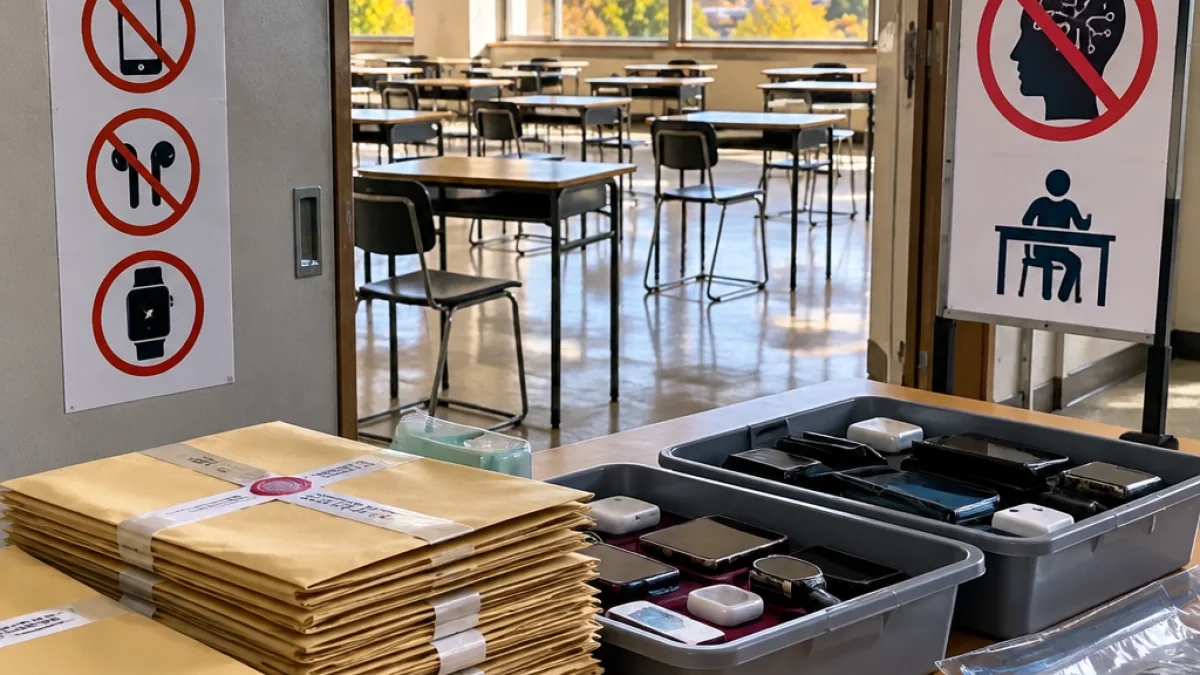
Authorities responded with additional checks for smart glasses, miniature cameras and other hidden electronic devices. They also introduced measures intended to restrict wireless communication and the use of recording equipment. However, the rules were announced and revised shortly before the examination, leaving candidates and supervisors uncertain about what would be required inside examination venues.
| Date or timing | Development |
|---|---|
| 15 November 2026 | A candidate in a separate tax-accountant examination admitted using a miniature camera, a smartphone and AI assistance. |
| 17 November 2026 | Authorities announced about 8,400 additional personnel, two days before the university examination. |
| 19 November 2026 | The College Scholastic Ability Test was held under the expanded security arrangements. |
| 22 November 2026 | President Lee accepted Minister Choi’s resignation. |
Thousands added to security operation
The government deployed approximately 8,400 additional personnel. About 1,800 were assigned to identify prohibited smart devices, while roughly 6,600 were added as corridor supervisors. The scale of the deployment underlined the seriousness of the threat officials believed artificial intelligence posed to the integrity of the examination.
Among the disputed measures was a requirement for stickers to be placed over buttons on students’ clothing. The stated purpose was to prevent miniature cameras from being hidden in the buttons. Officials also increased inspections for smart glasses, miniature cameras and other devices that could enable communication or the recording of examination material.
- Smart devices: Additional checks targeted phones, smart glasses, miniature cameras and other concealed electronics.
- Staffing: About 8,400 extra personnel were deployed, including device inspectors and corridor supervisors.
- Communication controls: Measures were introduced to limit wireless communication and hidden recording.
- Candidate uncertainty: The timing and repeated changes to the rules generated confusion before the examination.
Technology tests the examination system
The controversy illustrates the difficulty of protecting traditional examination systems when artificial intelligence can be combined with small cameras, smartphones and wireless communication. The problem was not limited to whether a candidate had brought a prohibited device into an examination room. Authorities also had to consider whether the technology could obtain questions, transmit them and return answers without being detected.
The response placed officials in a difficult position. Stronger controls were intended to reassure candidates that their results would be based on their own work. At the same time, introducing unfamiliar procedures only days before the test risked adding anxiety to an already demanding examination. The government’s decision to expand the security operation therefore became part of the controversy it was intended to contain.
Minister Choi’s departure means the political consequences will continue beyond the examination itself. The episode has raised questions about how education authorities should respond when new technology threatens the credibility of assessments, and how much advance notice students should receive when examination conditions change. For candidates whose university opportunities depend on a single test, confidence in the rules is closely tied to confidence in the result.
The resignation does not resolve the underlying challenge. South Korea must still determine how to address suspected artificial intelligence-assisted cheating, how to secure future examinations and how to balance intensive surveillance with a fair and manageable experience for students. The government’s handling of those questions will shape whether the next examination is defined by stronger safeguards or by renewed concern over the reliability of the system.