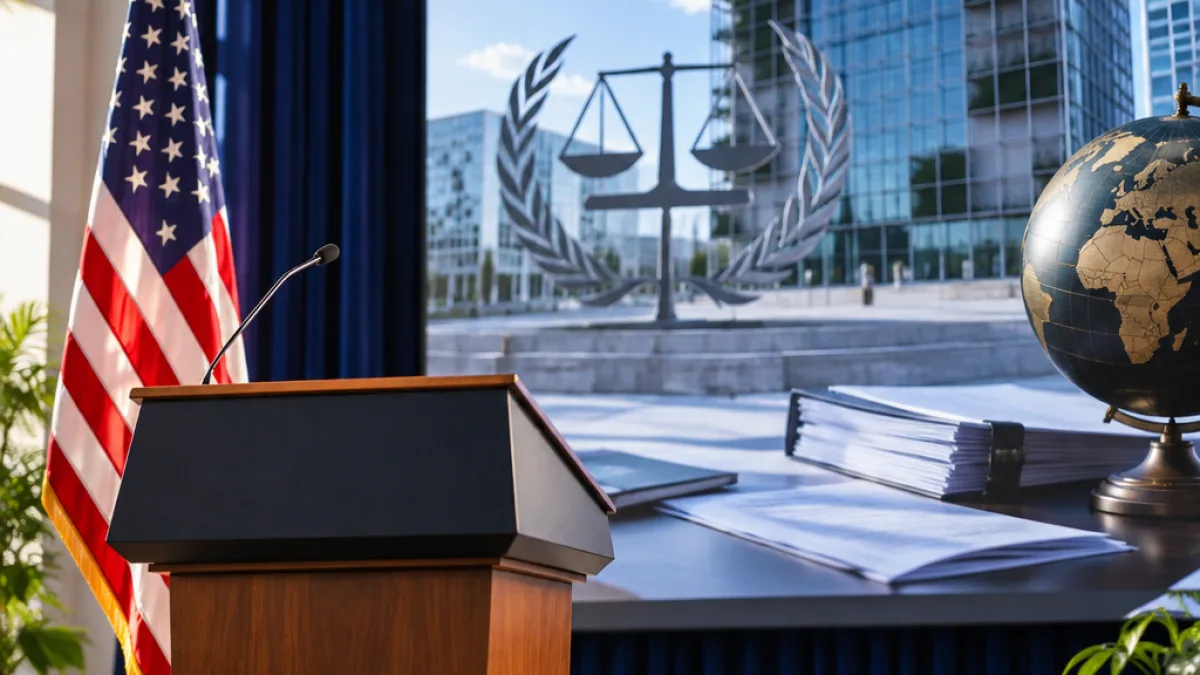
US Secretary of State Marco Rubio has launched a forceful attack on international law and the International Criminal Court, arguing that Washington will not accept what he portrayed as the authority of unelected judges and international officials over American citizens.
Speaking at the Federalist Society National Lawyers Convention in Washington on Friday, Rubio described the prevailing approach to international law as a project advanced by unnamed elites for their own interests. His remarks offered an uncompromising defence of national sovereignty and placed the ICC at the centre of a broader rejection of international legal oversight by President Donald Trump’s administration.
A direct challenge to international institutions
Rubio said the United States would not submit to what he called a “sterile vision of radical judges or soulless global bureaucrats”. The language marked a sharp repudiation of the idea that international courts or global institutions should be able to impose obligations on the United States without the consent of its government.
Although the secretary of state did not identify the elites he was referring to, he presented international law as an instrument that could be used to advance interests outside the democratic control of the American electorate. His argument was framed not as a limited disagreement with one court, but as a wider challenge to the legitimacy of international legal authority when it conflicts with Washington’s interpretation of national power.
“Stop quoting laws to men with swords,” Rubio said, invoking a remark attributed to the Roman general Pompey.
The reference gave the speech a deliberately confrontational tone. It suggested that the United States, because of its military and political power, should not be constrained by legal claims that its administration considers illegitimate. That argument carries significance beyond the United States because the ICC and other international institutions depend on states accepting that legal rules can apply across borders and to powerful actors.
The ICC remains a central target
Rubio’s remarks continued a pattern established during Trump’s first and second terms, when the administration repeatedly singled out the International Criminal Court for criticism. The latest intervention therefore represents both a continuation of existing policy and a renewed public statement from a senior member of the US government.
The speech did not set out a new legal measure or announce a specific action against the court. It did, however, make the administration’s political position clear: Washington rejects the prospect that international judicial bodies could enforce decisions or directives against Americans without the United States accepting that authority.
| Issue | Position expressed by Rubio |
|---|---|
| International law | Presented as a tool that elites can use to serve their own interests |
| International Criminal Court | Singled out for renewed criticism |
| US sovereignty | Placed above what Washington regards as unauthorised international legal demands |
Consequences for global accountability
The significance of the address lies in the tension between national sovereignty and international accountability. If a major power rejects the authority of international courts whenever its government disputes their decisions, the reach of those institutions becomes more dependent on political consent. Rubio’s speech did not resolve that tension; it placed the United States firmly on one side of it.
For countries and institutions that support international courts, the message is likely to be read as a warning that Washington will resist legal processes it believes threaten American officials or citizens. For the Trump administration, the position is presented as a defence of self-government against what it regards as an unaccountable global order.
Rubio also referred to the contemporary information environment, describing a period marked by both misinformation and an excess of information. His comments underscored the administration’s broader political argument that public institutions should be judged through national authority rather than by what he characterised as abstract or detached international standards.
The address leaves open how the United States will respond to any future attempt to apply international legal decisions to Americans. Its immediate importance is political rather than procedural: a senior US official has again rejected the legitimacy of external judicial authority and reaffirmed the administration’s opposition to the ICC.