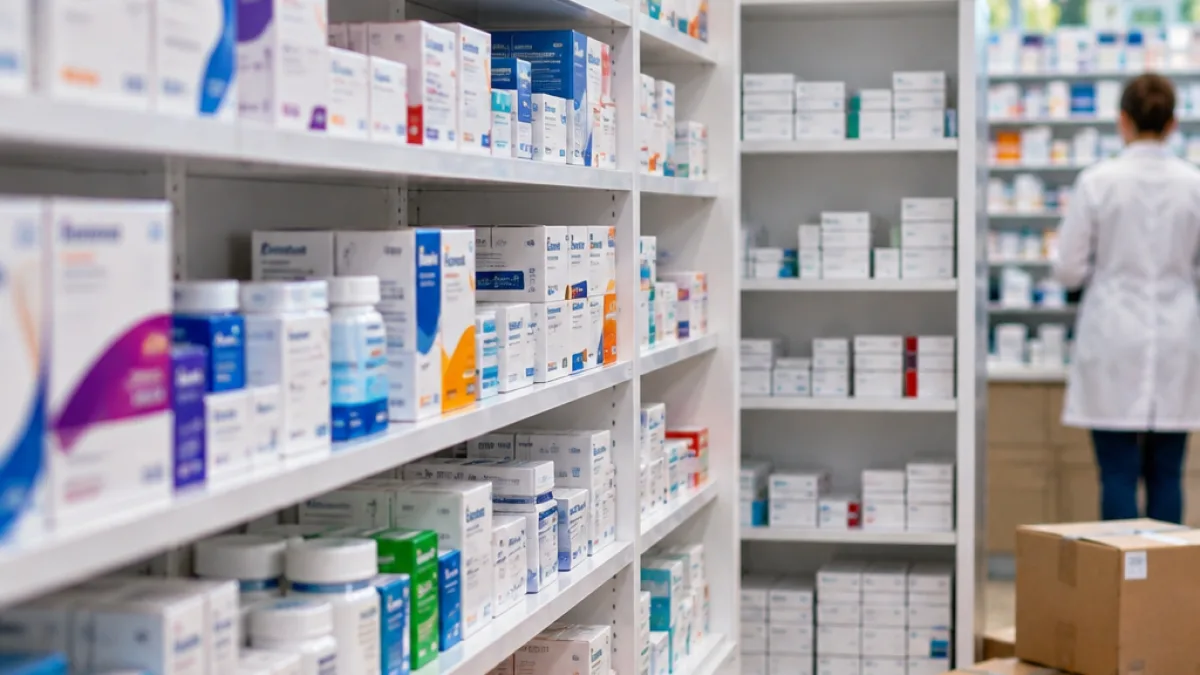
Russia remains heavily reliant on medicines manufactured abroad, despite President Vladimir Putin’s effort to make economic and industrial independence a strategic priority. Imported products represented 56 per cent of pharmaceutical spending in the first eight months of 2026, according to a survey based on Russian market data.
The figure has changed little since the start of the full-scale invasion of Ukraine. In 2022, imported medicines accounted for 57 per cent of expenditure in Russia’s pharmaceutical sector. The narrow difference over four years points to the difficulty of replacing foreign producers, even as Moscow has sought to reduce its exposure to international supply chains and limit the flow of capital abroad.
Sanctions do not cover most medicines
Medicines have generally been excluded from Western sanctions on humanitarian grounds. That exemption has allowed major international pharmaceutical companies to continue supplying the Russian market while trade between Europe and Russia in other sectors has fallen sharply.
European pharmaceutical exports to Russia have increased since the war began, even as European exports across all sectors have declined. Companies including Switzerland’s Roche and Novartis, Britain’s AstraZeneca and France’s Sanofi remain significant participants in the Russian market. Their continued presence illustrates the tension between economic restrictions imposed over the war and the need to maintain access to medical treatment.
“Working in Russia is like being a deep-sea diver.”
The comparison, made by a broadcaster’s Moscow correspondent, reflects the pressure on foreign companies operating in a market shaped by sanctions, political risk and the Kremlin’s stated ambition of economic sovereignty. At the same time, the exemption for medicines means that pharmaceutical trade has followed a different path from many other areas of commerce.
Generic production has grown, but complex treatments remain a challenge
Russia has made progress in producing generic medicines — products whose patents have expired and which can therefore be copied. These include many commonly used treatments. Calculations based on Russian federal statistics show that domestic generic production rose by 71 per cent in the first eight months of 2026 compared with the same period in 2021.
That growth has not translated into broad pharmaceutical independence. The central obstacle is technology and research, particularly in the development and manufacture of more complex medicines. Domestic manufacturers may be able to expand production of established drugs, but replacing international companies across the full range of treatments requires capabilities that Russia has not yet developed at the same pace.
| Measure | Finding |
|---|---|
| Imported share of medicine spending, first eight months of 2026 | 56% |
| Imported share in 2022 | 57% |
| Growth in generic production, 2026 versus 2021 | 71% |
Strategic independence remains incomplete
The figures underline the gap between Russia’s political objective and the structure of its pharmaceutical market. Moscow can point to higher domestic output in generic medicines, yet the overall share of spending on imported products has barely moved. The country therefore remains exposed to decisions taken by foreign manufacturers, changes in international trade and the availability of advanced treatments produced outside its borders.
For patients, the issue is not limited to industrial policy. The continued presence of foreign suppliers helps preserve access to medicines, but it also shows why the Russian government has treated domestic pharmaceutical development as a strategic priority. Until research capacity and production technology expand beyond generics, the country’s ambition to guarantee treatment during future international tensions will remain only partially achieved.