
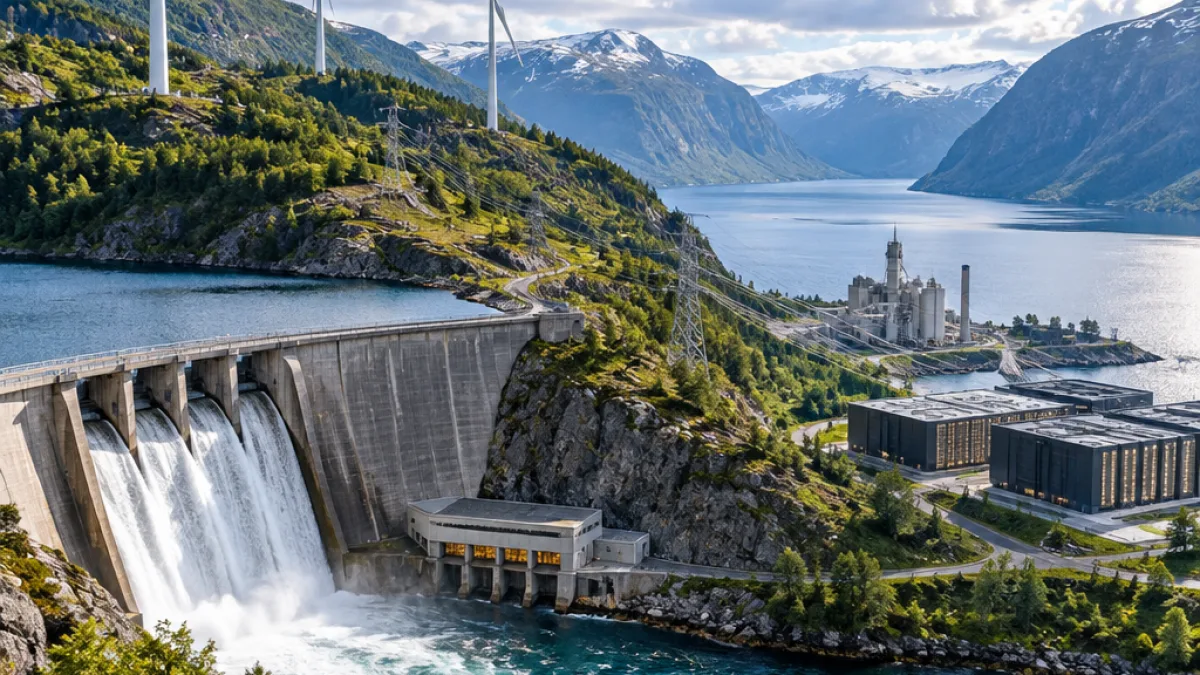
Norway’s electricity surplus is expected to narrow over the next decade as demand from heavy industry, data centres, electric transport and the conversion of offshore petroleum operations to electricity places greater pressure on the country’s power system.
The Nordic country has long relied on reservoir-based hydropower, which allows it to store energy and adjust generation according to demand. That flexibility has also made Norway a significant electricity exporter in northern Europe. However, slower growth in new generation capacity is beginning to challenge the cushion between domestic consumption and available supply.
A GlobalData market forecast projects that Norway’s total installed power capacity will rise from 41.7GW in 2025 to 50.8GW by 2035. Electricity consumption is expected to grow more quickly, increasing from 130.1TWh to 153.3TWh over the same period.
Demand is rising across several sectors
The expected increase is linked to power-intensive industries, expanding data-centre activity and the electrification of transport. Norway is also directing more electricity towards petroleum-related facilities, including offshore operations and onshore liquefied natural gas infrastructure.
Equinor’s Snøhvit Future project at Melkøya is cited as one example of the shift. Such projects can reduce emissions from fossil-fuel operations, but they also add new, substantial loads to the electricity network. The result is a more complex transition: demand for electricity is rising at the same time as the country seeks to increase the share of lower-carbon generation.
| Indicator | 2025 | 2035 forecast |
|---|---|---|
| Total installed capacity | 41.7GW | 50.8GW |
| Electricity demand | 130.1TWh | 153.3TWh |
| Renewables excluding large hydropower | 22.9% | 33.4% |
| Offshore wind capacity | 0.1GW | 1.9GW |
Wind development remains a bottleneck
GlobalData expects renewable sources other than large-scale hydropower to increase their share of Norway’s generation capacity from 22.9% to 33.4%. The expansion is expected to come from onshore wind, offshore wind and solar photovoltaic installations.
Onshore wind, however, has faced a difficult investment and regulatory environment. Development slowed after a licensing pause that lasted from 2019 to 2022, while local opposition and the introduction of a resource-rent tax in 2024 have further limited new projects. Only about 1MW of grid-connected onshore wind capacity was added in 2025.
Proposed licensing changes announced in September 2026 could shorten the approval process. The proposals include a two-year time limit and the removal of state objection rights. Their effect will depend on whether municipalities approve projects and whether sufficient grid capacity is available.
Exports remain strong, but the margin is tightening
Norway exported 34.3TWh of electricity and imported 11.5TWh in 2025, leaving net exports of roughly 22.8TWh. Those figures underline the country’s continuing importance to the northern European electricity market.
Statnett has warned that the combination of rising consumption and modest generation growth is gradually reducing that surplus. Norway’s ability to remain a reliable exporter will therefore depend not only on new wind and solar projects, but also on transmission and distribution upgrades capable of connecting them to areas where demand is growing.
- Demand: forecast to rise by 23.2TWh between 2025 and 2035.
- Generation: capacity is projected to grow by 9.1GW over the same period.
- Offshore wind: expected to reach 1.9GW by 2035, although costs and grid limitations are delaying projects.
Offshore wind is forecast to expand as the Sørlige Nordsjø II and Utsira Nord developments advance. Yet higher construction costs and constraints on the grid have slowed progress. For Norway, the central policy challenge is increasingly clear: maintaining its role as a flexible power supplier while building enough new infrastructure to support domestic electrification and protect its export capacity.