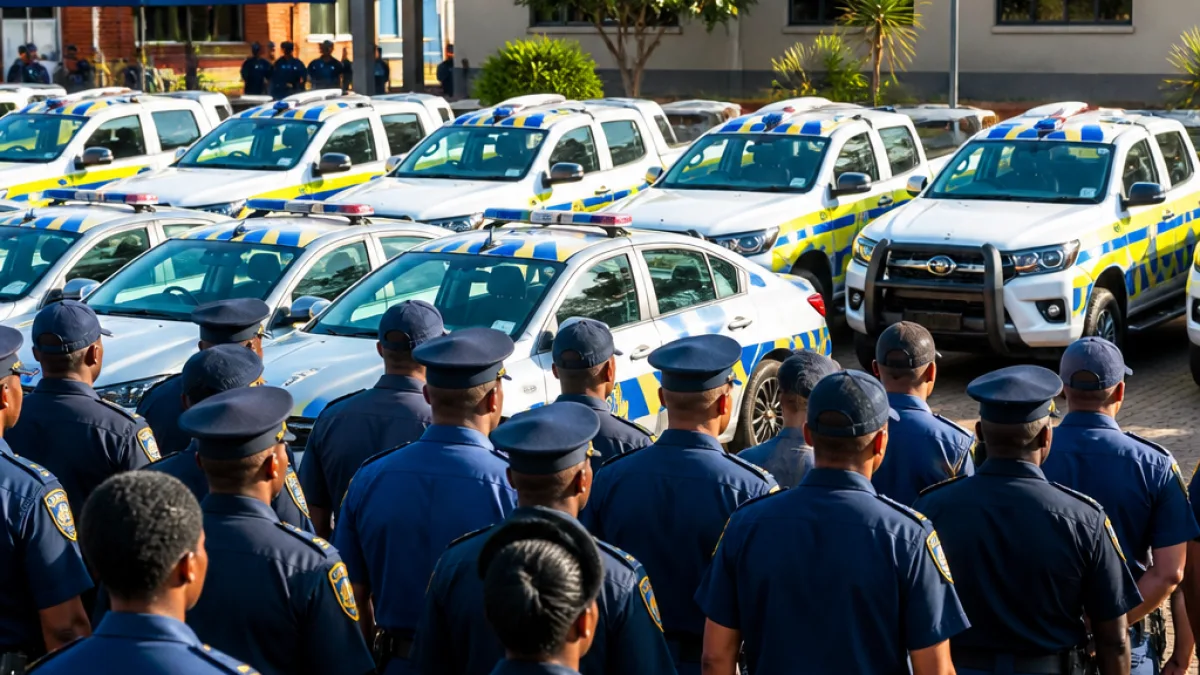
The South African Police Service (SAPS) has deployed 1 087 new vehicles in a national effort to improve frontline policing, investigative capacity and services for victims of gender-based violence and sexual offences.
The fleet, made up of sedans and double-cab bakkies, was handed over in Pretoria on Thursday by National Commissioner General Fannie Masemola. He was accompanied by Acting National Commissioner for Support Services Lieutenant General Bongiwe Zulu and Acting Deputy National Commissioner for Crime Detection Lieutenant General Hilda Senthumule.
Most vehicles assigned to investigations
SAPS spokesperson Colonel Amanda van Wyk said the largest portion of the vehicles — 739 — had been assigned to Detective Services. A further 290 would support Visible Policing and Operations, while 58 would remain at Head Office as a reserve fleet for special interventions.
The distribution is intended to place vehicles in operational areas where investigators, patrol officers and emergency-response personnel require transport to attend to cases and community complaints. The vehicles will be sent to 70 of the 140 police stations identified as high-crime stations, as well as to Family Violence, Child Protection and Sexual Offences units, 10111 emergency call centres and Flying Squads.
- 739 vehicles are allocated to Detective Services.
- 290 vehicles are allocated to Visible Policing and Operations.
- 58 vehicles will form a reserve fleet at Head Office.
- 200 vehicles are designated for Family Violence, Child Protection and Sexual Offences units.
Provincial allocation
The Eastern Cape received the largest provincial allocation, with 163 vehicles. Gauteng was allocated 151, followed by Mpumalanga with 147 and KwaZulu-Natal with 135. The Western Cape received 113, the Free State 103, North West 84, Limpopo 79 and the Northern Cape 54.
| Province | Vehicles |
|---|---|
| Eastern Cape | 163 |
| Gauteng | 151 |
| Mpumalanga | 147 |
| KwaZulu-Natal | 135 |
| Western Cape | 113 |
| Free State | 103 |
| North West | 84 |
| Limpopo | 79 |
| Northern Cape | 54 |
Support for GBV investigations
Of the new fleet, 200 vehicles have been allocated to Family Violence, Child Protection and Sexual Offences units. According to SAPS, the vehicles are intended to strengthen investigations into sexual offences, gender-based violence and femicide, while also helping victims reach the services available to them.
The allocation has a direct bearing on the practical handling of these cases. Investigators need to travel to crime scenes, conduct follow-up inquiries and engage with victims and other relevant parties. The SAPS announcement did not provide a timetable for the deployment of each vehicle or identify the individual stations receiving them, but it said the vehicles would be distributed among the specified operational structures.
Accountability for public assets
Masemola described the vehicles as an investment in police members, the communities they serve and the future of policing. He also placed emphasis on the fact that the fleet is publicly owned and must be used for operational purposes.
“These vehicles belong to the people of South Africa.”
That principle is central to the deployment. The fleet is meant to improve the SAPS’s ability to respond to crime and community needs, rather than provide personal convenience or privilege. The commissioner said public resources carried a responsibility of stewardship.
The allocation therefore combines an operational objective with a governance obligation. Vehicles assigned to detectives, patrol teams, emergency call centres and specialised units must remain available for the policing functions for which they were provided. The Head Office reserve is intended for special interventions, while the provincial allocations are directed towards strengthening capacity across the country.
The handover forms part of the SAPS’s continuing effort to improve frontline service delivery. Its immediate significance lies in adding transport to structures responsible for investigations, visible policing, emergency responses and the handling of vulnerable victims. The stated measure of success will be whether the new assets improve access to police services and support the investigation of cases in the areas where they are deployed.