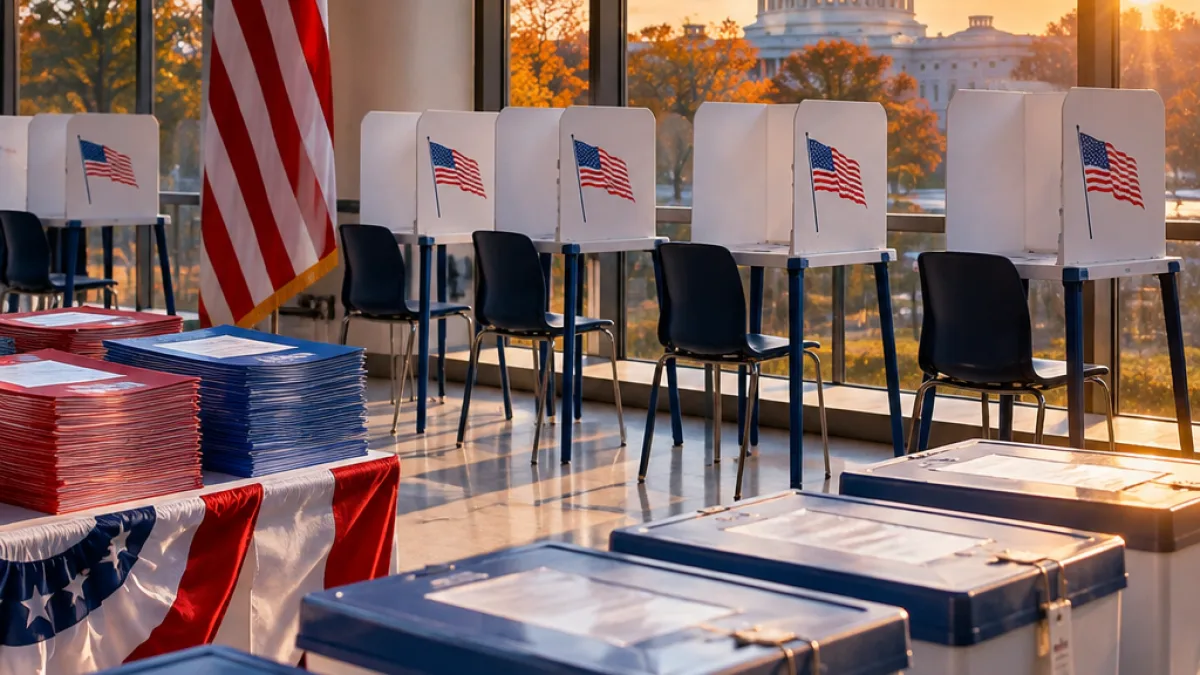
Control of the US Congress is at stake as Americans prepare to vote in midterm elections that will test President Donald Trump’s political position and determine whether Republicans retain their grip on Capitol Hill.
The elections on 3 November 2026 come halfway through the four-year presidential term. Mr Trump is not himself on the ballot, but the result will shape the balance of power around his administration. Democrats are seeking the relatively small number of gains needed to take both the House of Representatives and the Senate from the president’s Republicans.
The vote extends well beyond Congress. Governors will be elected in 36 of the 50 states, while almost every state will also hold elections for its own legislative chambers. Voting has already begun in parts of the country, with early ballots being cast before polling day.
Narrow margins make a small number of seats decisive
Republicans currently have a particularly slender advantage in the House. They hold 218 seats to the Democrats’ 214, alongside two vacancies and an independent member who aligns with the Republican caucus. Democrats therefore need a net gain of four seats to take control.
The Senate presents a different but similarly competitive picture. Republicans have 53 seats, compared with 47 held by Democrats. Democrats also need a net gain of four seats to secure a majority. Ten contests are identified as potential decision-makers, including races in Maine, Ohio, North Carolina, Iowa and Georgia.
| Chamber | Current Republican position | Democratic gain needed |
|---|---|---|
| House of Representatives | 218-214, with two vacancies and one Republican-aligned independent | Four seats |
| Senate | 53-47 | Four seats |
Those figures underline why the campaign has attracted intense attention. The outcome may turn on a limited group of contests rather than a nationwide wave. In the Senate, the closely watched races include states where the final result could decide which party controls the chamber. In the House, the existing margin leaves Republicans with little room for losses.
A costly contest and a test of presidential support
The financial scale of the election has also been striking. By 30 October, political advertising for the 2025-26 election cycle had reached a record $11.6 billion, according to AdImpact, which tracks campaign activity. The organisation said the largest spending was concentrated in battleground Senate races in Texas, Ohio and Michigan.
Elon Musk alone has spent $442 million supporting Republican candidates, according to campaign finance records cited in the source material. The figure illustrates the extent to which private money and high-profile political backing have become part of the contest, although the election remains a vote-by-vote test across congressional districts and states.
Midterm elections usually draw fewer voters than presidential contests. More than 155 million votes were cast in the 2024 presidential election, while turnout of a similar level to the previous midterm in 2022 would still mean more than 100 million people voting this year. That comparison explains both the lower participation normally associated with midterms and the substantial national reach of the 2026 poll.
The election is also being fought against a difficult backdrop for Mr Trump. His approval rating for his performance was recorded at 32% in a September Reuters/Ipsos poll, described as an all-time low. The result will not remove him from office, but it will provide a clear measure of how voters are responding to his presidency and to Republican candidates seeking to defend the congressional majority.
For Democrats, victory in either chamber would end unified Republican control of that institution and give them a stronger position in the national political contest. For Republicans, holding both chambers would preserve their current congressional advantage despite the narrow House margin and the president’s low poll rating. The combination of competitive races, substantial spending and a large expected electorate means the midterms are not a routine pause between presidential elections: they are a direct contest over who has the authority to shape the next phase of US politics.