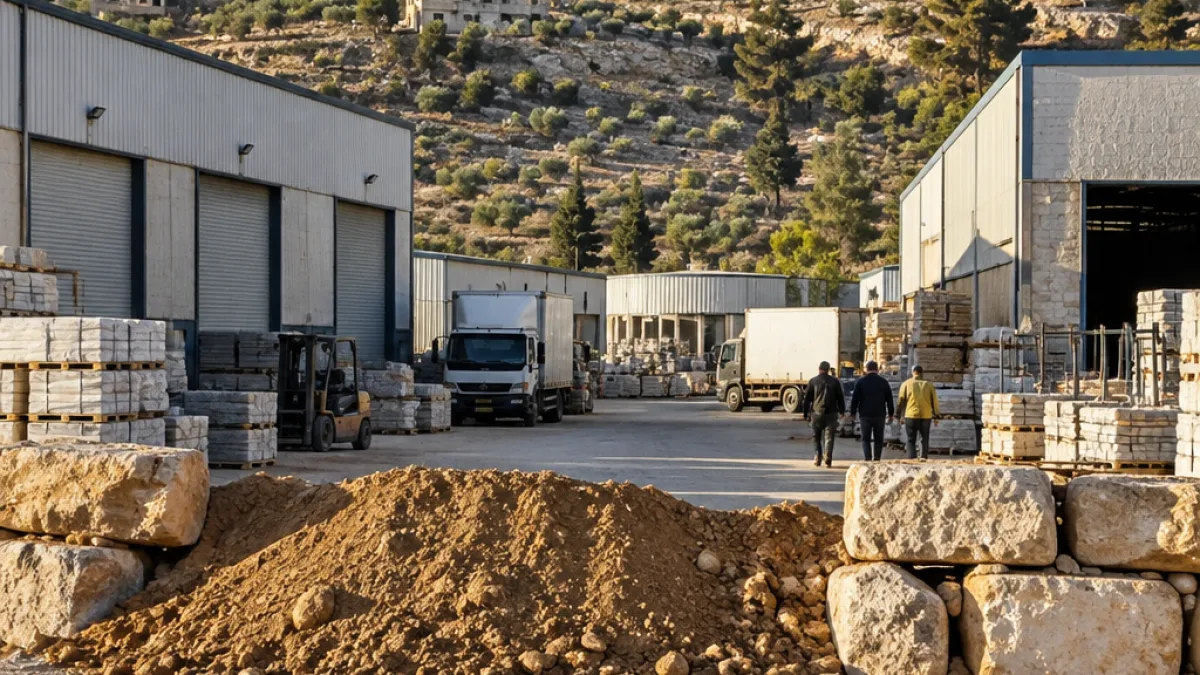
Dozens of Palestinian businesses in the occupied West Bank have been cut off from customers and suppliers after Israeli forces blocked access to an industrial zone, putting thousands of jobs and the survival of individual companies at risk.
The entrances to the Beit Ula industrial complex, north-west of Hebron, were closed on November 4 with earth embankments and stone barriers. The restrictions have affected approximately 60 businesses and the livelihoods of about 2,500 workers, according to the account from the area.
Among the companies affected is TB.LOC, which manufactures security and fire-resistant doors. Its owner, 63-year-old Fayez al-Amleh, said the factory’s production lines were still operating, but at a much reduced pace. The business employs 70 people, whose working hours have been reduced or shifted to part-time arrangements since the closure.
“Today, raw materials cannot get in, and we cannot get our products out of the industrial zone,” Fayez al-Amleh told Al Jazeera.
A sharp contraction in daily trade
The immediate commercial impact has been severe. TB.LOC’s daily sales have fallen from 70,000 shekels, equivalent in the source to about $21,988, to between 2,000 and 3,000 shekels, or roughly $628 to $942. That represents a collapse in turnover of more than 95 per cent at the lower end of the previous sales figure, based on the figures supplied.
The disruption extends beyond one factory. Beit Ula contains facilities involved in metalwork, door production, electrical cabinets, sponge and cardboard manufacturing. Preventing deliveries into and out of the zone therefore affects both the movement of inputs and the sale of completed goods, creating a bottleneck across several stages of industrial activity.
| Indicator | Reported figure |
|---|---|
| Businesses affected | About 60 |
| Workers whose livelihoods are threatened | About 2,500 |
| TB.LOC workforce | 70 employees |
| TB.LOC daily sales before closure | 70,000 shekels |
| TB.LOC daily sales after closure | 2,000–3,000 shekels |
Pressure on Hebron’s economic network
The industrial restrictions followed a wider military operation around Hebron, an important commercial centre in the occupied West Bank. Israeli military activity intensified after two Israeli soldiers were killed by suspected Palestinian gunmen at a checkpoint near the Palestinian city on October 23.
Thousands of Palestinians were forced to leave their homes during a 10-day siege of Hebron. Residents returned after Israeli soldiers withdrew from the city on November 2, but the access restrictions at Beit Ula began only days after the siege was lifted. The sequence has prolonged pressure on businesses that had already experienced a major interruption to normal trading.
Hebron mayor Yousef al-Jabari estimated that the siege caused losses of more than 12 million shekels a day, described in the source as approximately $3.8 million. That estimate illustrates the scale of the commercial network affected by movement restrictions, although the consequences for individual firms vary according to their ability to maintain supplies, production and deliveries.
- Supply chains: factories in Beit Ula are unable to bring in raw materials normally.
- Distribution: finished products cannot leave the industrial area for customers.
- Employment: reduced activity has led to shorter hours and lower pay for workers.
- Cash flow: the fall in sales threatens companies’ ability to continue operating.
For al-Amleh’s company, the effect is already visible in household incomes as employees take home less after moving to shorter or part-time work. For the wider industrial zone, the barriers have transformed a logistical restriction into a direct business crisis: firms cannot reliably obtain the materials needed to produce goods, while completed orders cannot be dispatched.
The episode also demonstrates how quickly security measures can transmit into the civilian economy. In Beit Ula, the consequences are being measured not only in lost sales but in disrupted employment, reduced wages and the isolation of businesses from the commercial relationships on which their operations depend.