Parties asked to examine proposals
Tánaiste Simon Harris has invited political leaders in Northern Ireland and the Republic to respond to Fine Gael’s proposals for preparing for Irish unity, opening a broader political discussion about how any future constitutional change could be managed.
Fine Gael published its so-called blueprint last week. Harris has now written to leaders of parties including unionist representatives, asking for their views and identifying areas that may require further examination. The move places the proposals before politicians with sharply different constitutional objectives, rather than presenting them solely as a Fine Gael initiative.
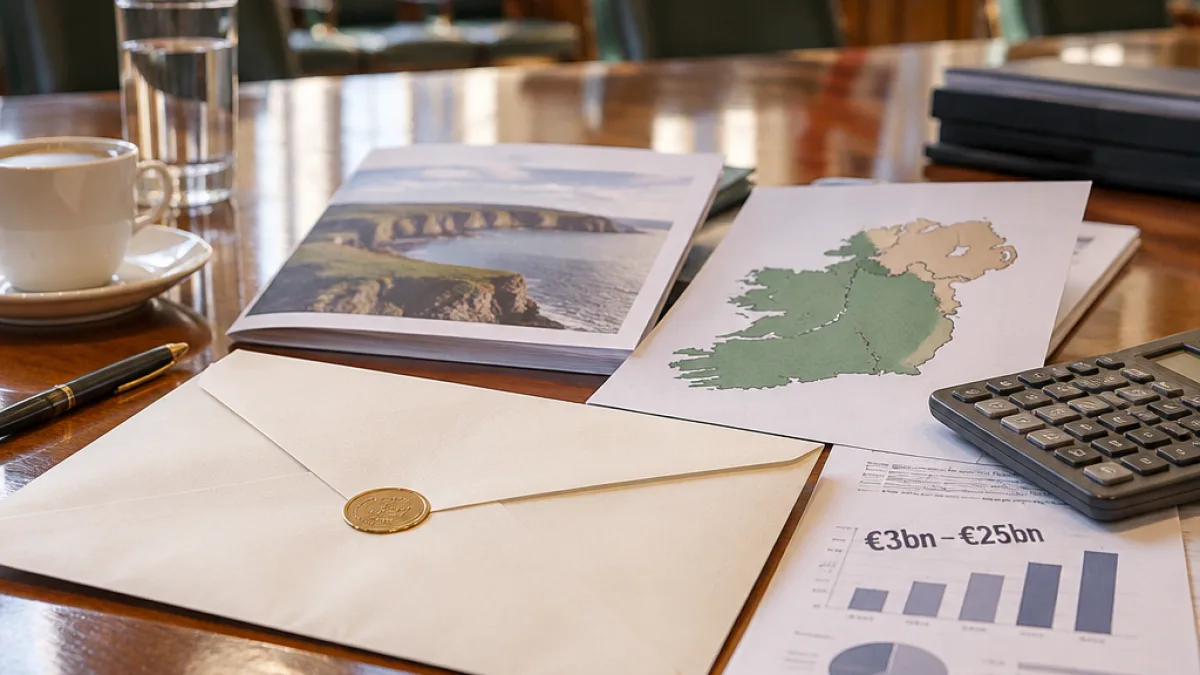
Among the party’s suggestions is the appointment of a junior minister for north-south relations in the Irish Government. Fine Gael has also published work by an economist who advises Harris, estimating that the initial year of reunification could cost the Irish exchequer between approximately €3bn (£2.5bn) and €25bn (£20.8bn).
| Issue | Proposal or estimate |
|---|---|
| Government structure | A possible junior ministerial role for north-south relations |
| Estimated first-year cost | Approximately €3bn to €25bn |
The figures underline the scale of the financial questions that would accompany any move towards a united Ireland. They are presented as an estimate of the first-year cost to the Irish exchequer, rather than as a settled funding plan. Fine Gael’s decision to publish the analysis alongside its political proposals means that the economic consequences are likely to form a central part of the debate.
Consent remains central
In his letter, Harris said the discussion should not be controlled by a single party. He stressed that the process should include different constitutional viewpoints and be based on the terms of the Good Friday Agreement, including the principle of consent.
“No one political party owns the discussion about the future of this island, nor should any one party seek to determine its outcome.”
Harris said the conversation would involve differing views and difficult discussions. His appeal to evidence and consent is significant because the proposals touch directly on the constitutional position of Northern Ireland, while the parties receiving them represent communities with competing views about its future.
Letters sent across the political spectrum
In Northern Ireland, the recipients are DUP leader Gavin Robinson, UUP leader Jon Burrows, SDLP leader Claire Hanna, TUV leader Jim Allister and Alliance leader Naomi Long. The list includes unionist, nationalist and cross-community parties, reflecting Harris’s stated intention that the discussion should be inclusive.
In the Republic, the letter was sent to Taoiseach and Fianna Fáil leader Micheál Martin, Sinn Féin leader Mary Lou McDonald, Aontú leader Peadar Tóibín, Labour leader Ivana Bacik, Social Democrat acting leader Cian O’Callaghan, Independent Ireland leader Michael Collins, Green Party leader Roderic O’Gorman and Richard Boyd-Barrett of People Before Profit.
The initiative comes days after the taoiseach circulated a separate document to his parliamentary party setting out his own thoughts on preparing for a united Ireland. The source material does not specify the contents of that document, but its circulation indicates that the issue is being considered within more than one party in the Republic’s governing political system.
For now, Harris is seeking responses rather than announcing a final policy or constitutional timetable. The immediate test will be whether parties engage with the proposals, particularly the estimated cost and the suggested ministerial structure. Any lasting process would also have to accommodate disagreement, respect the different constitutional positions represented across Northern Ireland and the Republic, and remain grounded in the consent principle cited by Harris.
- Fine Gael has asked political leaders in both jurisdictions to assess its preparations for Irish unity.
- The proposals include a possible junior minister for north-south relations.
- An accompanying economic assessment puts the estimated first-year cost at between €3bn and €25bn.