Liverpool has become the most filmed area in the UK outside London, with more than 1,600 film and television productions made in the city since 2019 and an estimated £150m delivered to the local economy.
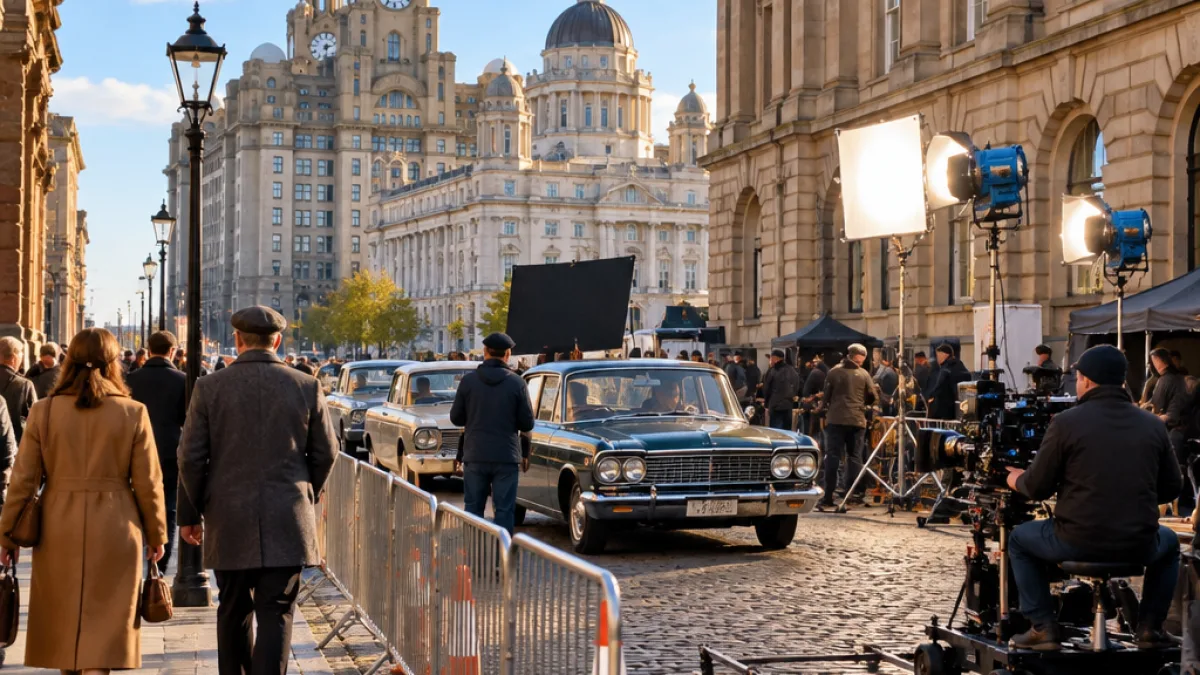
The scale of the activity has turned ordinary journeys across the Merseyside city into encounters with another era, another country or an entirely invented world. A car park can suddenly be filled with polished vehicles from the 1960s; a public park can acquire the appearance of a prison camp; and familiar streets can double as locations for espionage dramas and period stories.
A city transformed by filming
That visual disruption has become part of daily life for residents. The city’s filming profile has grown sufficiently large for Liverpool to earn the nickname “the Hollywood of the North”. Lynn Saunders, head of the Liverpool Film Office, said there are generally three or four productions being filmed at the same time.
“about three or four productions filming simultaneously”
The description helps explain why filming is now so visible across the city. Crews are not an occasional curiosity but a recurring presence, with productions using Liverpool’s streets, parks and buildings to create settings that reach well beyond the city itself. For residents, the result is a distinctive mixture of familiarity and theatrical illusion: a normal route into the centre can suddenly become a carefully dressed period location.
The recent pace has been especially striking. Liverpool has been used for projects set in the 1960s, Cold War stories and contemporary television, showing the breadth of material that its locations can accommodate. A Cold War intelligence base was created for an adaptation of a John le Carré work, while Sefton Park was used for an elaborate prison-camp set for the Channel 4 thriller Army of Shadows.
The Beatles return to their home city
The city’s strongest recent connection to the screen may be its relationship with the Beatles. Two projects connected to the group’s 1960s story have been filmed in Liverpool, including the ambitious series of four films directed by Sam Mendes. Each film focuses on one member of the band, and the productions operated under the codename “Clover”.
The shoots brought familiar names into locations associated with the band’s early lives. Paul Mescal was seen in the city while recreating scenes linked to Paul McCartney’s childhood surroundings, with sightings reportedly extending to local delis. Barry Keoghan was also believed to have been heard by a resident, although the circumstances made that impossible to confirm. The production’s presence nevertheless reinforced the connection between Liverpool’s everyday landscape and its musical history.
According to Saunders, cast members and crews have responded positively to the city’s atmosphere, with the relaxed nature of Liverpool helping the work proceed in an informal setting. That sense of accessibility is reflected in reports that members of the Beatles cast were seen walking around Sefton Park and speaking with people.
More than a backdrop
A separate BBC project, Hamburg Days, is also exploring the group’s formative period in Germany while featuring Liverpool. Together, the Beatles productions underline how the city can function both as a real setting and as a place capable of standing in for another time and location.
The broader significance lies in the combination of cultural visibility and economic effect. Liverpool’s filming activity has made it increasingly recognisable to television and film audiences, while the reported investment demonstrates that productions are also contributing beyond the finished programmes. The city’s screen identity is therefore being built not by one runaway success, but through a steady flow of projects across genres and periods.
| Measure | Reported figure |
|---|---|
| Productions since 2019 | More than 1,600 |
| Local economic contribution | About £150m |
| Typical simultaneous shoots | Three or four |
For Liverpool, the challenge now is not simply attracting productions but sustaining the momentum that has made filming so conspicuous. Its recent record suggests that the city has become a dependable national screen hub, with locations capable of supporting intimate character drama, historical recreation and large-scale cultural projects alike. The film crews may continue to interrupt the view, but they are also helping to define Liverpool’s place in Britain’s entertainment landscape.