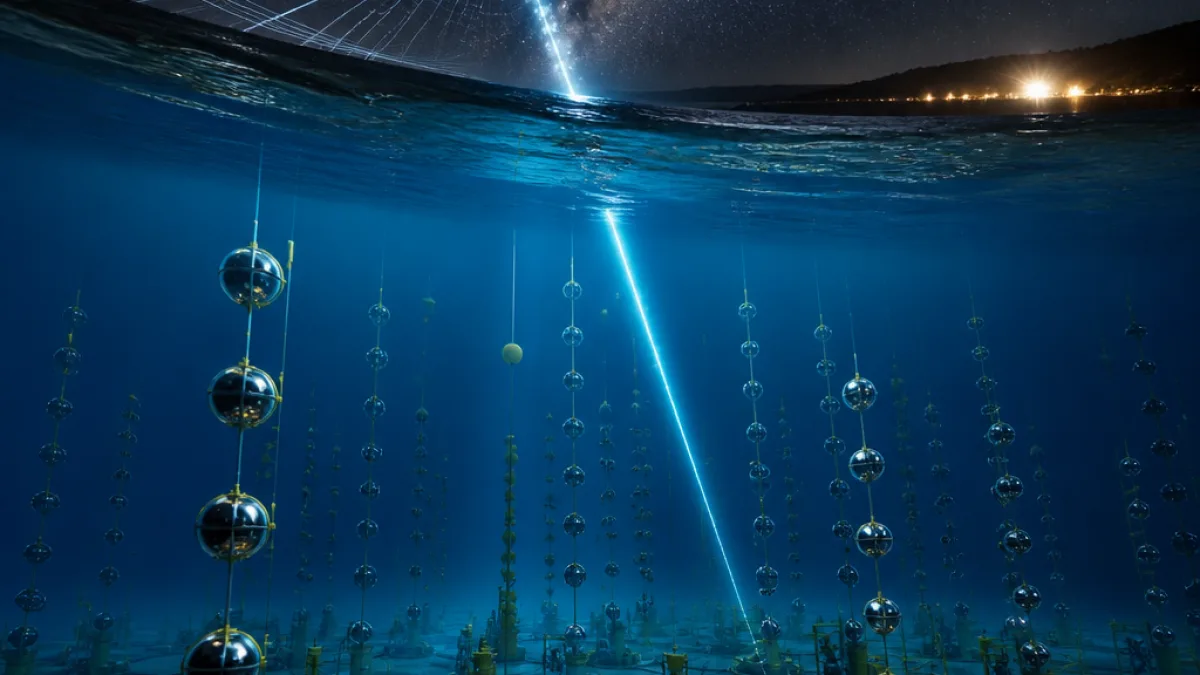
Scientists are investigating an exceptionally energetic neutrino detected by the Cubic Kilometre Neutrino Telescope, or KM3NeT, after the particle produced a signal unlike any previously recorded. The event, identified as KM3-230213A, was recorded in the early hours of 13 February 2023, but its possible origin remains unresolved.
The particle’s energy was the central surprise. The muon associated with the detection carried around 35 times more energy than any earlier neutrino event, including all detections made during the first 15 years of operation of the IceCube Neutrino Observatory. IceCube has a detection area about 20 times larger than KM3NeT, making the scale of the observation particularly striking.
A detection without an obvious cosmic companion
Neutrino detections are difficult to interpret because these particles interact so weakly with matter. The KM3NeT spokesperson Paschal Coyle, a researcher at the French National Centre for Scientific Research, described neutrinos in 2025 as
“the closest thing to nothing that we can imagine”, while also emphasising their importance to understanding the universe.
In this case, the difficulty is increased by the absence of accompanying observations. The event was not associated with other photons, and observatories including IceCube did not record anything unusual at the same time. Those features have left researchers attempting to reconstruct the event’s history from a single, highly energetic signal.
| Feature | What was observed |
|---|---|
| Detection | KM3NeT recorded the event on 13 February 2023 |
| Particle | Designated KM3-230213A |
| Energy | Its muon carried about 35 times the energy of previous detections |
| Other signals | No accompanying photons were reported, and IceCube detected no unusual event |
Several explanations remain in play
One earlier analysis suggested that the neutrino may have originated in a blazar, an active galactic nucleus powered by a supermassive black hole whose relativistic jet is directed towards Earth. That proposed source was estimated to be about eight billion light-years away.
A separate study offered a different possibility: that the particle could be evidence of dark matter scattering in the Earth’s crust. That interpretation was also put forward as a possible reason KM3NeT detected the event while IceCube did not. Neither explanation has removed the wider uncertainty surrounding the observation.
The latest proposal, set out in a new paper published in Physical Review D, takes another route. It points to primordial black holes—theoretical remnants from the early universe—as a possible source. Primordial black holes have also been discussed as an alternative explanation for dark matter, so the idea connects the unusual neutrino event with one of the major unresolved questions in modern physics.
A speculative route to a fifth dimension
The paper’s approach has attracted attention because it also raises the possibility that the event could relate to a fifth dimension. That is a theoretical interpretation of the data, not an established discovery. The particle’s remarkable energy, the lack of a corresponding photon signal and the failure of other observatories to report an unusual event have created the conditions for competing models rather than a single accepted answer.
- KM3NeT recorded the most energetic neutrino-related event described in the source material.
- The particle has no confirmed source, with a blazar, dark matter interactions and primordial black holes among the proposed explanations.
- The latest paper presents a possible connection with a fifth dimension, but the interpretation remains theoretical.
The investigation illustrates both the promise and the limits of neutrino astronomy. A particle that scarcely interacts with matter can carry information from extreme cosmic environments, yet the same lack of interaction makes its journey difficult to trace. For now, KM3-230213A remains a subatomic mystery: a rare signal powerful enough to challenge existing explanations, but not yet sufficient to establish the existence of dark matter, primordial black holes or an additional dimension.