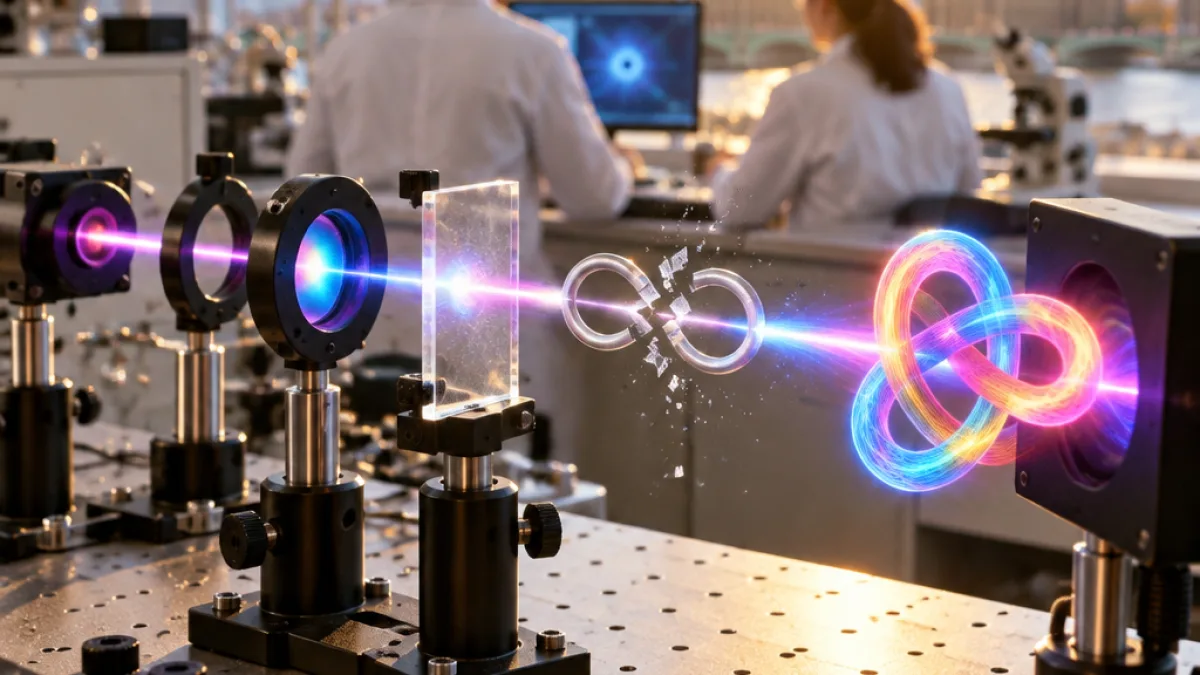
Researchers at the University of Pennsylvania have demonstrated that a distinctive property of quantum light can survive after the entanglement linking photons has been lost, a result that could inform efforts to build networks connecting quantum computers.
Quantum computers could gain substantially from being linked together, allowing them to exchange information through particles of light. But the connections required for that exchange are highly sensitive. Even small disturbances can destroy the entanglement between photons, interrupting communication between quantum devices.
The new study focuses on whether useful information can nevertheless remain available after that failure. The researchers transferred a particular pattern between photons and found that it remained intact even when the particles no longer shared their quantum connection. The work uses topology, a branch of mathematics concerned with properties that remain stable when an object is distorted.
A pattern rather than a physical object
The feature examined by the team is known as a quantum skyrmion. Its defining characteristic is not a solid shape or boundary, but a pattern formed from two properties of light. One is spin, which is linked to polarisation. The other is orbital angular momentum, describing the way a light wavefront twists.
Across the pattern, the direction in which light oscillates changes from place to place. Haoqi Zhao, the study’s first author and a postdoctoral fellow at Yale, compared this to regions of hair growing in different directions. Taken together, those changes cover every possible polarisation state a fixed number of times.
Mathematicians describe that arrangement with a topological number. The number can remain unchanged even when parts of the underlying pattern are disturbed. In practical terms, altering individual sections does not necessarily erase the overall structure. Zhao likened the principle to moving individual strands in a swirl of hair without removing the swirl itself.
“It’s as if one dancer’s unique movement suddenly became part of a duet, and persisted even when the dancers were separated.”
The analogy was used by Liang Feng, professor of materials science and engineering at the University of Pennsylvania and the study’s senior author, to describe how the characteristic could be transferred between photons and then persist after their separation.
Why the result matters for quantum networks
Quantum networking depends on delicate relationships between particles. Entanglement allows information associated with separate quantum systems to be connected, but that relationship is vulnerable to disruption. The study does not remove the problem of entanglement loss. Instead, it identifies a different property of the light that can remain available when the connection itself has broken down.
| Feature | Role in the study |
|---|---|
| Entanglement | The fragile quantum connection between photons |
| Spin | Linked to the polarisation of light |
| Orbital angular momentum | Describes the twist of the light wavefront |
| Topological number | Describes the pattern’s mathematically stable property |
The researchers first needed a method for creating and transferring the relevant structure between photons so they could test its resilience. Their experiment then examined whether the pattern would remain after the photons lost entanglement. The reported finding suggests that quantum information may have more than one layer of protection: a connection can fail while a topologically defined feature survives.
That distinction is important because it separates the fragile relationship between particles from the more robust mathematical character of the light pattern. The result could therefore contribute to research into communication systems in which disturbances do not erase every feature carried by a quantum signal.
Further work would be needed before such an approach could be incorporated into functioning quantum networks. The study demonstrates the survival of a particular pattern under the conditions tested; it does not show that quantum computers can already communicate reliably over a network. Its significance lies in showing that the loss of entanglement need not mean the complete disappearance of every structured property transferred between photons.