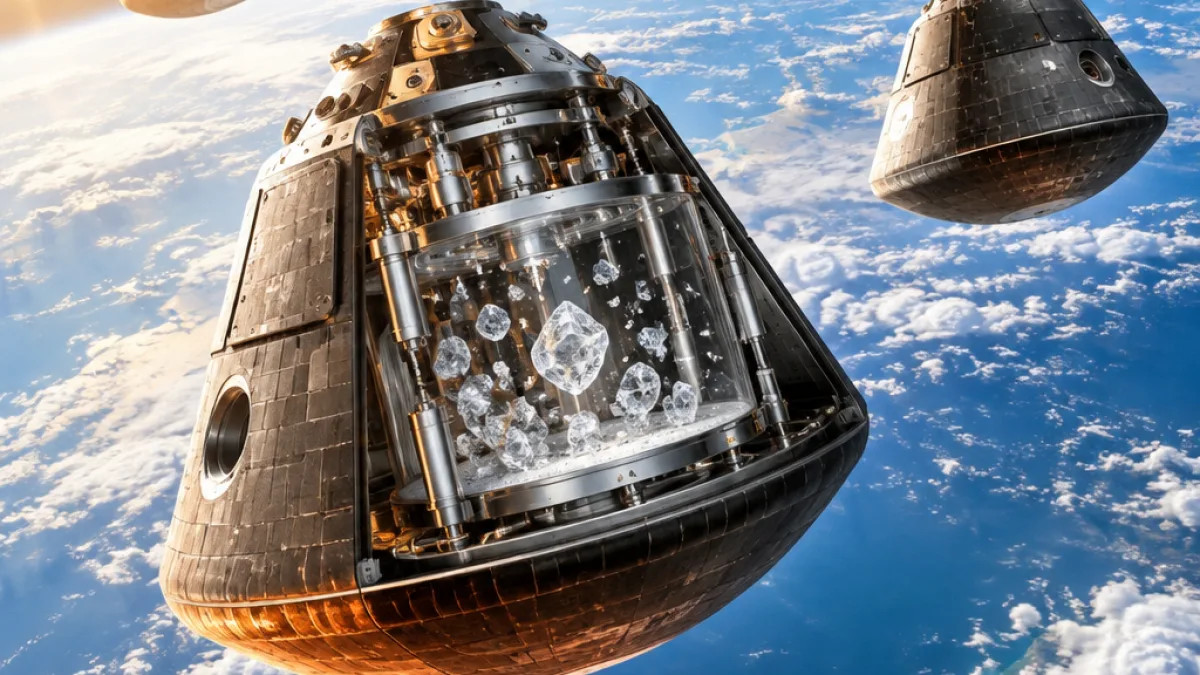
Three commercial spacecraft are now orbiting Earth at the same time as part of an effort to establish whether medicines and other advanced materials can be manufactured in space. One of the washing-machine-sized capsules is growing tiny crystals linked to a potential cancer drug, while the other two are being used to examine heat-resistant materials and navigation equipment needed for high-speed returns through the atmosphere.
The vehicles belong to California-based Varda Space Industries, which launched two of them on 1 October and sent a third into orbit on 20 October. They are travelling roughly 300 miles above Earth. The company says the simultaneous operation of three spacecraft is a milestone as it works towards a future fleet of orbiting manufacturing facilities.
“We’re the first company in human history to launch multiple commercial re-entry vehicles simultaneously,”
Will Bruey, Varda’s chief executive, said the increasing frequency of launches was making the prospect of producing goods in orbit more certain. The company’s capsules are designed not only to carry out manufacturing work but also to return products to Earth, making re-entry systems a central part of the experiment.
Why microgravity matters for crystals
The scientific case for conducting some production beyond Earth rests largely on the behaviour of materials in microgravity. On the ground, gravity causes particles suspended in liquids to settle. Differences in density can also generate currents within a fluid. Both effects may disrupt the orderly formation of crystals.
Dr Meganne Christian, mission manager for in-space manufacturing at the UK-based Satellite Applications Catapult, said removing those influences could allow crystals to form in a more controlled arrangement. That matters because the size, shape and structure of drug crystals can affect how readily a medicine dissolves, how stable it remains and the way it can be given to patients.
Possible consequences for medicines
For pharmaceutical companies, the attraction is not simply the novelty of producing a drug in orbit. A different crystal structure could alter the formulation of a medicine and potentially make it easier to administer. In some cases, the source material says, treatments that currently depend on intravenous infusion might eventually be reformulated as more convenient injections.
| Spacecraft activity | Purpose |
|---|---|
| Crystal growth | Investigating a potential cancer-drug material in microgravity |
| Heat protection tests | Assessing materials for atmospheric re-entry |
| Navigation tests | Developing systems for hypersonic returns |
Beyond pharmaceuticals
The same physical conditions could be relevant to materials outside medicine. The source describes possible applications in the production of semiconductors, which are used in products ranging from smartphones to electric vehicles. In principle, reducing gravity-driven settling and fluid movement could give manufacturers greater control over some processes, although the current missions are part of an emerging programme rather than evidence that large-scale commercial production has already been achieved.
The three capsules therefore represent several tests at once: whether sensitive materials can be made in orbit, whether the resulting products can survive the journey back to Earth, and whether spacecraft can operate often enough to support a viable service. Varda’s record of having three commercial re-entry vehicles in orbit simultaneously is an important operational step, but the wider ambitions of space-based manufacturing will depend on how consistently such missions can deliver useful products.
- Three Varda spacecraft are operating in orbit simultaneously.
- Two launched on 1 October, followed by a third on 20 October.
- One capsule is growing crystals associated with a potential cancer drug.
- Other possible applications include semiconductors and advanced re-entry materials.
For patients, the most significant possibility is that improved control of crystal growth could contribute to medicines that are more stable or simpler to administer. For industry, the missions are an early test of whether the unusual environment of orbit can justify the expense and complexity of launching, operating and recovering manufacturing hardware. The results will help determine whether space factories remain a bold concept or become part of the pharmaceutical supply chain.