South Korea’s Ministry of Education is partnering with telecoms company LG Uplus and cybersecurity specialist Theori Korea to strengthen artificial intelligence and information-security education for middle and high school pupils across the country.
The organisations have signed a memorandum of understanding to support the operation of the AI and Information Security Gifted Education Center, which identifies promising young people and provides specialist teaching at an early stage. The agreement is intended to bring industry expertise, technical infrastructure and practical problem-solving into the education system.
Industry expertise to support classroom learning
LG Uplus said the agreement was signed at LG Science Park in Seoul’s Gangseo District on 31 October. The company announced the partnership on 1 November, describing it as a collaboration designed to help students develop skills in two closely connected areas: AI and information security.
Under the arrangement, the three parties will work on a combined information-security curriculum. Their plans also include competitions, lectures delivered by specialists and programmes giving pupils an opportunity to learn about careers in the sector.
The division of responsibility is set out in the agreement:
- LG Uplus will contribute knowledge and infrastructure from telecommunications, AI and information security.
- Theori Korea will provide practical training, drawing on its experience running the Dreamhack security-education platform.
- The Ministry of Education will supervise the gifted-education centres and work on improving the curriculum.
Students put training into practice
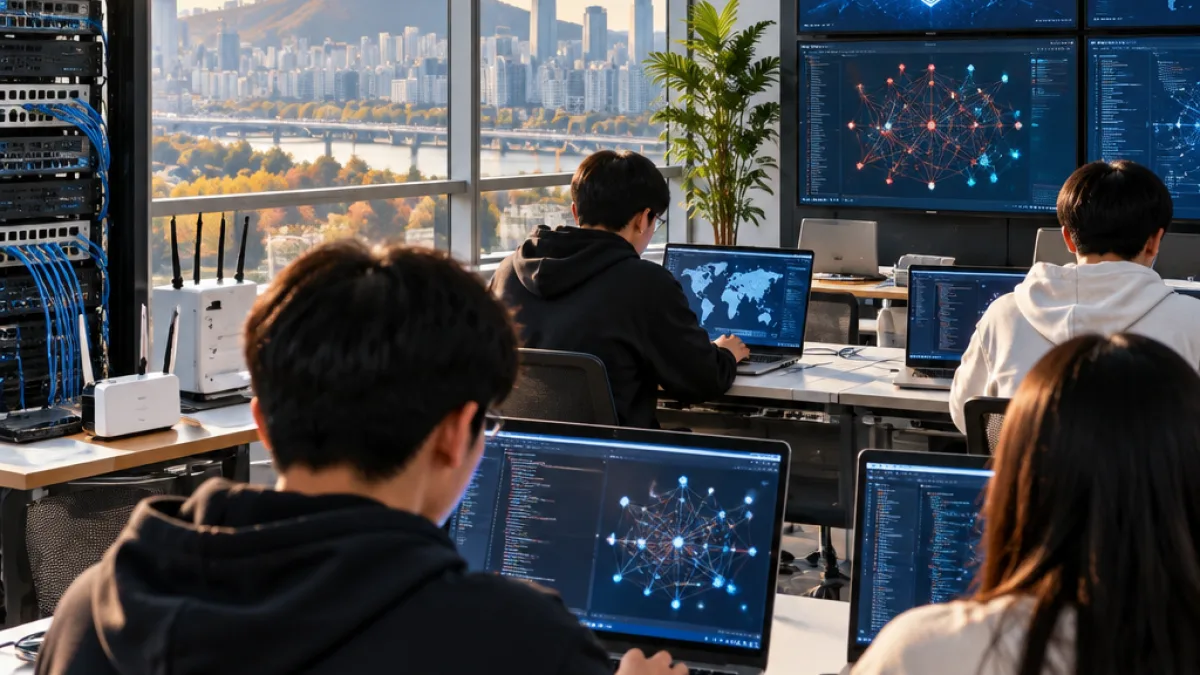
The partnership was announced on the same day as the team stage of the 12th AI and Information Security Gifted Education Center Information Security Competition. Forty-eight pupils, selected from gifted-education centres in four regions of South Korea, worked in teams to tackle security problems.
The event was structured to test whether students could apply learning from their courses rather than simply absorb theoretical material. LG Uplus supplied the venue, networks and AI practice infrastructure, allowing participants to work in an environment intended to resemble a real security setting. Theori Korea designed the problems, supported the technical operation of the contest and assessed the teams’ work.
| Part of the programme | Details |
|---|---|
| Students involved in the competition | 48 |
| Regional gifted-education centres represented | Four |
| Education focus | Artificial intelligence and information security |
| Planned activities | Curriculum development, competitions, expert talks and career programmes |
A national route into specialist skills
The centre’s role is to find and educate information-security talent among pupils in middle and high school. By involving employers and technical specialists directly, the new arrangement places greater emphasis on hands-on work, including the process of identifying and solving security problems.
For schools and pupils, the practical effect will be access to resources and expertise that sit outside a conventional classroom structure. Students will be able to encounter professional networks and AI infrastructure through lessons and competitions, while career-experience activities will provide information about possible routes into the field.
The agreement also gives the Ministry of Education responsibility for ensuring that the programme operates across the gifted-education centres and that its teaching content develops. That central oversight is intended to connect the contributions of the private-sector partners with the wider education system.
LG Uplus and Theori Korea’s involvement reflects the technical demands of information security, where practical exercises can be used to examine how systems respond to threats and how problems are addressed. The competition provided an early demonstration of that model, bringing together pupils from four regions and asking them to work collaboratively on specialist tasks.
The initiative does not replace the existing gifted-education centres. Instead, the memorandum establishes a framework for the ministry, the telecoms company and the security firm to develop their curriculum, activities and support. Its immediate emphasis is on giving young people earlier exposure to AI and cybersecurity, while building a more direct link between education, professional expertise and future careers.