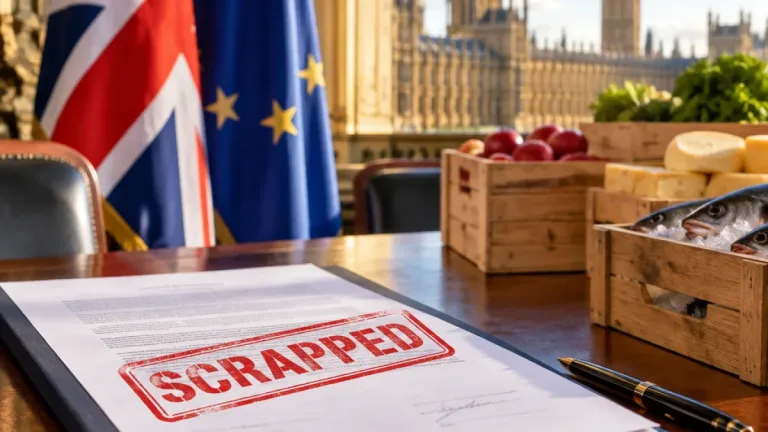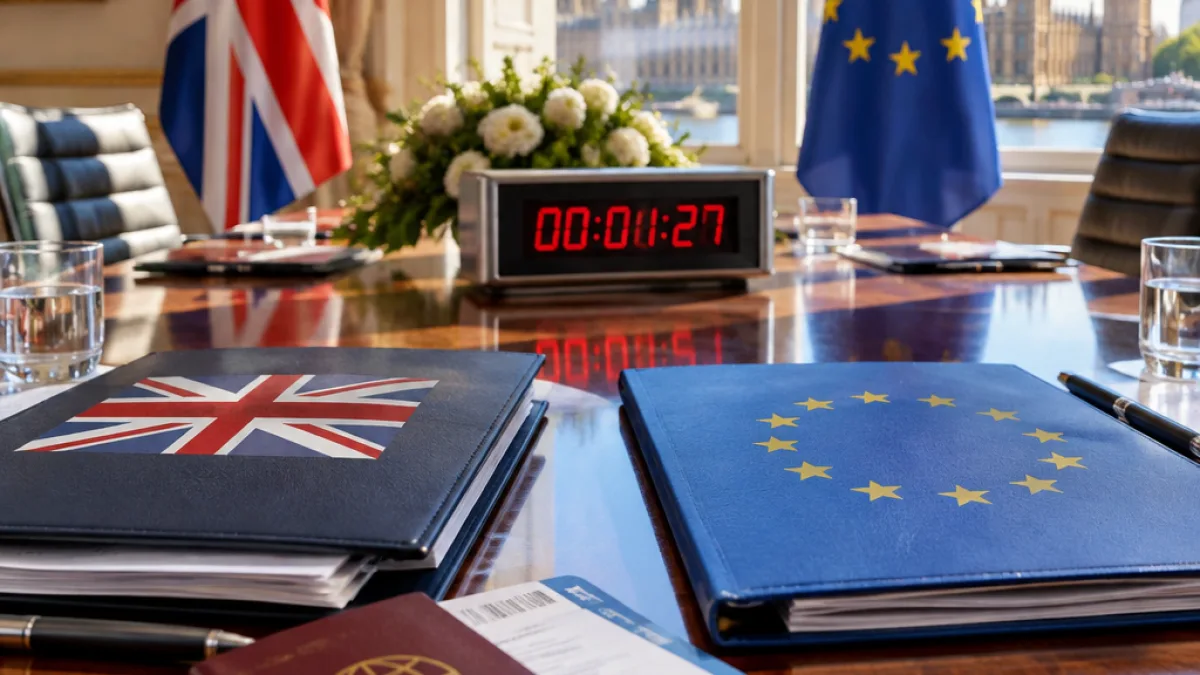
Prime minister Andy Burnham is expected to conclude an agreement with the European Union aimed at rebuilding closer ties with Brussels, as negotiations continued into the final hours before a high-level summit on Friday.
The emerging package is reported to include a revised youth mobility scheme that could allow up to 100,000 young European citizens to come to the UK each year. The arrangement has been provisionally agreed in principle, according to reporting cited in the source, although discussions between British and EU negotiators were still described by Downing Street as being close to the deadline.
A test of the Government’s European strategy
Mr Burnham has presented the summit as a practical test of whether a closer relationship with the bloc can deliver tangible benefits for people in Britain. He said the proposed agreement would help lower costs, restrain prices in supermarkets and open up opportunities for young people.
“In a more dangerous world, we are stronger together.”
The Prime Minister is due to meet Ursula von der Leyen, president of the European Commission, and Antonio Costa, president of the European Council, in Brussels. He is also scheduled to attend an opening ceremony at Forum Europa before holding talks with the two EU leaders.
What is being discussed
| Area | Position reported before the summit |
|---|---|
| Youth mobility | A revised scheme could admit up to 100,000 young EU citizens annually |
| Negotiations | UK and EU discussions were continuing and described as going down to the wire |
| Political objective | Closer UK-EU ties, with the Government stressing costs and opportunities |
The youth mobility proposal would represent a potentially substantial expansion of the existing arrangement, with the number of EU participants reportedly capable of being doubled. However, the wording available before the summit indicates that the details were not yet fully settled. The reported figure should therefore be understood as part of a deal still being finalised, rather than as a completed programme already in operation.
Why the summit matters
The meeting carries significance beyond the individual measures under discussion. It is intended to establish a more cooperative framework between Britain and the EU after years in which relations have been dominated by the political and economic consequences of Brexit. The Government’s argument is that cooperation with European partners can address pressures felt by households while also widening routes for young people to study, work or gain experience.
Mr Burnham has framed the talks in terms of shared interests and common values, as well as the wider international environment. His message is that Britain and the EU face a more uncertain and dangerous world and should respond through closer cooperation. That language places the summit within a broader foreign policy argument, rather than presenting it solely as a negotiation over travel or economic arrangements.
But the political test will be whether the agreement produces benefits that can be clearly demonstrated. The Prime Minister has linked the talks to lower costs and supermarket prices, while the reported youth mobility plan would affect a defined group of European citizens. Those claims will invite scrutiny over what is formally agreed, when any changes take effect and how the promised benefits are measured.
- The proposed arrangement could enable 100,000 young EU citizens a year to enter the UK.
- Negotiators were still working towards a final agreement before Friday’s summit.
- Mr Burnham is presenting closer European cooperation as a response to economic and security pressures.
The summit is consequently a significant moment for the Government’s approach to Brexit. A completed agreement would give ministers an opportunity to point to a more functional relationship with Brussels. Failure to settle the package, or uncertainty over its practical effects, would leave the central political question unresolved: whether closer ties can translate into visible improvements for people in the UK.