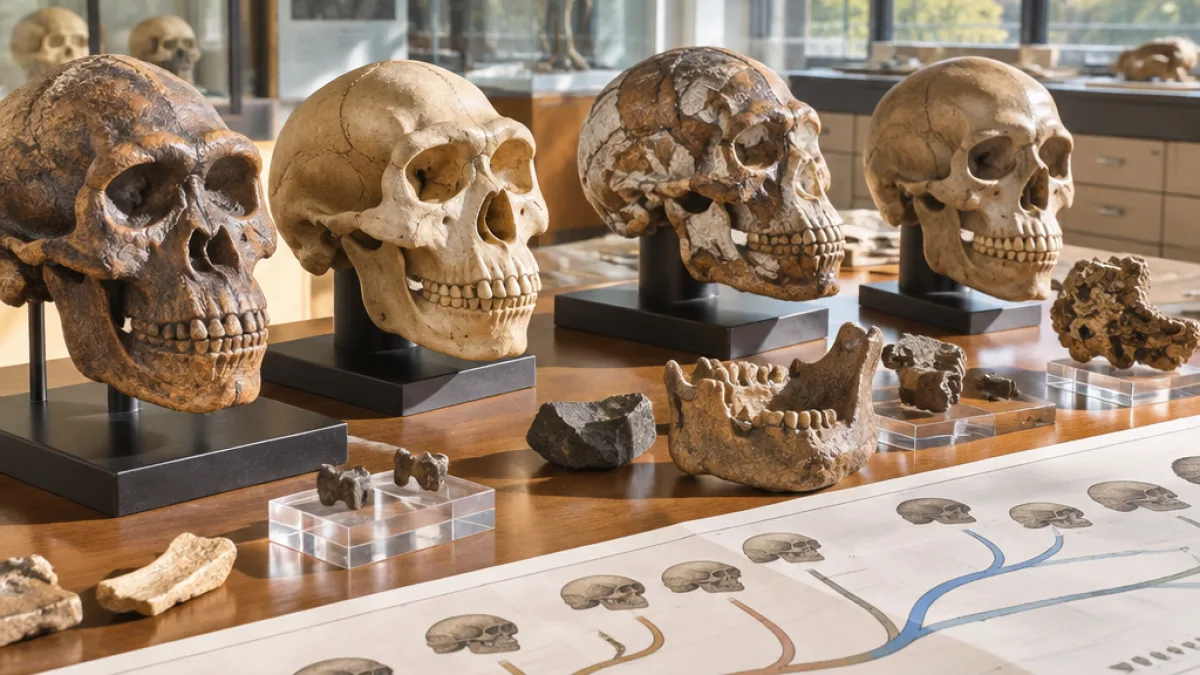
A proposal to redraw the human evolutionary tree would place several groups of ancient human relatives within the genus Homo, the classification that includes modern people. Researchers from Monash University argue that fossils dating from the past four to five million years should be considered part of one broader genus, rather than divided between Homo and other established groups.
The study, published in the American Journal of Biological Anthropology, focuses on the way scientists classify species using fossil evidence. Its authors suggest that groups including Australopithecus and Paranthropus may have been separated from Homo by boundaries that are becoming increasingly difficult to defend as more fossils are examined.
A family tree rather than a ladder
Human evolution is often presented as a straightforward progression from ape-like ancestors to early members of Homo and, eventually, Homo sapiens. The research challenges that simplified picture. Fossils instead point to a history containing multiple branches, overlapping species and uncertain relationships, rather than a single line in which one form neatly replaced the next.
That distinction matters because biological classification is intended to describe relationships between organisms. As new discoveries reveal combinations of anatomical features in different fossil groups, traits once treated as defining one category may no longer provide a clear dividing line. The researchers say this has made it harder to establish where Homo should begin and where other classifications should end.
What the proposed change would mean
Under the proposal, the genus would encompass a much wider range of ancient human species and close fossil relatives. Those species varied substantially in their appearance, anatomy and behaviour, but the study argues that such differences do not necessarily justify placing them in separate genera when viewed across the full span of human evolution.
| Group | Current conventional treatment | Position in the study |
|---|---|---|
| Homo | Genus containing modern humans and some ancient relatives | Retained as the broader genus |
| Australopithecus | Usually classified separately | Could be included within Homo |
| Paranthropus | Usually classified separately | Could be included within Homo |
Why classification remains contested
The argument does not suggest that all ancient human relatives were identical. Instead, it questions whether the differences between named groups are large or consistent enough to support the traditional arrangement. The study’s central claim is that classification should reflect the increasingly complex evidence from the fossil record, including similarities that cross boundaries previously treated as fixed.
Dr Ian Towle, a research fellow at the Monash Biomedicine Discovery Institute and the study’s lead researcher, argues that recent discoveries have exposed weaknesses in the existing system. The challenge applies not only to species already assigned to Homo, but also to members of Australopithecus and Paranthropus, which have generally been kept outside the genus.
A change with scientific and public consequences
Scientific names are more than labels. They shape museum displays, textbooks and the way researchers compare fossils across sites and periods. A broader definition of Homo would therefore alter the language used to describe millions of years of human evolution, while also requiring older interpretations to be reconsidered.
The proposal is likely to remain part of an ongoing scientific discussion rather than immediately replacing every existing classification. Fossil evidence is incomplete, and each newly identified specimen can add detail while also complicating the overall picture. For the public, the study offers a reminder that the human family tree is not a finished diagram: it is a working model, revised as evidence changes what scientists can infer about the past.
- The study proposes placing human species and close fossil relatives from the last four to five million years within Homo.
- Australopithecus and Paranthropus are among the groups that could be reclassified.
- The researchers say overlapping traits and a branching fossil record make traditional boundaries harder to justify.