Soil that had been subjected to sterilising gamma radiation continued to consume oxygen and release carbon dioxide for six years, according to research that challenges the assumption that certain biochemical reactions belong exclusively to living organisms.
The finding emerged from a 15-year investigation led by Sébastien Fontaine, a biochemist at the French National Institute for Agriculture, Food, and Environment. Fontaine’s team was seeking a baseline for the amount of carbon released by soil in the complete absence of life. Instead, the experiment produced a persistent chemical signal that appeared to survive the removal of living organisms.
A test designed to remove biology
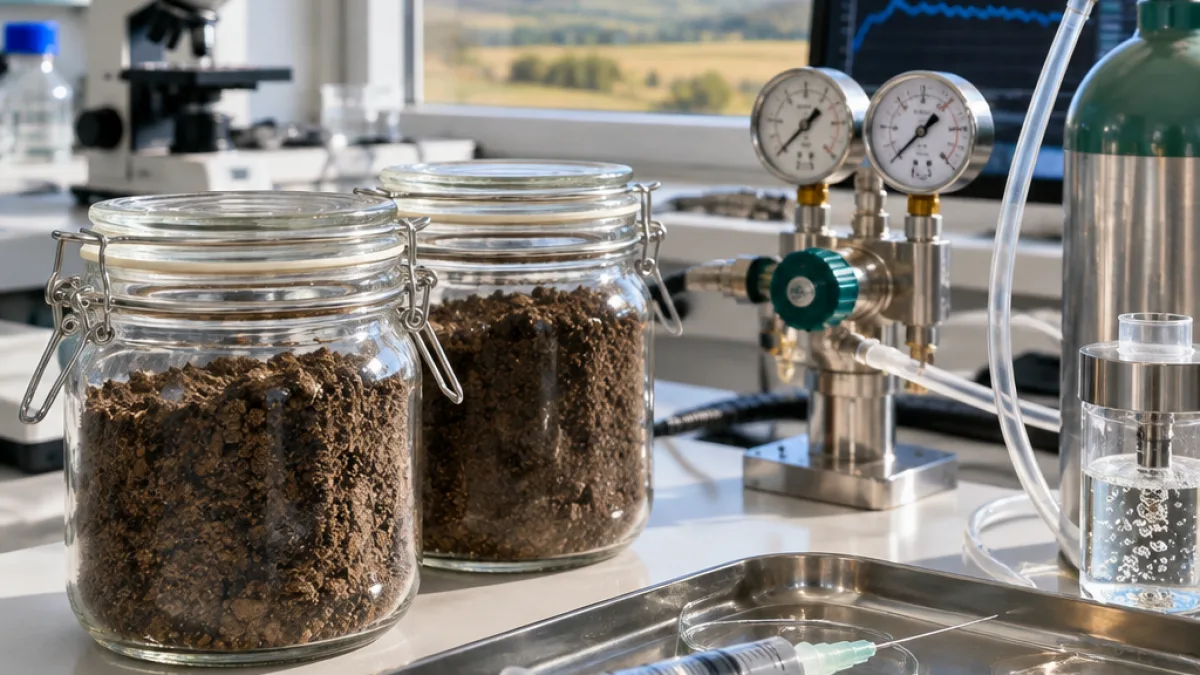
Researchers placed soil in sealed jars and exposed it to gamma radiation intended to sterilise the material. They then repeatedly sampled the air inside the containers with a sterile syringe, measuring its carbon content. The expectation was that carbon dioxide production would decline once microbial respiration had been eliminated.
That decline did not occur as anticipated. The scientists waited for weeks and then months, while microscopic examination of the irradiated soil showed no visible signs of life. Carbon dioxide nevertheless continued to accumulate. The laboratory repeated the work and obtained the same result, reducing the likelihood that the observation was simply caused by a flaw in one experimental setup.
Eventually, the researchers broadened their question. Rather than asking which surviving organism was responsible, they investigated whether the chemical reactions themselves could continue without cells. In a 2025 paper in Science Advances, Fontaine and his colleagues proposed that a process resembling metabolism may be possible outside living cells, even without the proteins that normally organise such reactions inside organisms.
When chemistry continues without cells
In biology, metabolism describes the network of reactions by which cells process molecules and obtain energy. The new work does not show that the sterilised soil was secretly alive. Instead, it points to the possibility that some of the underlying chemistry can persist in non-living material. Among the reactions under consideration are those that release energy from carbon-rich sugar molecules.
The distinction matters because it places a familiar biological process on a possible continuum between life and geology. Joseph Moran, an organic chemist at the University of Ottawa who was not involved in the research, said the experiments examine what happens to biological molecules when they are no longer controlled by living systems.
“The chemistry of life is not exclusive to life.”
Moran described the work as “the chemistry of geology”, highlighting the possibility that reactions now associated with cells may also be produced by the behaviour of molecules and minerals in the wider environment.
Why the result matters
The immediate consequence is for experiments that use soil to study carbon. If irradiated, apparently lifeless soil can continue to generate carbon dioxide, then measurements made when scientists are trying to separate biological activity from non-biological chemistry may require more careful interpretation. The result also raises questions about how carbon behaves after the organisms that once processed it are gone.
Fontaine’s work may also bear on the origins of life. If reactions resembling metabolism can take place without living cells, then some of the chemistry needed by the earliest organisms could have existed before life itself. The experiments do not establish how life began, nor do they identify a complete pathway from non-living chemistry to biology. They instead suggest that the divide between the two may be less absolute at the molecular level than commonly assumed.
| Experimental observation | Significance |
|---|---|
| Soil was exposed to sterilising gamma radiation | The researchers aimed to remove living organisms |
| No visible life was detected under a microscope | The carbon dioxide signal could not readily be attributed to observed microbes |
| Oxygen was consumed and carbon dioxide released for six years | Persistent chemical activity continued after treatment |
- 15 years: duration of Fontaine’s investigation.
- Six years: period during which the treated samples continued to exchange oxygen and carbon dioxide.
- 2025: publication year of the team’s proposal in Science Advances.
The central claim remains a proposal based on the experiments rather than a final account of the chemistry involved. However, the repeated observations give the finding weight: soil that appeared lifeless under the microscope continued to behave as though an active carbon process was under way. For scientists studying the Earth’s carbon cycle and the chemical origins of life, that persistence makes “dead” soil an unexpectedly important laboratory for examining what biology may have inherited from geology.