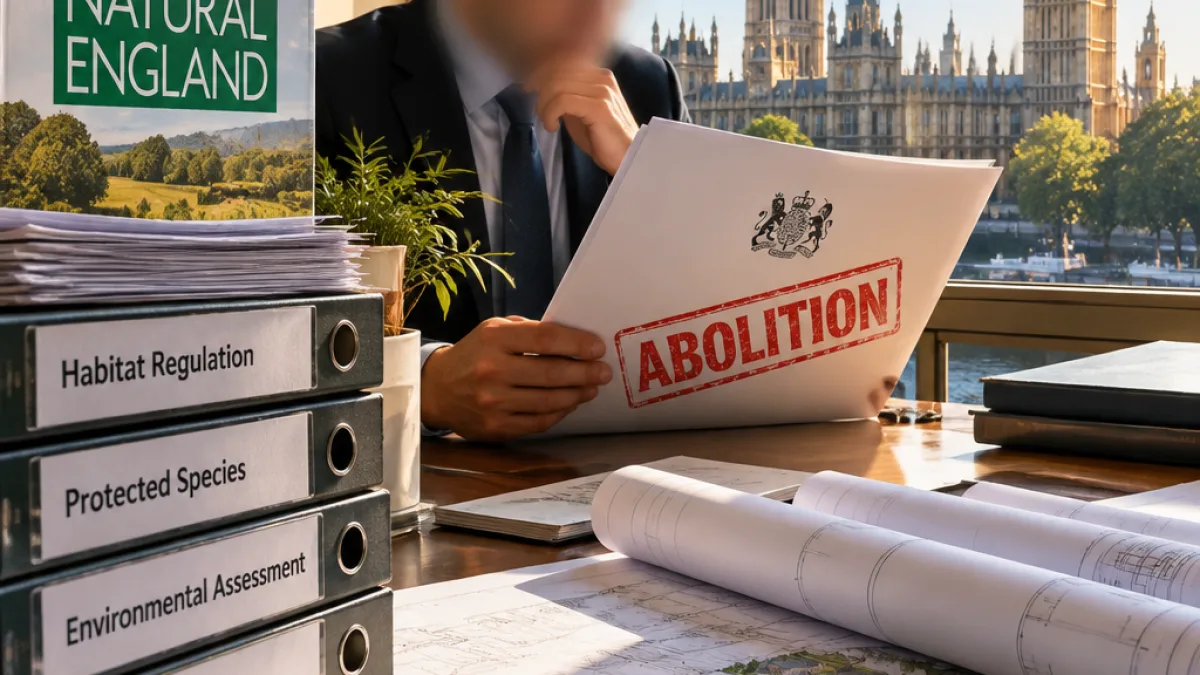
Natural England could be abolished as part of a government review of organisations operating at arm’s length from ministers, Louise Haigh has said, opening a new political dispute over planning, environmental regulation and the control of public decision-making.
Haigh, the first secretary of state and de facto deputy prime minister, said ministers were examining the future of such bodies after successive governments created what she described as a proliferation of quangos. The stated aim is to change how responsibilities are distributed across Whitehall, with some organisations potentially being scrapped and others brought directly inside government departments.
A possible route to faster planning
The case for removing Natural England would centre on the argument that its abolition could make planning decisions quicker and support housebuilding and economic growth. That position reflects a wider Conservative argument that environmental bodies can delay the delivery of new homes. Last month, the Conservatives said that, if returned to power, they would abolish both Natural England and the Environment Agency in an effort to increase housebuilding.
However, no decision to abolish Natural England was announced in the material released by the government. Haigh said ministers were considering all arm’s-length bodies, meaning the organisation’s future remains part of a broader review rather than a confirmed policy change. That distinction matters: a review can lead to abolition, a transfer of functions or a different relationship between a public body and its sponsoring department.
Ministers challenged over responsibility
Speaking before a planned address to the CBI conference, where she was due to argue for greater government control of public utilities, Haigh said the proliferation of such organisations had made it harder for ministers to control decisions taken in government’s name. Her criticism was directed not only at the present system but at successive administrations that had created more bodies while moving decision-making away from departments.
“We’ve had successive governments complain about this, but unfortunately, successive governments have created more of these and pushed more decision-making out of their own departments.”
Her argument is that ministers should not distance themselves from decisions before objecting to the results. Haigh also said that responsibilities should be devolved where that was appropriate, suggesting the government’s approach could involve both greater ministerial control in some areas and the transfer of powers in others. The central political question is therefore not simply whether Natural England survives, but who should make decisions about development and environmental protection, and who should ultimately be answerable for them.
Environmental groups warn against a false choice
Tony Juniper, the chair of Natural England, defended the organisation’s record and rejected the idea that its work necessarily conflicts with development. His response presented nature recovery and economic expansion as objectives that can be pursued together, rather than as competing priorities.
“It’s never been the case that healthy nature is in opposition to economic development, but actually enables it. It’s possible to do both.”
Juniper said he was proud of the work carried out in recent years to bring together national ambitions for growth and the recovery of nature. His intervention highlights the concern likely to surround any attempt to curb or remove the watchdog: environmental groups may argue that speeding up planning by reducing scrutiny could weaken protections, while ministers and Conservative opponents will focus on whether the current system is sufficiently responsive to the need for new homes.
What is being considered
| Issue | Position set out in the source |
|---|---|
| Natural England | May be included in a review of arm’s-length bodies; abolition has not been confirmed. |
| Planning and housebuilding | Supporters of abolition say it could speed decisions and assist new development. |
| Environmental protection | Critics are likely to be concerned about reducing the organisation’s role. |
| Government accountability | Haigh says decision-making should not be pushed away from ministers without clear responsibility. |
The review places the government under pressure to explain precisely what would replace Natural England if ministers chose to abolish it, and how its responsibilities would be handled. It would also have to demonstrate that faster decisions would not come at the expense of the environmental objectives the organisation was established to pursue. Until those details emerge, the proposal remains a signal of intent rather than a settled reform.
- Natural England’s status is under review, but its abolition has not been confirmed.
- The government is linking its quango review to ministerial accountability and the organisation of Whitehall.
- The Conservatives have separately pledged to abolish Natural England and the Environment Agency if they win power.