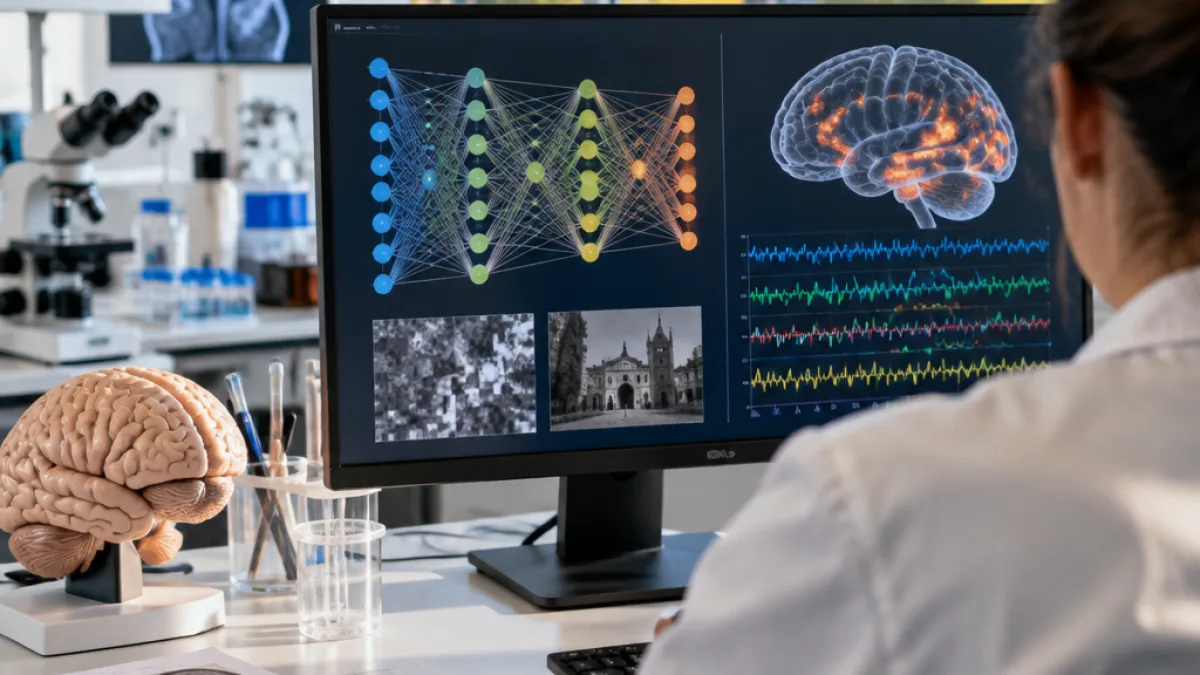
Artificial intelligence models may reproduce patterns of human brain activity without processing visual information in the same way as the brain, according to a study from York University that challenges a central assumption in modern neuroscience.
Researchers have increasingly used artificial neural networks, or ANNs, to investigate how the brain recognises objects and makes sense of what the eyes see. These computer systems are designed to perform tasks including identifying objects in images. Because some models can predict activity recorded in parts of the brain involved in visual recognition, they have become important tools for developing explanations of how vision works.
The new research suggests that this apparent similarity may not be enough to show that an AI system has the same underlying mechanisms as the brain. A model can produce predictions that match measured brain responses while relying on internal processes that are different from those used by biological neural systems.
A test of whether the comparison works both ways
Previous assessments generally examined the relationship in one direction: whether activity within an AI model could be used to predict activity in the brain. The York team approached the problem from the opposite direction, asking whether recorded brain signals could predict what was occurring inside the artificial network.
To carry out that assessment, the researchers developed a technique called reverse predictivity testing. Their reasoning was that a genuinely brain-like model should show a dependable relationship in both directions, rather than merely matching selected patterns in neural data. The approach was intended to expose differences that conventional comparisons might miss.
“Artificial intelligence systems are often described as ‘brain-like’ because they can predict activity in parts of the brain that help us recognise objects.”
Kohitij Kar, an assistant professor at York University and senior author of the study, said scientists had largely tested that claim by asking whether AI models could predict brain activity. The new method instead examines whether the brain’s recorded activity can predict the model’s internal activity, providing a more demanding comparison of the two systems.
| Traditional comparison | Reverse predictivity test |
|---|---|
| AI activity predicts measured brain activity | Measured brain activity predicts AI activity |
| Tests whether outputs correspond | Tests whether the relationship is reciprocal |
Why the finding matters for visual neuroscience
Vision can appear straightforward because people recognise familiar objects and interpret movement continuously in everyday life. The study’s authors, however, describe these abilities as computationally difficult. A useful model must therefore do more than generate plausible answers or imitate selected responses: it should help explain the neural mechanisms that make recognition possible.
Kar, who is also the Canada Research Chair in Visual Neuroscience and a member of York’s Centre for Vision Research, said the long-term aim was to create computational models that reveal how the underlying neural machinery operates. The questions extend beyond static recognition to the way people see objects moving, a task that is routine for humans but challenging to represent computationally.
The findings do not mean that artificial neural networks have no value in brain research. Their ability to reproduce aspects of brain activity remains one reason they have become prominent investigative tools. Instead, the study indicates that similar predictions should not automatically be treated as proof of similar processing.
- ANNs are widely used to study visual recognition.
- Matching brain activity alone may not establish that an AI model uses the brain’s mechanisms.
- Reverse predictivity testing examines whether the similarity works in both directions.
The result places greater emphasis on how AI models are evaluated in neuroscience. Researchers may need to look beyond whether a network predicts a measured response and test whether brain data can account for the network’s internal operations as well. That distinction matters because models used to explain cognition are expected not only to perform tasks, but also to clarify how those tasks are achieved.
By questioning the assumption that successful prediction necessarily indicates shared mechanisms, the York study adds a caution to the growing use of AI as a window into the brain. It suggests that the resemblance between artificial and biological intelligence must be examined through more than one type of comparison before models can be regarded as explanations of human vision.