Durban has been selected as South Africa’s preferred host city for possible bids to stage the 2036 or 2040 Olympic Games, placing the country at the beginning of an effort to become the first African nation to host the global multi-sport event.
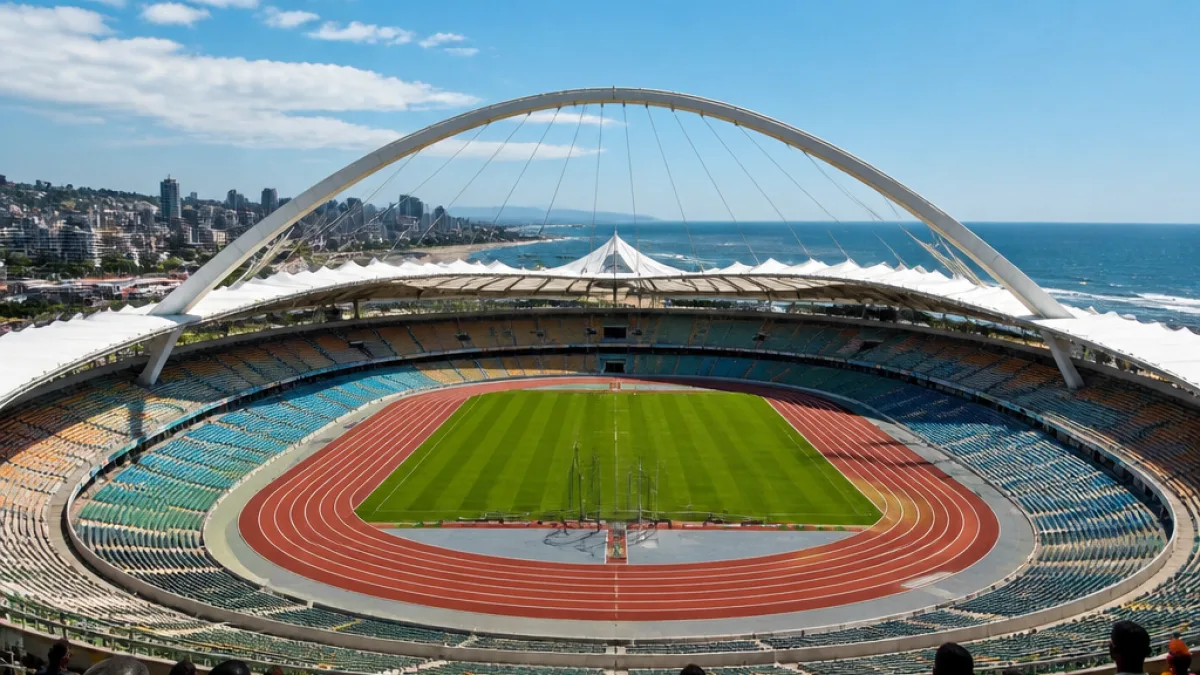
The South African Sports Confederation and Olympic Committee (Sascoc) confirmed the decision on Thursday, identifying Moses Mabhida Stadium as the proposed centrepiece of the campaign. The Durban venue, built for the 2010 Fifa World Cup, would also be the focal point of a wider national plan if South Africa progresses beyond the early stages of the process.
A Durban-led, multi-city plan
Although Durban would carry the main hosting responsibility, the proposed Games would not be confined to KwaZulu-Natal. Cape Town and Johannesburg had also expressed interest in being considered, and both cities could be used for selected sporting codes.
Sascoc acting president Lwandile Simelane said the three cities had been involved in discussions about the possible arrangement. The expectation is that Durban would stage between 60% and 70% of the competition, while other events could be allocated elsewhere in the country.
“It is a national Games,” Simelane said.
The proposed distribution is intended to combine national participation with a concentrated event footprint. Durban would host the Olympic village as well as the opening and closing ceremonies, while the use of Cape Town and Johannesburg would allow additional venues and sporting facilities to form part of the application.
| Element | Current proposal |
|---|---|
| Preferred host city | Durban |
| Potential editions | 2036 or 2040 |
| Main venue | Moses Mabhida Stadium |
| Estimated Durban share | 60% to 70% of events |
| Other possible host cities | Cape Town and Johannesburg |
Interest is not yet a formal bid
The announcement does not mean that South Africa has secured the Games, or that a final bid has already been submitted. Government has approved Sascoc’s request to express interest in hosting either the 2036 or 2040 edition, but the country remains at an early point in the process.
Several major questions still need to be addressed before South Africa can determine whether it is ready to pursue the opportunity. These include the likely financial cost, the condition and availability of sporting facilities, and the capacity of public transport infrastructure to move athletes, officials and spectators during the event.
Those considerations will be central to any decision. Olympic hosting involves far more than a main stadium and a calendar of competitions. The bid would have to present a workable plan for accommodation, training sites, transport links and the movement of large crowds, while also showing how venues in different cities could be connected without creating unnecessary travel demands.
Keeping the Games compact
Sascoc’s proposed model is designed to avoid an overly scattered tournament. Durban would provide the main base, with the Olympic village and ceremonies located there, while selected codes would be staged in the other cities. Simelane said the intention was to ensure that athletes and spectators were not required to move across the country excessively.
The approach would allow South Africa to use facilities beyond the preferred host city while retaining a central identity for the Games. It would also give Cape Town and Johannesburg a possible role in an Olympic project without displacing Durban as the principal location.
South Africa is among seven countries that have shown interest in the 2036 Games. Germany, Hungary, India, Qatar and South Korea are among the countries identified in the early discussions. At this stage, however, the field remains part of a developing process rather than a final list of confirmed bids.
For Durban, the announcement offers the possibility of returning Moses Mabhida Stadium to the centre of an international sporting vision 16 years after the 2010 football tournament. For the country, the next challenge will be to establish whether the ambition of hosting the Olympics can be matched by the infrastructure, transport planning and financial commitments required to deliver a compact, national Games.