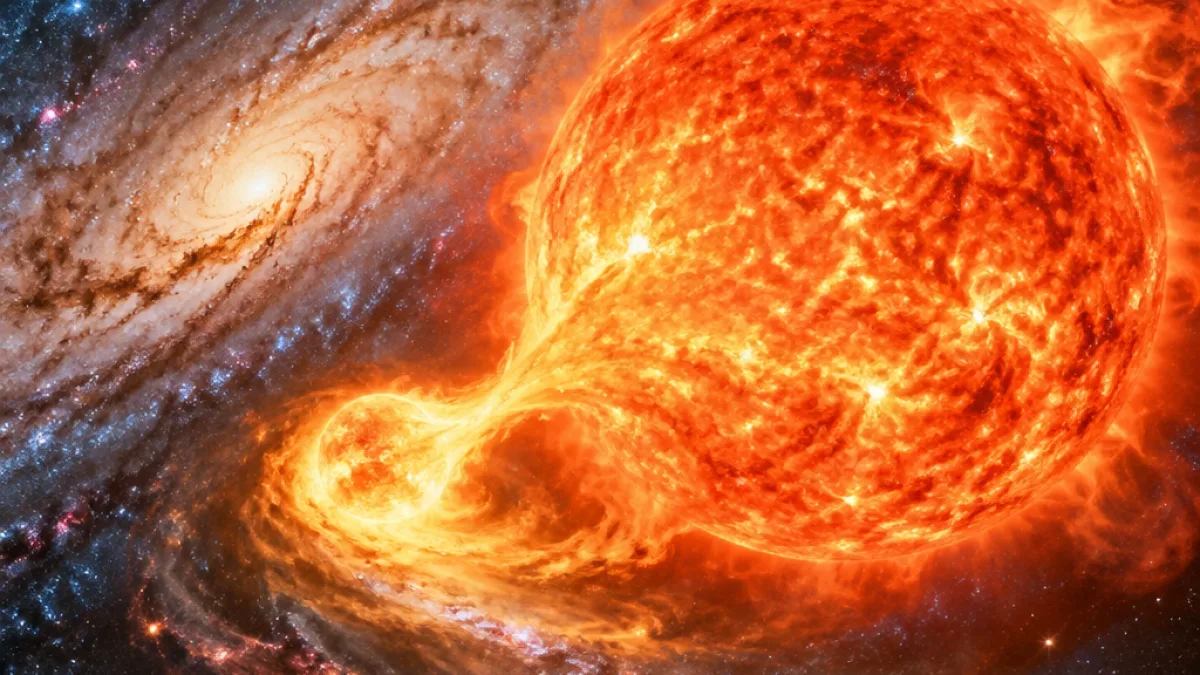
Astronomers have recorded what they believe is the first direct example of a star engulfing and merging with its companion, observing the event in a binary system in the Andromeda galaxy.
The system centres on a red giant known as WNTR23bzdiq, roughly 2.5 million light-years from Earth. The star is estimated to be about seven times as massive as the Sun and around 350 times wider. Researchers say a smaller companion appears to have spiralled into the giant before a dramatic eruption of light near the end of 2025.
A long-predicted stellar event
Stars nearing the end of their lives can expand to many times their original dimensions. In a binary system, where two stars orbit one another, that growth can bring the larger object into contact with its partner. The smaller star may then move inwards, losing orbital energy as it encounters material from the swollen giant.
That process is expected to create friction, heat and additional light. Until now, however, astronomers had not directly observed a system while the proposed engulfment was taking place. The changes can be difficult to distinguish from other forms of stellar activity, particularly because the signal is relatively faint compared with the scale of the surrounding galaxy.
“Catching a star engulfing its companion in the act is very difficult.”
Viraj Karambelkar, an astrophysicist at Columbia University in New York and lead author of the study, said the effect could be extremely subtle and requires telescopes to monitor the sky over an extended period.
Years of observations revealed the change
The team first noticed that WNTR23bzdiq was becoming brighter in 2023, using data from NASA’s now-defunct NEOWISE space telescope and the WINTER telescope at Palomar Observatory in California. Examination of earlier records indicated that the red giant had already begun increasing in luminosity in 2018.
Researchers previously proposed that the rising brightness might have been caused by a companion moving towards the giant’s core. As the two objects interacted, the resulting friction could have released energy in the form of heat and light. The eruption observed several years later provided a much stronger signal for investigating that possibility.
| Observation | Reported detail |
|---|---|
| Location | Andromeda galaxy, about 2.5 million light-years away |
| Red giant | About seven solar masses and 350 solar widths |
| Brightness increase | First traced back to 2018 |
| Major eruption | Seen near the end of 2025 |
| Material expelled | About 0.1 to 0.2 solar masses |
Webb observed the aftermath
NASA’s James Webb Space Telescope examined the object 47 days after the eruption. Those observations allowed the researchers to study the event in greater detail and develop a model in which a companion with roughly 70% of the Sun’s mass struck the centre of the red giant.
On that interpretation, the outburst expelled material equivalent to between one-tenth and one-fifth of the Sun’s mass. The researchers say the two stars may have combined into a single object. The binary system has been given the nickname “Bao”.
Karambelkar said the findings match a theoretical prediction that stars can engulf their companions, but he also stressed that the observations do not settle the system’s final fate. One alternative is that both stars survived, although they would then be orbiting one another much more closely than before.
- The brightening began years before the final eruption.
- Infrared and ground-based observations helped track the changing system.
- Webb’s follow-up observations supported, but did not prove conclusively, a stellar merger.
The distinction matters because the system’s later behaviour could help astronomers determine whether a complete merger occurred or whether the two stars remain bound in a tighter orbit. Either outcome would provide information about the final stages of binary-star evolution and about the physical processes that accompany a red giant’s expansion.
The study therefore turns a long-standing theoretical scenario into an event that can be examined through recorded observations. Continued monitoring of Bao will be important as astronomers assess whether the system behaves like one merged star or retains evidence of two surviving companions.