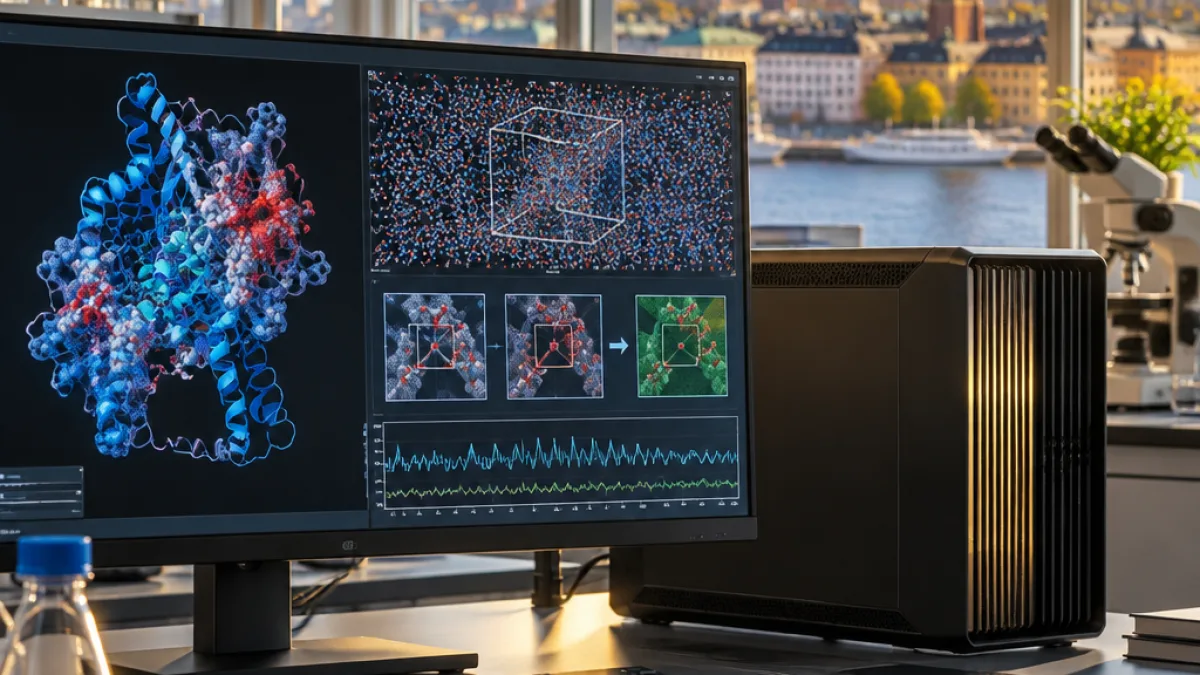
NVIDIA has released a package of artificial-intelligence tools for scientific research, including an open model, a chemistry question set and software recipes intended to connect the system with accelerated scientific workflows.
The company announced the collection at SC26 in Chicago on 16 November, with Ian Buck, NVIDIA’s vice-president of Hyperscale and High-Performance Computing, presenting the release. The most striking result associated with it came from the KTH Royal Institute of Technology, where an agent using the system repaired 81% of deliberately broken GROMACS molecular-dynamics setups during an overnight run on a single DGX Spark workstation.
That figure is not a conventional performance score. It represents the proportion of faulty simulation configurations that the agent successfully corrected. Crucially, the repairs were checked by GROMACS, the molecular-dynamics software used to run the calculations, rather than being assessed by the same artificial-intelligence system that proposed them. This provides a more meaningful test of whether the changes worked within the scientific tool itself.
Three parts of one collection
NVIDIA’s announcement brings together three separate components. Treating them as one product risks obscuring the different roles they play, as well as their differing levels of maturity and licensing arrangements.
| Component | What it provides |
|---|---|
| Nemotron 3.5 Super VL | An open, 120-billion-parameter mixture-of-experts model |
| LitmusBench v0.2 | An open chemistry dataset containing roughly 50,000 questions |
| Post-training recipes | Instructions for connecting the model with CUDA-X scientific software |
The model is described as having 120 billion parameters, with 12 billion active for each token. It combines Mamba-2 and Transformer technology, uses 512 routed experts in each mixture-of-experts layer and includes a C-RADIO vision encoder. Its stated context window extends to up to one million tokens. The system can accept text, images and two-minute MP4 video, while producing text responses.
The checkpoint is available on Hugging Face under the OpenMDW-1.1 terms, which permit commercial and non-commercial use. However, the checkpoint itself is not a new release made on 16 November. NVIDIA published the repository on 12 October and issued its own announcement on 15 October. The new element is the wider structure built around the model: the evaluation resource, the training guidance and examples of the technology being applied to named scientific workflows.
From laboratory assistant to workflow tool
The GROMACS experiment matters because it moves the evaluation away from a question-and-answer leaderboard. Molecular-dynamics simulations rely on correctly configured inputs and produce results through established scientific software. An agent that can identify and repair an invalid setup could help researchers diagnose routine failures before a longer calculation is launched.
Even so, the reported result has a defined scope. It concerns a set of deliberately damaged configurations, tested in a particular overnight run and on one workstation. It does not establish that the system can reliably design experiments, interpret every molecular-dynamics result or replace expert review. The fact that GROMACS verified the repairs strengthens the result, but it does not remove the need to understand how the test cases were created or how broadly the performance transfers to other scientific tasks.
The collection therefore represents a shift in emphasis for scientific AI. Open model weights alone give researchers a starting point, but usable systems also require suitable evaluation data and reliable links to specialist programmes. NVIDIA’s package attempts to provide all three. Its practical value will depend on how researchers use the recipes, how well the model performs beyond the reported cases and how clearly the separate components’ licensing and limitations are documented.
- 81% of deliberately faulty GROMACS setups were repaired in the reported KTH trial.
- The model has 120 billion parameters, with 12 billion active per token.
- LitmusBench v0.2 contains approximately 50,000 chemistry questions.
For laboratories considering such systems, the announcement offers both a technical resource and a test of scientific credibility. The key question is not simply whether an AI model can produce plausible instructions, but whether its proposed changes survive the checks imposed by the software and methods used by researchers. In the GROMACS example, that distinction is central to the significance of the result.