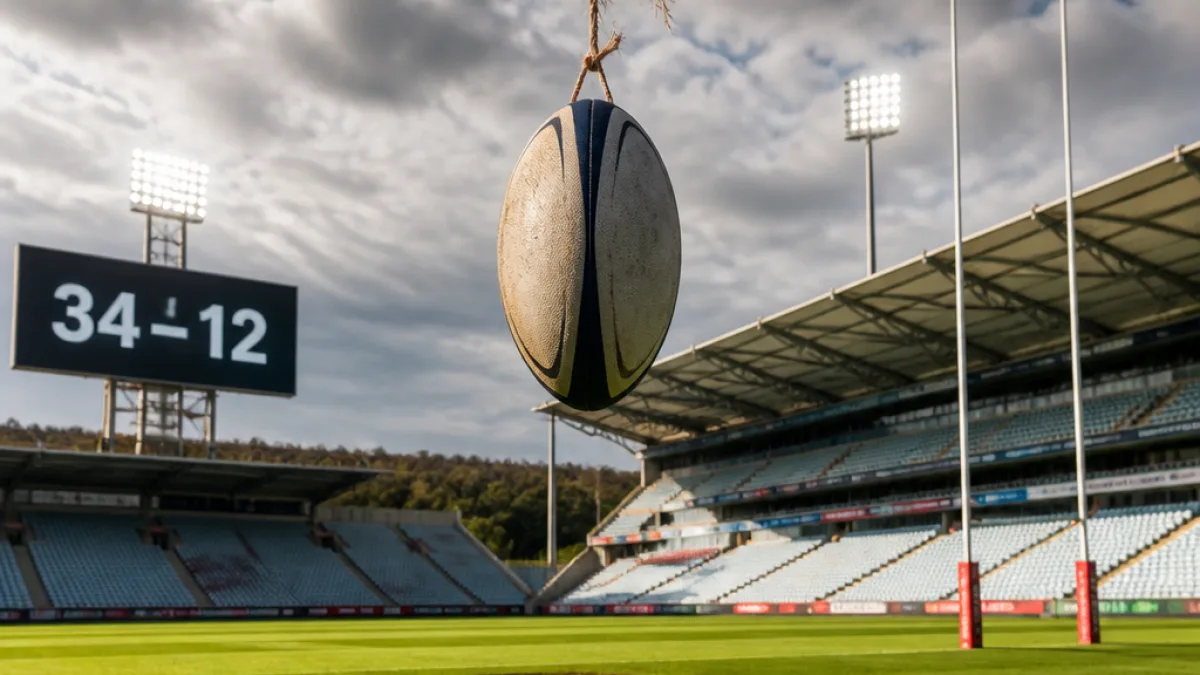
England’s Rugby League World Cup campaign is on the verge of an unprecedented group-stage exit after a 34-12 victory over Papua New Guinea failed to deliver the commanding margin required to revive their semi-final hopes.
Brian McDermott’s side needed a substantial win in Wollongong after their opening defeat by Tonga left qualification outside their control. Even following an 82-0 victory over France, England still had to overturn a significant points-difference deficit against Samoa. Their 22-point success over Papua New Guinea was not enough to settle the contest in their favour.
A fast start gives way to frustration
England began with the urgency demanded by the situation. Matty Ashton, AJ Brimson, Dom Young and Harry Smith all crossed in the opening 21 minutes, giving the team a 22-0 advantage and briefly suggesting that the required total might be within reach.
That early momentum did not last. England’s execution deteriorated, while Papua New Guinea produced a more resilient performance than the opening exchanges had indicated. The visitors were restricted to a penalty goal for the remainder of the first half, and the match moved away from the high-scoring contest England needed.
Two converted Papua New Guinea tries after the interval increased the pressure and exposed England’s growing frustration. The team then went 48 minutes without scoring before Morgan Knowles finally added a further try. Mikey Lewis scored with the final play, but the late points could not transform the wider arithmetic of the group.
The qualification equation
England’s position had already been weakened by a 30-12 loss to Tonga in the tournament opener. To move above Samoa on points difference, they needed to win by 70 points or more against Papua New Guinea. Their eventual margin fell well short of that requirement.
| Factor | Position after England’s win |
|---|---|
| England’s result | 34-12 victory over Papua New Guinea |
| Required margin against PNG | At least 70 points to overtake Samoa on points difference |
| Remaining route | Tonga must beat Samoa by more than 46 points |
The only remaining route would require Tonga to defeat Samoa by more than 46 points. That outcome is possible in mathematical terms, but England’s prospects are remote. The result leaves the side dependent on an extraordinary scoreline in the other fixture rather than on its own performance.
A wider reckoning for English rugby league
The implications extend beyond one match. England’s likely elimination would represent the first time that England or Great Britain had failed to reach the last four of the Rugby League World Cup. The tournament’s format, involving 10 teams arranged in uneven groups, has also attracted criticism because England’s defeat in the opening weekend placed them in a uniquely precarious position.
That structure explains part of the pressure surrounding the campaign, but it does not remove the questions raised by England’s performance. The team had the opportunity to build an overwhelming lead against Papua New Guinea and instead allowed the contest to become scrappy and close. The failure to sustain the initial plan proved decisive in a competition where points difference has become central to qualification.
“Fundamentally flawed.”
That was the assessment of the World Cup structure reported by Jon Wilkin. For McDermott and the English administrators, however, the format is only one part of the post-tournament debate. The opening defeat by Tonga, the inability to maintain control against Papua New Guinea and the dependence on results elsewhere have combined to leave England facing a premature departure from a tournament in which semi-final qualification had previously been expected.
- England beat Papua New Guinea 34-12.
- Six players scored England’s tries across the match.
- England now require Tonga to beat Samoa by more than 46 points.