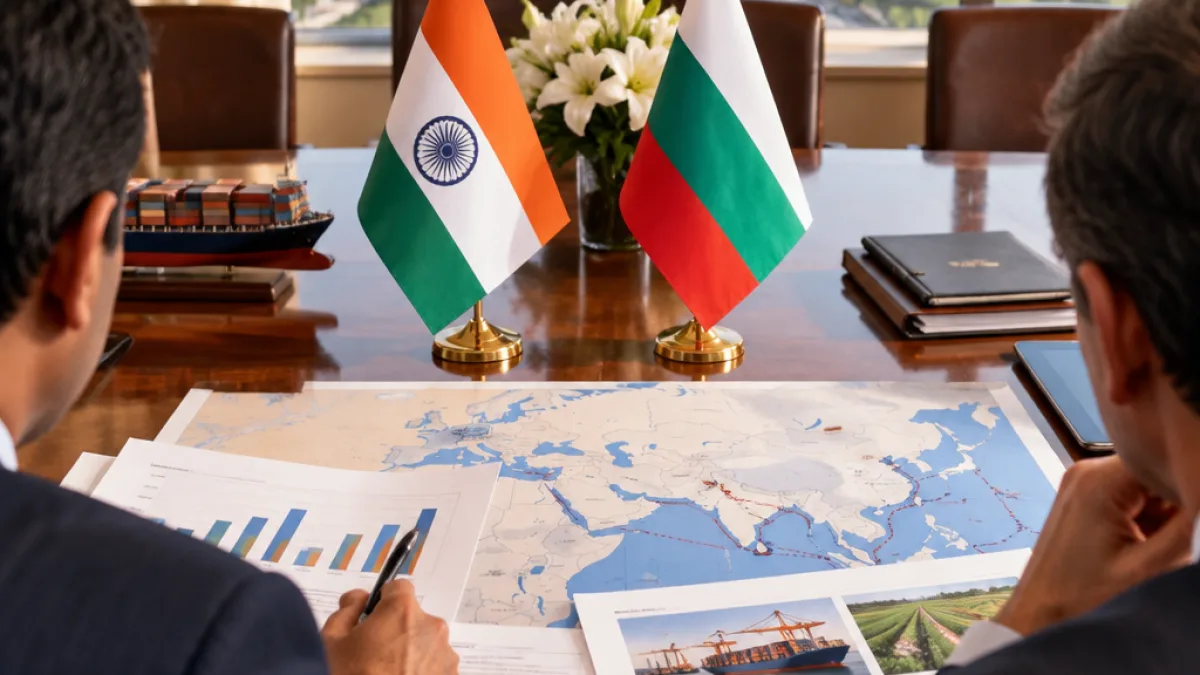
NEW DELHI: India and Bulgaria have agreed on a detailed roadmap for bilateral cooperation, with External Affairs Minister S Jaishankar calling for stronger engagement between businesses after the India-EU Free Trade Agreement comes into force.
The roadmap was discussed during Jaishankar’s meeting with Bulgarian counterpart Velislava Petrova in New Delhi on Saturday. The agenda covered a broad set of economic and strategic areas, including trade, connectivity, investment, technology and talent mobility. The two sides also reviewed people-to-people relations and cultural exchanges, indicating that the proposed cooperation will extend beyond government-to-government engagement.
Business engagement tied to EU trade opening
Jaishankar’s call for vigorous business exchanges places the private sector at the centre of the next phase of India-Bulgaria ties. The minister linked the bilateral relationship with the wider process of India’s engagement with the European Union, while thanking Bulgaria for its support in that process.
“Your visit also takes place when we are intensifying our relationship with the European Union and we thank you for all the support you have extended to that process.”
The focus on business interaction is significant because the roadmap brings together commercial areas and enabling infrastructure. Trade and investment were discussed alongside connectivity, technology and movement of talent. Taken together, these areas provide a framework for companies to assess commercial opportunities as the broader India-EU trade arrangement moves towards implementation.
However, the announcement does not disclose specific investment commitments, trade targets, company-level agreements or timelines for individual projects. The immediate outcome is therefore a policy framework rather than a quantified commercial package. Its practical value will depend on how the identified areas are converted into business exchanges and institutional cooperation.
Connectivity and wider regional links
The ministers also exchanged views on the prospects of the India-Middle-East-Europe Economic Corridor (IMEC) and other connectivity initiatives. The discussion adds a regional dimension to the bilateral roadmap, connecting India-Bulgaria relations with wider efforts involving transport and economic links across multiple regions.
Connectivity was reviewed as one of several subjects rather than as a standalone infrastructure announcement. No project details, financing arrangements or implementation schedule were provided in the information released. For businesses, the importance of the discussion lies in keeping connectivity, trade and investment within the same strategic conversation.
| Area reviewed | Relevance to bilateral engagement |
|---|---|
| Trade and investment | Scope for stronger commercial exchanges |
| Technology and talent mobility | Potential support for skills and innovation links |
| Connectivity and IMEC | Regional economic and transport cooperation |
| Security and people-to-people ties | Broader institutional relationship |
Security issues remain part of the dialogue
Beyond economic matters, Jaishankar and Petrova discussed the situation in the Black Sea and the ongoing war in Ukraine. The inclusion of these issues reflects the security environment surrounding Bulgaria and the wider European region, while showing that the bilateral relationship is being handled across both commercial and strategic tracks.
Jaishankar also thanked the Bulgarian government for helping repatriate Indian seafarers from attacked commercial ships and for providing medical assistance to those injured. The reference was to the October 6 attacks in Bulgaria’s exclusive economic zone. The Palau-flagged Able, carrying seven Indian crew members, was hit by drones, injuring one person. Bulgarian authorities helped evacuate the crew to Varna and arrange medical care.
Jaishankar recalled his visit to Sofia in June, saying it had given fresh momentum to bilateral relations. With the new roadmap now approved, the next phase will be judged by the conversion of high-level priorities into measurable trade, investment, technology and mobility outcomes. For companies, the minister’s message is clear: engagement with Bulgarian counterparts is expected to intensify as India’s economic relationship with the European Union advances.
- Roadmap: India and Bulgaria approved a detailed framework for cooperation.
- Business: Jaishankar urged stronger commercial exchanges after the India-EU trade agreement takes effect.
- Scope: Discussions included trade, investment, technology, talent mobility, connectivity and IMEC.