Bhopal: Madhya Pradesh's plan to expand its electricity transmission network is facing pressure from a shortage of critical equipment, including high-voltage insulators and power transformers, at a time when renewable-energy projects are adding to the volume of power that must be moved across the state.
The issue is not confined to procurement schedules. Transmission infrastructure forms the link between generating stations and the substations of distribution companies, which then supply electricity to households, industries and commercial establishments. Any prolonged gap between project requirements and the availability of equipment could therefore complicate the state's effort to strengthen the network, although the available account does not specify particular project delays or power interruptions.
Demand rising with infrastructure expansion
Madhya Pradesh has an installed generation capacity of 12,090 MW, including solar power, and a population of around nine crore. The state's transmission system is operated by Madhya Pradesh Power Transmission Company Limited, commonly known as MP Transco, which wheels electricity from generation stations to distribution companies.
The pressure on the supply chain has emerged as transmission infrastructure is being expanded rapidly across the country. The managing director of MP Transco, Sunil Tiwari, said the difficulty was not the result of a fall in manufacturing output. Instead, the pace of infrastructure development has increased demand faster than the equipment supply chain can respond.
“A large share of power transmission equipment is manufactured domestically. However, the power sector is facing a shortage of such equipment, not because production has declined, but because the rapid pace of infrastructure development across the country has widened the gap between demand and supply,”
That distinction is important for assessing the problem. The available information points to a capacity and timing mismatch: manufacturers are producing equipment, but transmission utilities need components in quantities and timeframes that the existing supply chain is struggling to meet.
Insulators emerge as a critical bottleneck
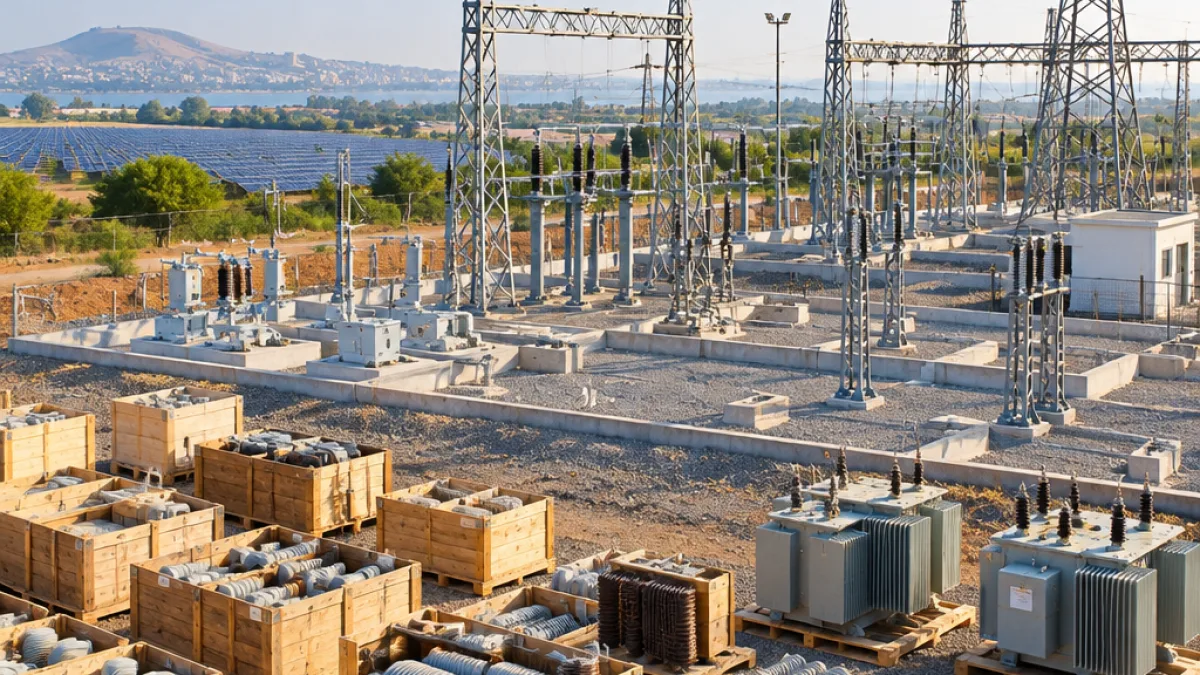
High-voltage insulators have become a particular area of concern. They are required to support and electrically isolate conductors in transmission installations, and the report indicates that projects need thousands of insulator strings of different voltage capacities every year.
Manufacturing of porcelain insulators has been affected by difficulty in obtaining the raw materials needed for production. Some manufacturing units have also faced disruptions because of gas shortages linked to interruptions in the global energy supply chain. These constraints add another layer of uncertainty for utilities that must coordinate equipment orders with construction and commissioning work.
The situation also shows that domestic manufacturing does not automatically guarantee immediate availability. Even where a component is largely made in India, production depends on raw materials, energy supplies, specialised manufacturing capability and the ability of suppliers to meet different technical and voltage specifications.
What the equipment gap means
| Component or factor | Position described |
|---|---|
| High-voltage insulators | Short supply; raw-material availability is a concern |
| Power transformers | Included among the critical equipment facing shortages |
| Porcelain insulators | Production affected by difficulty in sourcing materials |
| Specialised products | Some continue to be imported |
| Polymer and composite insulators | Increasingly adopted for certain installations |
Manufacturers are increasingly turning to polymer and composite insulators, particularly in polluted and dusty environments. These products are lighter, easier to handle and require comparatively less maintenance, according to the information available. Their wider use could provide an alternative in some applications, but the report does not establish whether they can replace every specialised product required for Madhya Pradesh's transmission projects.
Some specialised transmission products continue to be imported. This leaves the expansion programme exposed not only to domestic production constraints but also to the availability of equipment from outside the country. For a state preparing to transmit increasing quantities of renewable power, that dependence makes the scheduling of procurement and installation a central operational concern.
Need for clearer delivery monitoring
The immediate accountability question is whether equipment shortages are being reflected in project timelines, procurement plans and commissioning schedules. The available details identify the supply problem but do not give a project-wise list of affected works, the size of any backlog, or revised completion dates. Such information would help establish whether the issue is limited to procurement pressure or is already affecting the pace of network expansion.
The equipment challenge also underlines the need to strengthen domestic manufacturing capacity and ensure timely access to essential components. As renewable generation grows, adding generating capacity alone will not be sufficient; the transmission network must be able to carry that electricity to distribution systems. For Madhya Pradesh, the performance of MP Transco's expansion programme will therefore depend not only on construction but also on the reliability and transparency of the equipment supply chain.