Laboratory-grown human brain tissue has produced electrical activity patterns resembling those observed in premature infants, prompting a neuroscientist to ask whether learning changes not only what the brain knows, but how it experiences the world.
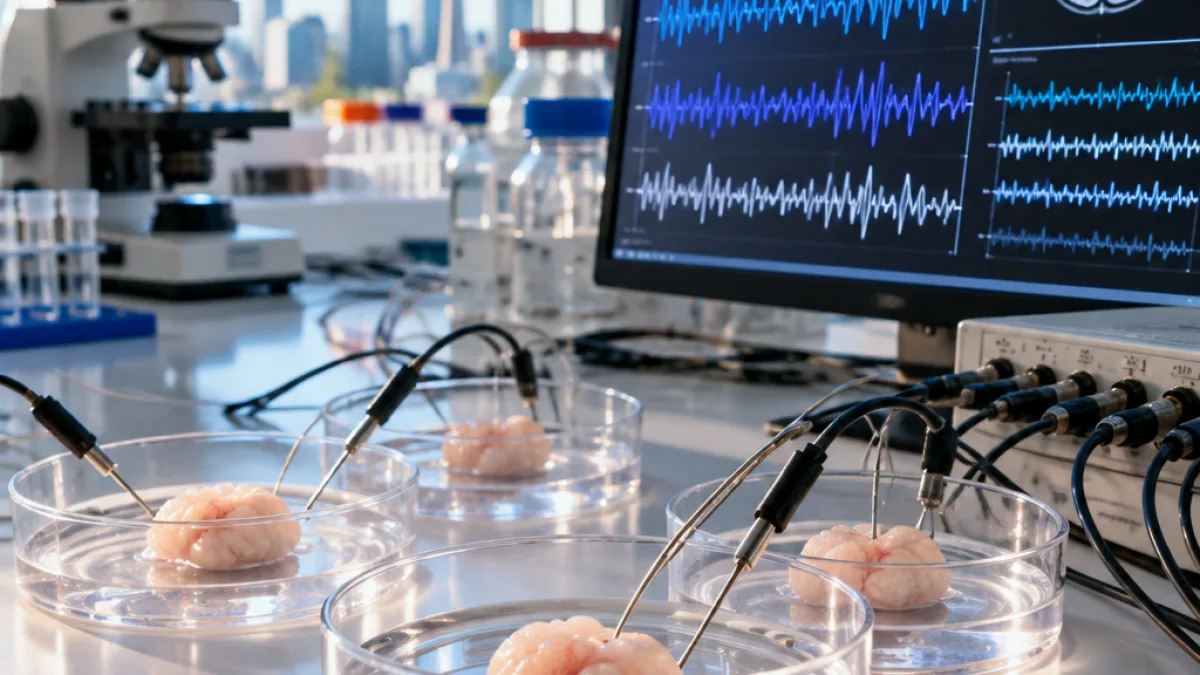
The work involves brain organoids — small clusters of living neural tissue developed from stem cells in a laboratory. Alysson Muotri, a professor of pediatrics and cellular and molecular medicine at the University of California, San Diego, used the organoids in preliminary experiments aimed at exploring questions surrounding inner experience and consciousness.
A model for studying the developing brain
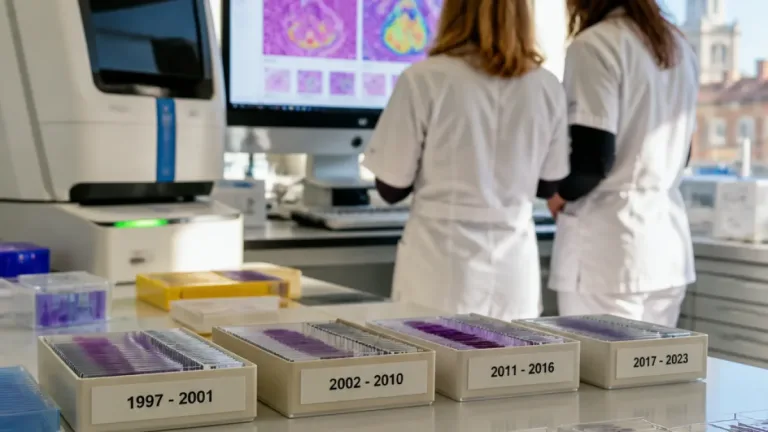
The research begins with ordinary human cells, which can often be collected from skin. Scientists reprogram those cells into induced pluripotent stem cells, according to the source material, before using them to produce the neural tissue clusters. The resulting organoids are not described as complete brains. Rather, they are laboratory models that can allow researchers to examine certain forms of neural activity.
In the experiments described, the organoids generated electrical patterns similar to those seen in premature infants. The comparison does not establish that the tissue has thoughts, feelings or human-like awareness. It does, however, provide a basis for investigating how organized activity can emerge in developing neural systems.
Muotri’s interpretation centres on a possible tension between early openness to the environment and the effects of learning. The researcher suggests that children’s brains may initially be more conscious of their surroundings before experience and education direct their thinking. As people learn categories, explanations and terminology, the process may make perception more focused — while also narrowing the range of possibilities the mind considers.
“learned” via repeated stimulation
The wording is important. The organoids did not demonstrate learning in the same sense as a child attending a lesson or an adult acquiring a skill. Instead, the source says preliminary tests indicated that repeated stimulation produced changes described as learning. The findings therefore raise a question for further study rather than settling what consciousness is or when it begins.
What the preliminary findings suggest
| Observation | What it may help researchers examine |
|---|---|
| Electrical activity resembling patterns in premature infants | How organized neural activity develops |
| Changes after repeated stimulation | Whether simple neural systems can adapt to input |
| Less “conscious” behaviour after learning | Whether learning changes the breadth of perception |
The central claim remains tentative. The researcher thinks that learning could make behaviour appear less conscious by reducing the openness associated with an earlier, less directed state. That idea is philosophical as well as scientific, and the available findings do not show that adults were literally more conscious as children. They instead invite researchers to distinguish between awareness, responsiveness, perception and learned behaviour.
- The organoids are laboratory-grown neural tissue, not full human brains.
- The electrical patterns resemble those of premature infants, but that resemblance does not prove human consciousness.
- The reported learning effect is preliminary and was linked to repeated stimulation.
The research illustrates both the promise and the limits of brain organoids. These models may offer a way to study aspects of human neural development in controlled conditions, including how activity responds to stimulation. At the same time, the source material provides no evidence that the organoids possess subjective experience, and it does not establish that learning narrows awareness in people.
For now, the work points to a broader scientific problem: how electrical activity becomes organized, how exposure changes neural responses and how those processes relate — if at all — to consciousness. The organoids may help make those questions experimentally approachable, but the distinction between measurable neural activity and inner experience remains unresolved.