A parliament without an opposing bloc
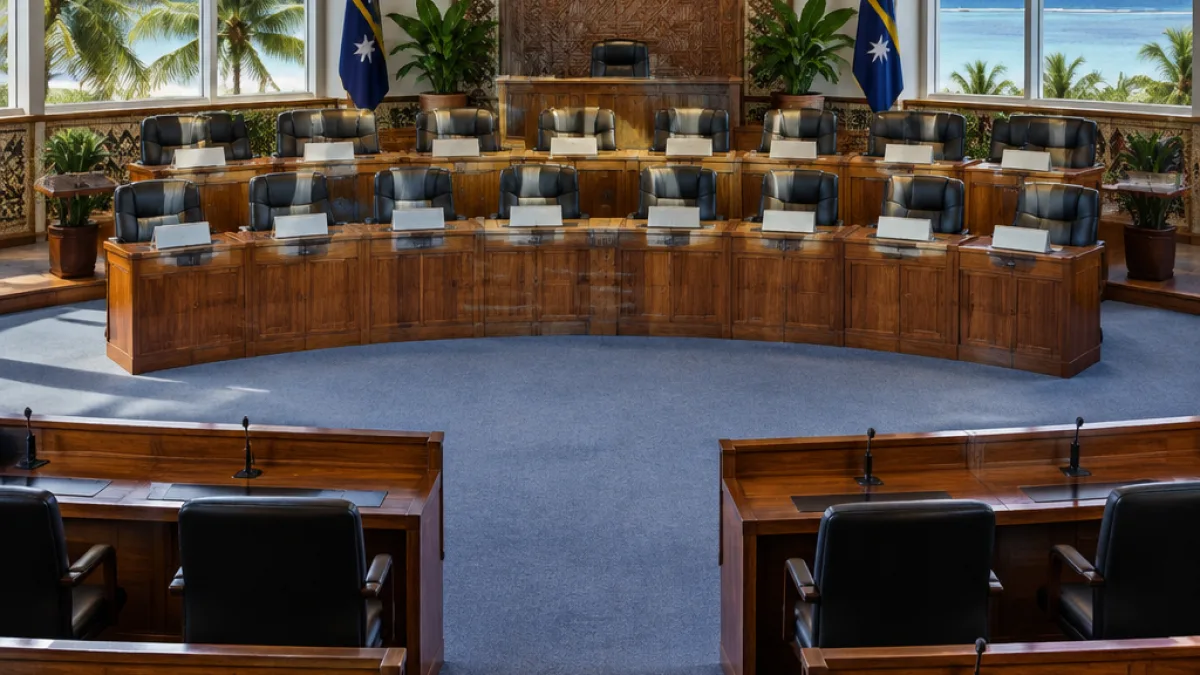
Nauru’s parliament has been left without a political opposition after the remaining lawmakers outside President David Adeang’s government joined the government side, according to the president.
Adeang said the shift represented “unity, stability and shared purpose” in the Pacific island country. The move means all 19 members of Nauru’s single-chamber legislature now support the government, an arrangement the president said had not occurred since the country became independent in 1968.
The change followed the appointment of lawmakers Pyon Deiye and Jason Bingham Agir as deputy cabinet ministers. Adeang announced the development in a Facebook post, but did not provide a detailed explanation for why the lawmakers had moved into government ranks. He referred instead to a common commitment to place Nauru’s interests first.
“There will still be a diversity of views and robust debate as in any strong and healthy democracy,” Adeang wrote.
Questions over scrutiny
The president did not identify who would perform the scrutiny normally associated with an opposition in a legislature where every member supports the government. Nauru’s political system has a single house of parliament, making the disappearance of an opposing bloc especially significant for the public examination of government decisions.
Political alliances in South Pacific island states can be fluid, and legislators may move between government and opposition groupings. The source material says debate in the region is nevertheless generally robust. Nauru’s situation is unusual because it has no opposing politicians at all, rather than simply a government with a shifting or narrow majority.
- Parliament: all 19 lawmakers are now aligned with the government.
- Government appointments: Pyon Deiye and Jason Bingham Agir became deputy cabinet ministers.
- Official explanation: President Adeang cited unity, stability and a shared purpose.
- Unresolved issue: the government has not said who will provide formal opposition scrutiny.
Limited independent information
Information about the political realignment has come from government Facebook posts, which were described as the only available source of news about the change. All news outlets in Nauru, a country of about 12,000 people, are government-owned, according to the source.
That media environment adds to the importance of questions about how parliamentary decisions will be examined and reported. Foreign journalists face significant practical barriers to reporting from the country: applications for journalist visas cost 8,000 Australian dollars, equivalent to $5,445 in the source material, and foreign reporters are discouraged from travelling there.
| Measure | Detail |
|---|---|
| Parliament | 19 members |
| Population | About 12,000 |
| Independence | 1968 |
| Journalist visa application | A$8,000 |
A small state under attention
Nauru is a constitutional republic and a member of the United Nations. It is among the world’s smallest countries by population and physical size. Its remote location, limited infrastructure and environmental damage linked to phosphate mining have contributed to a small visitor economy, unlike Pacific islands where international tourism is a leading economic activity.
The latest political development has nevertheless drawn attention beyond the island. Adeang made international headlines in August when he said Nauru would officially adopt Naoero as the country’s name, using the local spelling. The government’s decision to bring all lawmakers onto its side now raises a different question about the country’s democratic institutions: whether debate within government can provide the same public accountability as an organized opposition.