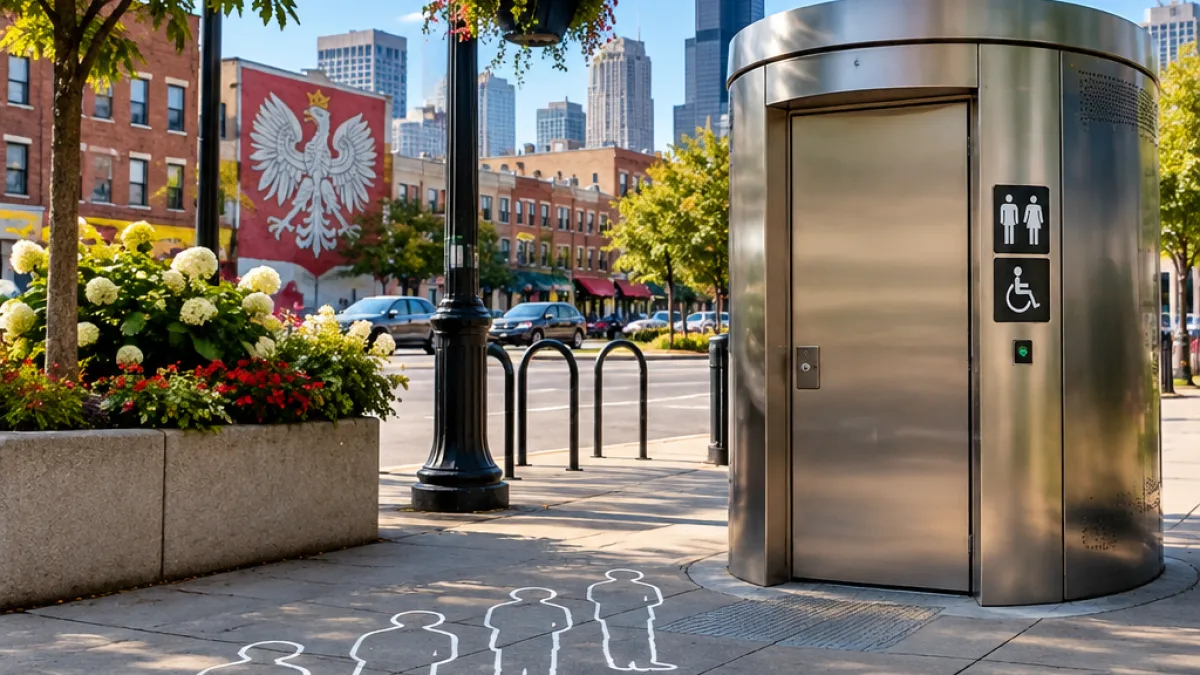
Chicago has opened its first self-cleaning public toilet, turning an ordinary bathroom break into a small but carefully staged moment in the city’s infrastructure history.
Christian Malatesta, a Wicker Park resident who had contacted Ald. Daniel La Spata weeks earlier, became the facility’s first user on Wednesday. After greeting La Spata, Malatesta entered through an automatic door at the stainless-steel structure in the Polish Triangle. A few minutes later, a flush could be heard. When the door opened, he emerged with both thumbs raised.
“Great craftsmanship,” Malatesta told reporters and city officials gathered outside.
A bathroom years in the making
The new facility is the product of a longer discussion about what cities owe people who are away from home. La Spata, whose 1st Ward includes the Polish Triangle, began pushing for more public washrooms in 2021. That campaign followed a Tribune investigation that found large parts of Chicago had few, if any, publicly operated bathrooms.
In 2024, La Spata told constituents that JCDecaux was prepared to install several higher-quality public toilets through its wider agreement with the city. The ward then directed about $315,000 toward installing the Polish Triangle facility at the busy meeting point of Milwaukee Avenue and Division Street. JCDecaux donated the structure itself to Chicago for the pilot project.
That combination of public spending and private contribution has made the opening more than a novelty. It is also an early test of whether a dedicated, purpose-built washroom can become a practical part of daily city life rather than an exception reserved for parks, transit stations or commercial businesses.
Who stands to benefit?
La Spata said the bathroom is intended for everyone, while pointing to groups that can face particular difficulties when public facilities are scarce. His examples included children, older people and visitors unfamiliar with the city. For anyone caught short while walking through a busy neighbourhood, the availability of a public toilet can affect how long they stay, where they go and whether they feel comfortable navigating the area.
The city’s first installation is being presented as the starting point for a broader network. La Spata described public washrooms as a basic requirement in major cities and said Chicago had to take the first step somewhere.
“Somebody had to be the first,” La Spata said.
What the pilot represents
The opening also highlights a familiar challenge for urban planners: facilities that are easy to overlook until they are needed. Public toilets rarely attract attention when they are available, but their absence can shape a person’s experience of a neighbourhood. Families, seniors and travellers may have to shorten an outing or rely on the permission of a café or shop if no public option exists.
For Chicago, the Polish Triangle installation offers a visible way to assess demand and the role such facilities might play before more locations are added. The pilot began with a single user, a ceremonial flush and a positive first review, but its larger significance will depend on whether the city can turn that opening-day curiosity into reliable public access across more neighbourhoods.
- Location: the Polish Triangle, near Milwaukee Avenue and Division Street
- First user: Wicker Park resident Christian Malatesta
- Public investment: about $315,000 from the 1st Ward
- Next possibility: a wider network of public washrooms across Chicago
For now, the stainless-steel structure stands as a modest piece of public infrastructure with an unusually memorable launch. Its first visitor was selected in advance, the city’s alderman watched from outside, and the new facility passed its opening-day test. The more consequential question is whether one public toilet can help make access to a basic necessity a normal feature of city planning.