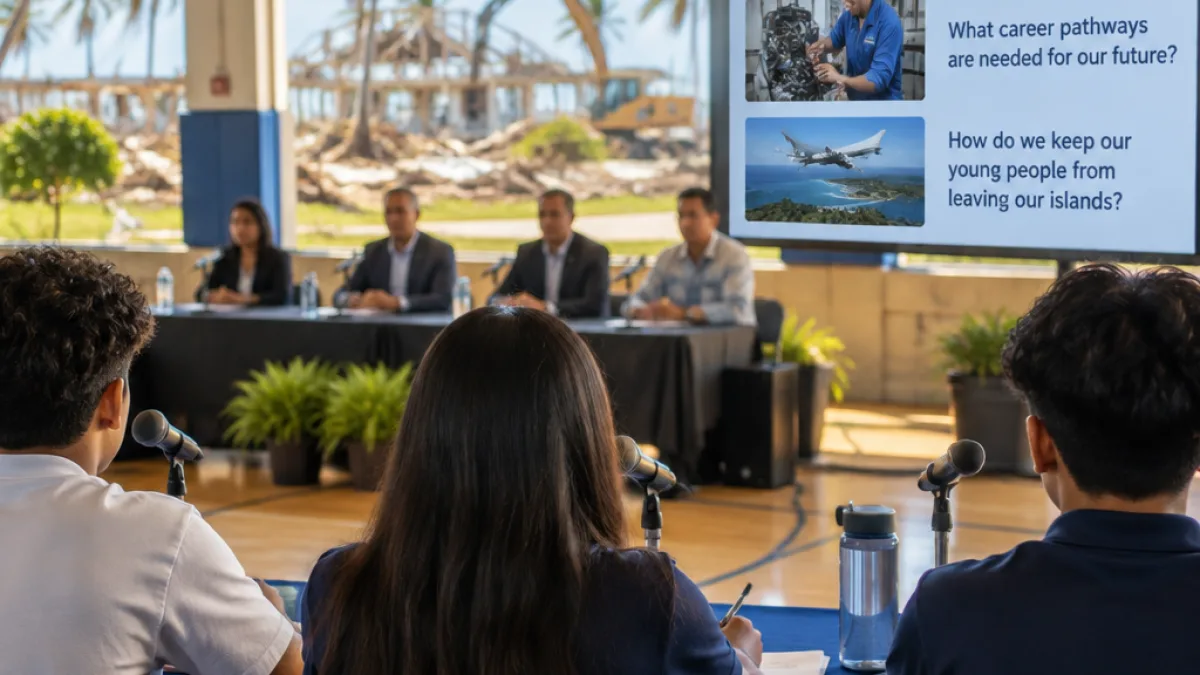
Students at Marianas High School pressed two gubernatorial candidates on the education and economic pressures driving young people away from the Commonwealth of the Northern Mariana Islands during a debate held Oct. 29.
The student-organized event focused on several issues affecting schools and families, including declining education budgets, high utility costs and the continuing recovery from successive typhoons. It had initially been planned for Oct. 16 but was postponed because of Typhoon Champi.
Republican candidate Ralph DLG Torres and independent candidate Lawrence F. Camacho attended with their running mates, Benjamin Jones Jr. and Edith Deleon Guerrero. Independent candidate Blas Jonathan “BJ” T. Attao did not take part because of a family emergency.
Students focus on the loss of young people
One of the central questions concerned the CNMI’s population decline. Students referred to an estimated loss of about 1,000 people each year and asked how the candidates would keep more residents in the islands.
Camacho, who previously served as education commissioner, said the challenge was connected to how students are prepared for life after secondary school. He pointed to the Public School System’s Portrait of a Graduate initiative, which links academic learning with career planning, technical abilities and preparation for college.
“When it comes to workforce, we do not have a numbers problem. We have a pipeline problem,” Camacho said.
His response framed education as part of a longer-term workforce strategy. The initiative he cited is intended to connect what students learn in classrooms with possible employment and postsecondary routes, although the debate also highlighted the limits of training when suitable work is not available after graduation.
Training must be matched with jobs
Jones, the principal of Kagman High School and Camacho’s running mate, placed greater emphasis on the shortage of opportunities awaiting students once they finish school. He argued that education and career preparation cannot, by themselves, stop young residents from leaving if graduates have few options at home.
“Now, there are no opportunities, and that's why our biggest export in the CNMI are our people,” Jones said.
Jones proposed enlarging internship and technical-certification opportunities through the Public School System, Northern Marianas College and the Northern Marianas Technical Institute. The goal, as described during the debate, would be to help students leave school with skills that employers can use immediately.
- Career preparation: students raised the need for clearer routes from classroom learning to employment.
- Technical training: proposed expansion includes internships and certification programs involving schools and postsecondary institutions.
- Population retention: candidates were asked how education and employment policies could reduce the departure of young residents.
Education funding under pressure
Students also asked the candidates which public programs should be protected if government revenue continues to weaken. The question placed education within a wider debate over fiscal choices, rather than treating school funding as an issue separate from the Commonwealth’s economic difficulties.
Camacho said a future administration should give priority to education, essential public services and economic recovery. He said savings could come from reducing unnecessary travel, duplicate contracts and projects that do not produce results.
“When the CNMI faces a budget shortfall, education will not be the first thing we sacrifice,” Camacho said.
The debate gave students a direct role in testing how candidates would balance immediate financial constraints with longer-term investment in schools. Their questions also connected education to household costs, disaster recovery and the availability of jobs, showing how school policy is experienced beyond the classroom.
For students in the CNMI, the discussion centred on whether the education system can provide a credible path to college, technical training or work without requiring graduates to leave. The candidates’ answers placed different weight on the two sides of that challenge: improving the pipeline into careers and creating enough opportunities for trained young people to remain in the Commonwealth.