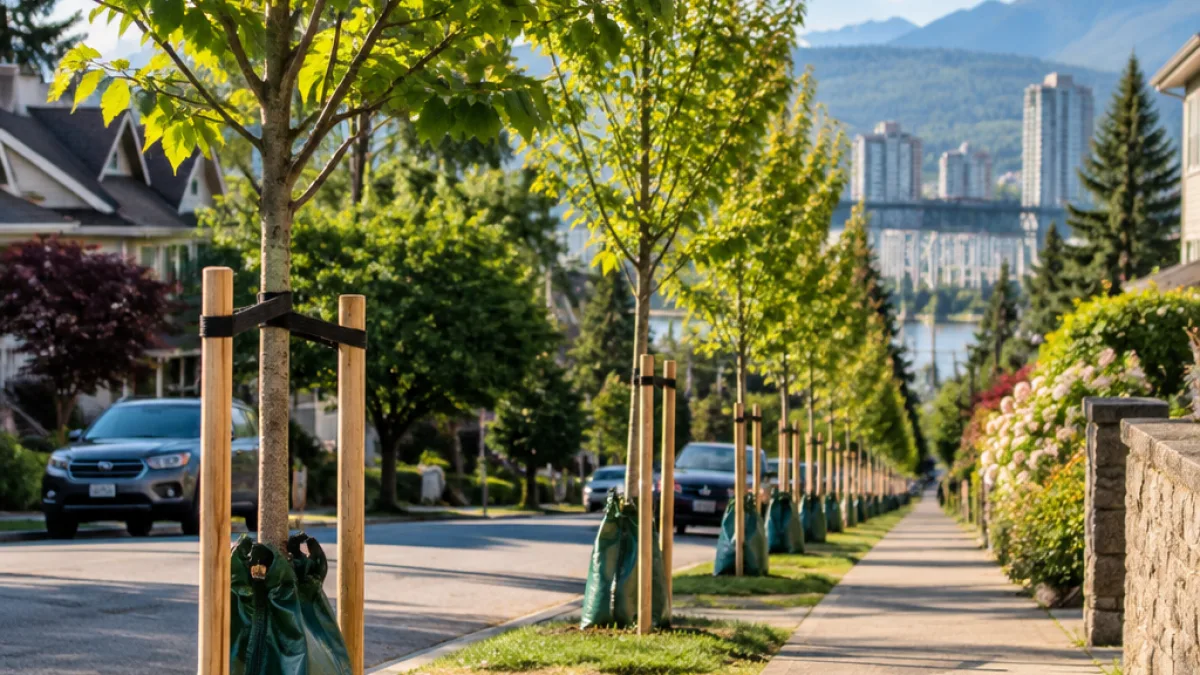
New Westminster is set to receive up to $1,051,940 to expand its urban tree canopy, with the funding supporting the planting of 1,050 street and boulevard trees across the city.
The money comes through the Federation of Canadian Municipalities’ Growing Canada’s Community Canopies initiative. In New Westminster, it will be used for Phase 2 of the city’s Urban Biodiversity Enhancement Initiative, a program that links tree planting with efforts to prepare neighbourhoods for climate-related stresses.
Planting where heat exposure is greatest
The city says the new planting will be directed strategically toward areas with lower tree-canopy coverage and greater vulnerability to extreme heat. That focus gives the project a practical dimension beyond the number of trees in the ground: the placement of each tree is intended to influence shade, natural cooling and the resilience of public spaces over time.
“Expanding shade and natural cooling in New Westminster neighbourhoods is an important part of preparing for future events.”
That assessment, from the city’s chief administrative officer, Donnie Rosa, is rooted in the experience of the 2021 heat dome, which city officials have identified as evidence of the serious risks extreme heat can pose to the community. Rosa said the funding would allow the city to speed up urban-forest work in locations most exposed to those conditions, while also supporting biodiversity and a more resilient community.
The project is not being described as a simple planting exercise. Dean Gibson, the city’s director of parks and recreation, said the municipality must consider both the species selected and the conditions in which trees will grow. Phase 2 will therefore include improvements to hardscaped areas, such as paved sidewalks, alongside the planting work.
- 1,050 street and boulevard trees are to be planted with the new funding.
- $1,051,940 is available to New Westminster through the national initiative.
- The city’s Phase 2 program has a broader target of 6,000 new street and boulevard trees by 2030.
- Planting will emphasize neighbourhoods with limited canopy and higher exposure to extreme heat.
A longer urban-forest plan
The second phase builds on work already completed through the city’s biodiversity initiative. Phase 1 resulted in 2,300 trees being planted across 40 parks and public open spaces. The next phase shifts more attention to streets and boulevards, where tree health depends on the space available around sidewalks and other built infrastructure.
| Program element | Figure or target |
|---|---|
| New funding | Up to $1,051,940 |
| Funding-supported planting | 1,050 trees |
| Phase 2 planting target | 6,000 trees by 2030 |
| Phase 1 result | 2,300 trees in 40 parks and public spaces |
Gibson said the city’s approach is to put the right trees in suitable locations and create conditions that can sustain them for decades. That places the long-term performance of the urban forest alongside the immediate goal of increasing canopy. Sidewalk and other hardscape improvements are part of that effort, although the source material does not identify the specific streets or neighbourhoods where work will occur.
The federal initiative, announced in May 2024, is intended to support at least 1.2 million new trees across Canada by the end of March 2031. It provides participating communities with funding, resources and coaching. For New Westminster, the local program now connects that national objective with a city target for thousands of new street and boulevard trees, while directing attention to the uneven distribution of shade and the effects of extreme heat.