A new display direction
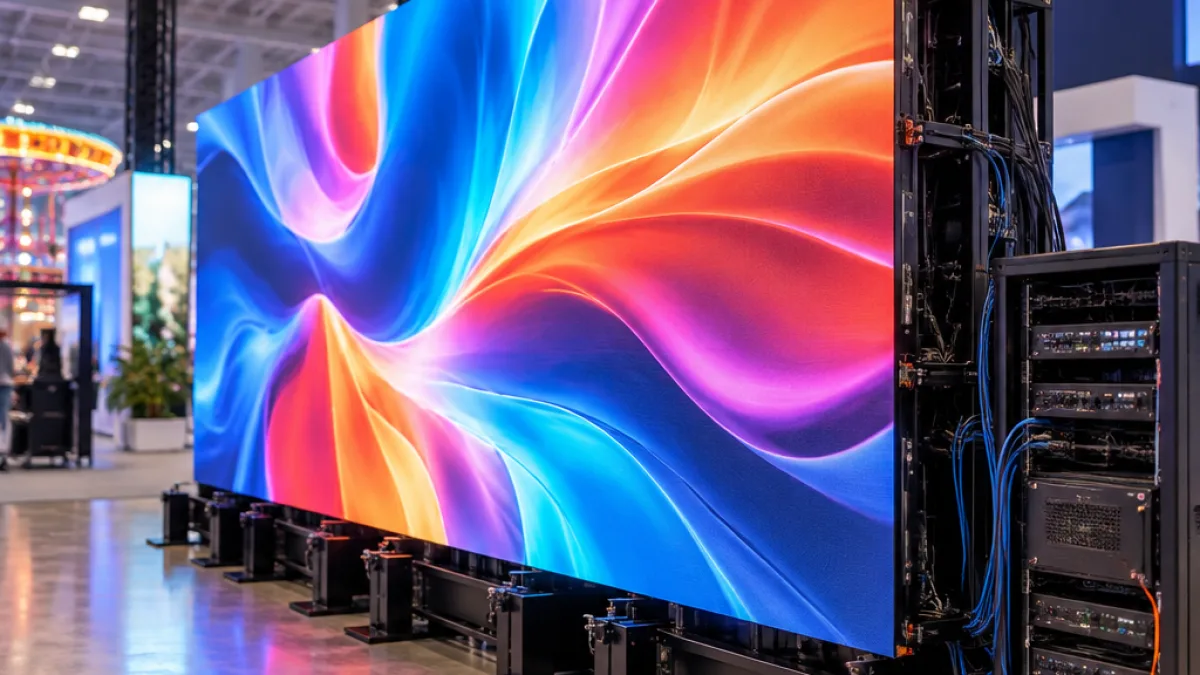
Norxe, a manufacturer best known for projection systems, is preparing to enter the direct-view LED market with a platform designed for applications where image performance and operational resilience are critical. The company plans to present the technology at IAAPA Expo 2026 in Florida later this month, giving customers and partners an early look before the system reaches wider development and deployment.
The new series will be offered in 0.7-millimetre, 0.9-millimetre, 1.2-millimetre and 1.5-millimetre pixel pitches. Pixel pitch, the distance between the centres of adjacent pixels, affects viewing distance and image detail. The range gives integrators options for configuring LED walls for different environments, from installations requiring fine image detail to applications where a larger pitch may be suitable.
Norxe says the display can support refresh rates of up to 240 hertz and is designed for low latency. Those specifications are particularly relevant when a display must reproduce fast-moving content or respond rapidly to an operator, rather than simply show conventional video. The platform also supports ST 2110 IP video, a professional networking standard used to move media over managed IP infrastructure, along with separate redundancy for power and video.
Common electronics and installation planning
The LED system is built around Norxe’s Unify electronics and application programming interface platform, creating a shared technical foundation with other products in the company’s portfolio. That approach is intended to give the new display line a common control and management structure rather than treating it as an isolated product.
Norxe will support the platform with Unify Display Manager, a pre-installation tool for planning an LED wall and its related equipment. The software allows integrators to map out controllers, cabling and associated components before installation. In complex display projects, this planning stage can affect both the practical installation process and the ability to identify equipment requirements in advance.
| Feature | What Norxe says it supports |
|---|---|
| Pixel pitches | 0.7, 0.9, 1.2 and 1.5 millimetres |
| Refresh rate | Up to 240 Hz |
| Video infrastructure | ST 2110 IP video |
| Resilience | Power and video redundancy |
Designed for simulation
The company is also positioning the technology for simulation work. It supports Night Vision Goggle training through dedicated infrared diodes and can provide continuous time-of-day simulation through precise dimming control. These capabilities indicate that Norxe is targeting environments in which the display must reproduce controlled visual conditions, not merely deliver a bright or high-resolution image.
For training operators, the ability to vary lighting conditions continuously can be important to the realism and repeatability of an exercise. The source material does not identify specific customers or installations, but the inclusion of infrared support and time-of-day control shows that Norxe is adapting its display expertise for specialized visual systems where colour management, latency and reliability all influence the result.
An early preview rather than a finished launch
Espen Olsen, Norxe’s vice-president of global sales, said the company’s focus has been on producing a complete image reliably in demanding applications. He described projection as an important part of the business while arguing that the performance of the display ultimately determines the outcome.
“This is deliberately an early preview. We want customers and partners to see the direction we are taking and bring their feedback directly into the engineering process.”
That positioning matters. The IAAPA demonstration is being presented as an opportunity for feedback, rather than as the final public arrival of a mature product line. For integrators and prospective users, the event may therefore be as much about assessing Norxe’s technical direction as evaluating a finished commercial system.
Norxe’s move reflects a broader strategic question for display specialists: whether expertise developed in projection can be carried into LED systems without sacrificing the image-control, connectivity and reliability requirements of professional users. By combining fine pixel pitches with high refresh rates, networked video, simulation features and built-in redundancy, the company is attempting to make that case. Its next challenge will be turning the early platform into a dependable offering that can be designed, installed and managed consistently across demanding applications.