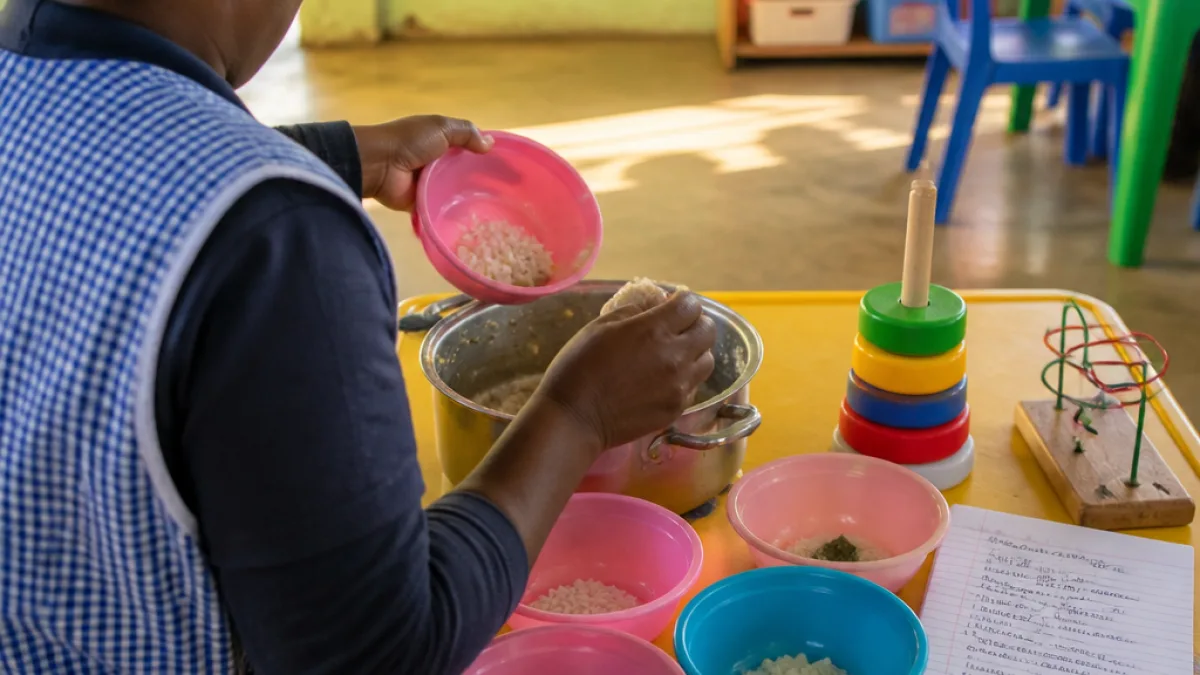
Early childhood development centres serving vulnerable communities are being pushed into debt and forced to ration food as state support remains well below the cost of keeping their doors open. The financial pressure has intensified debate in the Western Cape over whether centres can continue providing safe care and adequate nutrition while waiting for changes to the national funding framework.
The subsidy available to centres is R24 per child per day, while non-centre programmes receive R13. Advocacy organisation Real Reform for ECD (RR4ECD) says the realistic cost of operating a centre is closer to R45 per child per day. The gap leaves providers attempting to cover food, staff salaries and daily supplies with a funding allocation that does not match their basic expenses.
A funding gap felt on the ground
For centres in poorer areas, the difference is not an accounting exercise. It affects what can be placed on children’s plates, whether workers can be paid at or above the minimum wage and whether there is enough money for the consumables required for day-to-day operations.
Clayton Morar, speaking for RR4ECD, said centres in marginalised communities had little room to absorb the shortfall. Some were relying on donations, contributions from their communities and fees where those options were available. But the same sources of support were more difficult to secure in communities already facing financial hardship.
“ECD centres in vulnerable communities are simply forced to make do with less, placing pressure on their ability to provide children with adequate nutrition, pay staff salaries at or above minimum wage, and afford other consumables required for their daily running expenses,” Morar said.
He said some centres had been compelled to borrow money to remain operational. That creates a difficult cycle: centres need additional funds to meet immediate needs, but debt adds another cost to already stretched budgets. The result is pressure on providers to keep delivering a service even when their main public subsidy does not cover the cost of doing so.
What the subsidy currently covers
| Programme type | Daily subsidy | Estimated daily requirement cited by RR4ECD |
|---|---|---|
| ECD centres | R24 per child | About R45 per child |
| Non-centre programmes | R13 per child |
RR4ECD is calling for the centre allocation to rise from R24 to R45. The organisation’s position is that this would bring public support closer to the actual cost of providing the service, rather than leaving individual centres to bridge the gap through fees, donations or unpaid liabilities.
Province says national rules limit its options
The Western Cape Education Department said the province could not simply supplement the subsidy from its own reserves. Since responsibility for ECD management moved from Social Development to Basic Education, the department has been operating within the national framework governing the subsidy.
WCED spokesperson Bronagh Hammond said any adjustment had to be made in line with that framework.
“The Western Cape Education Department is guided by the national ECD subsidy framework, which determines any adjustment to the per-child subsidy rate,” Hammond said.
She said a higher allocation would therefore depend on decisions made through the national funding system. This leaves centres and advocacy groups pressing for relief at provincial level while the department points to rules that restrict its ability to alter the rates independently.
Why the issue matters beyond individual centres
ECD centres provide care and early learning before children enter formal schooling. Their financial condition therefore has consequences beyond their own accounts. When a provider reduces meals, struggles to retain staff or accumulates debt, the pressure is experienced by children and the communities that depend on the service.
RR4ECD’s warning is particularly focused on centres operating in vulnerable areas, where raising additional money from fees or local donors is more difficult. Centres with stronger community support may be able to cover some costs temporarily, but that option is not equally available across the province or the country.
- Centres receive R24 per child each day, while non-centre programmes receive R13.
- RR4ECD estimates that about R45 per child per day is needed to meet operating costs.
- Providers report pressure on nutrition, staff pay and essential consumables.
- The WCED says subsidy changes are governed by the national ECD framework.
Centres waiting for a sustainable answer
The immediate challenge is to keep centres functioning while the broader funding dispute continues. Providers cannot indefinitely depend on donations or take on debt to compensate for a shortfall in public support. Nor can the cost of maintaining early childhood services be separated from the quality of care and nutrition children receive each day.
The debate now centres on whether the national subsidy can be brought closer to the cost identified by providers, and how quickly that can happen. For the WCED, the funding route is determined nationally. For centres on the ground, however, the consequences of waiting are already visible in reduced resources, mounting liabilities and difficult choices about daily provision.