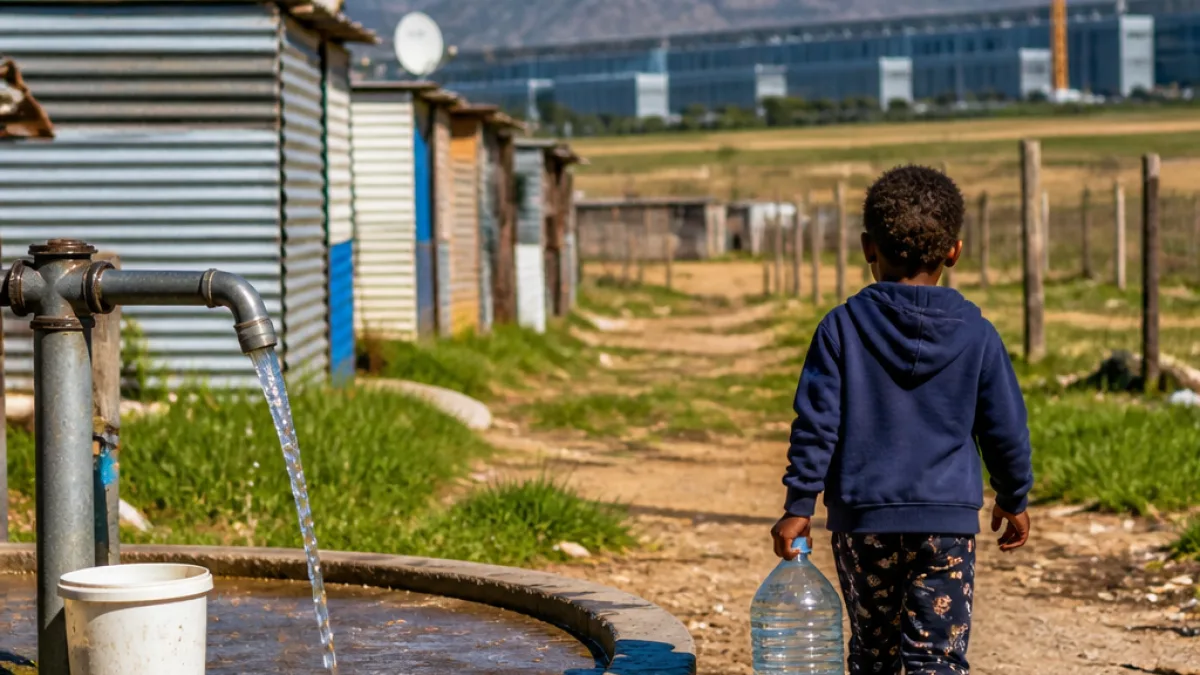
At a communal tap near land acquired by a major data-centre developer, a young boy carried a large bottle of water back towards Barcelona. In the informal community near Cape Town International Airport, where small metal homes face the heat, residents do not have piped water or sanitation. Older people pay boys a few rand to fetch water for them.
That daily reality has become central to a dispute over the city’s expanding data-centre sector. Activists are challenging the rezoning of a portion of land near Barcelona, saying the possible arrival of a large, power-intensive facility must be considered alongside the needs of residents who still lack basic services.
Rezoning appeal heard this month
The land was acquired by Equinix, a United States-based company that operates about 280 data centres worldwide. The rezoning could allow the company to develop the site, although its managing director, Sandile Dube, said there were no immediate plans to do so.
Dube said that, should a project proceed, it would follow the required process and take local community concerns into account. The rezoning appeal was heard this month, with a non-binding recommendation expected within 90 days. That process places the immediate focus on the land-use decision, while also bringing wider questions about how Cape Town manages scarce water, electricity demand and development in areas marked by unequal access to services.
“It’s a direct land issue. It affects the water and sanitation policy. It affects socio-economic development because any form of development must benefit the community.”
— Housing Assembly activist Kenneth Matlawe
Matlawe, who lived in Barcelona for 15 years, is part of the Housing Assembly movement, which has joined the UK-based non-profit Foxglove and other organisations in opposing the rezoning. Extinction Rebellion has also been involved in the campaign. The groups are calling for a pause on the construction of new data centres in South Africa until dedicated regulations are established for the rapidly growing sector.
Growth versus resource pressure
South Africa already has more than 60 data centres, the largest number on the African continent, according to the report. The sector is expanding as artificial intelligence drives demand for digital infrastructure. Government supports data-centre investment as part of efforts to position South Africa as “Africa’s digital gateway”.
For Cape Town, however, the debate is taking place against a particularly sensitive resource backdrop. The city is described in the report as water-scarce, while the proposed development site is close to a community where water is collected by hand. Data centres also require substantial electricity and cooling capacity, which has prompted activists to question whether the benefits of the industry will be matched by safeguards for surrounding communities.
| Issue | What the report says |
|---|---|
| Proposed site | Land near Barcelona and Cape Town International Airport |
| Developer | Equinix, which operates about 280 data centres globally |
| Current status | Rezoning appeal heard this month |
| Expected next step | Non-binding recommendation within 90 days |
The conflict has therefore moved beyond a single property application. Activists are asking whether infrastructure planning can keep pace with a sector that depends on reliable water and power, and whether communities closest to new developments will share in the economic gains. Their concern is sharpened by the contrast between high-tech investment and Barcelona’s lack of piped water and sanitation.
The central issues raised by the campaign include:
- the impact of new data centres on water and electricity resources;
- the need for clear, dedicated rules for a rapidly expanding industry; and
- whether development near underserved communities will produce meaningful socio-economic benefits.
Until the recommendation on the rezoning appeal is issued, the future use of the land remains unresolved. Equinix has not indicated an immediate development plan, but the case has already exposed the competing pressures facing Cape Town: attracting investment and digital infrastructure while ensuring that communities without basic services are not left carrying the environmental and resource costs.