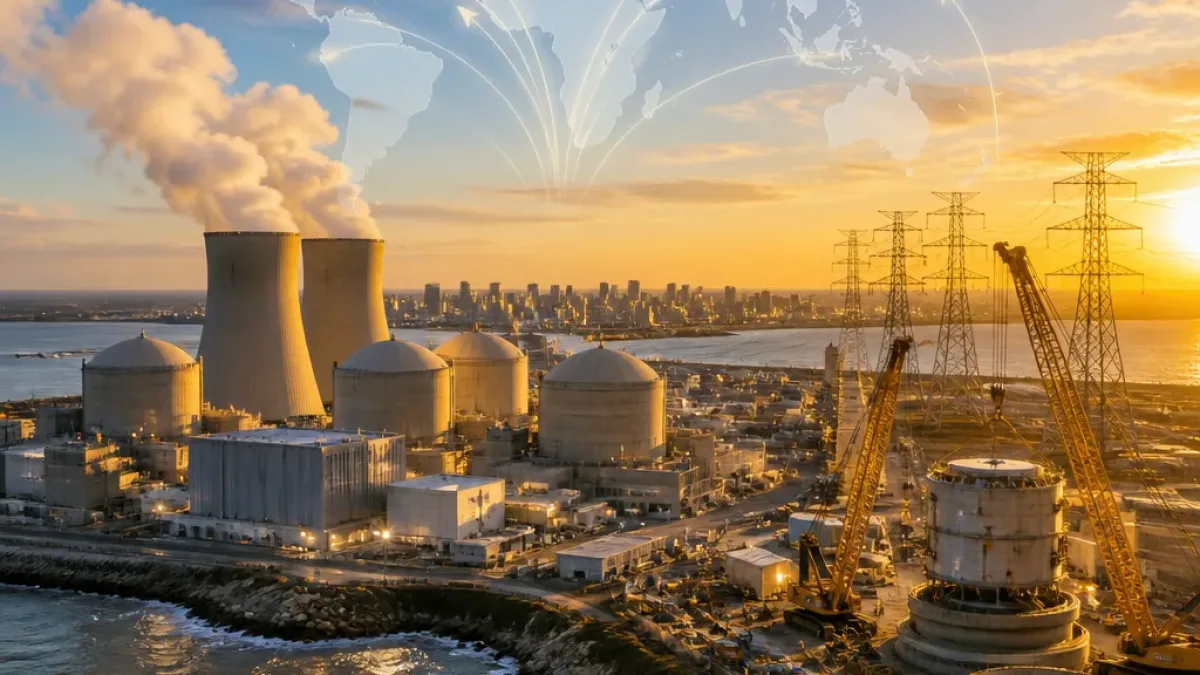
The head of the United Nations' nuclear watchdog warned Friday that the world is poised for a major expansion of nuclear energy, with global capacity potentially rising to more than three times current levels by 2060. The projection, delivered in the International Atomic Energy Agency’s annual report to the U.N. General Assembly, links growing nuclear build-out to rising demand for reliable, carbon-free electricity from electrification and large data centers.
IAEA projects sharp rise in nuclear power
Rafael Grossi, director-general of the IAEA, said the agency’s latest outlook reflects a significant upward shift in expectations for future nuclear capacity. He cited the surge in demand for dependable low-carbon power driven by electrification trends and the energy needs of artificial intelligence and technology companies.
“In 2025, more than 400 operating reactors in more than 30 countries produced 10% of global electricity and a quarter of its low-carbon electricity,”
The IAEA noted that more than 60 new reactors are currently under construction, and Grossi said projections for future capacity have “shifted dramatically upward.” The agency framed nuclear energy as on par with solar in terms of potential contribution to energy systems and described it as a safe option within a portfolio of electricity sources.
Security and safety concerns alongside expansion
Alongside the growth outlook, Grossi warned of mounting threats to nuclear safety and nonproliferation. He highlighted several geopolitical flashpoints in his presentation to U.N. member states:
- Iran: Grossi said the technical groundwork for a diplomatic settlement exists and urged a return to negotiations so the IAEA can resume verification activities without delay.
- North Korea: He pointed to the country’s unchecked nuclear program as an example of the consequences when oversight is absent and international limits are breached.
- Ukraine: The director-general singled out the Zaporizhzhia nuclear power plant, Europe’s largest, as remaining in a precarious position amid the conflict, with frequent disruptions to power and safety systems.
The IAEA’s warnings underline the dual challenge facing policymakers: managing a potential global expansion of nuclear power while strengthening safeguards, inspections and contingency planning in conflict zones and politically fraught settings. Grossi also raised concerns — without naming specific states — about reports that some countries are discussing acquiring nuclear weapons, underscoring enduring proliferation risks.
Current contribution and near-term construction
The IAEA report provided a snapshot of the current role of nuclear generation and near-term activity around reactor construction. Key figures presented to the General Assembly include:
| Metric | Figure |
|---|---|
| Operating reactors (2025) | More than 400 |
| Countries with operating reactors | More than 30 |
| Share of global electricity | 10% |
| Share of low-carbon electricity | 25% |
| Reactors under construction | More than 60 |
Those figures illustrate that while nuclear power already makes a material contribution to low-carbon electricity, the IAEA sees a markedly larger role emerging over the coming decades.
Implications for U.S. policy and global climate goals
The IAEA’s outlook has direct bearings for Washington as it balances emissions targets, grid reliability and national security. An accelerated global build-out could influence U.S. decisions on licensing, investments in advanced reactor designs, supply chain development and export controls tied to nonproliferation. It also amplifies the need for international coordination on safety standards and inspection access.
Grossi’s remarks serve as both a projection of energy trends and a cautionary note: expanding nuclear power will require expanded verification and safety efforts, particularly in regions where conflict or political friction threatens facilities or undermines oversight.
The IAEA report will feed into ongoing international discussions about pathways to decarbonize electricity systems, the role of large baseload sources, and the diplomatic work necessary to keep nuclear technology strictly within peaceful bounds.