The Massachusetts National Guard has been ordered into action to assist firefighters battling a wildfire that moved across the state line from New York into Williamstown, Gov. Maura Healey announced Monday.
State steps in as blaze crosses border
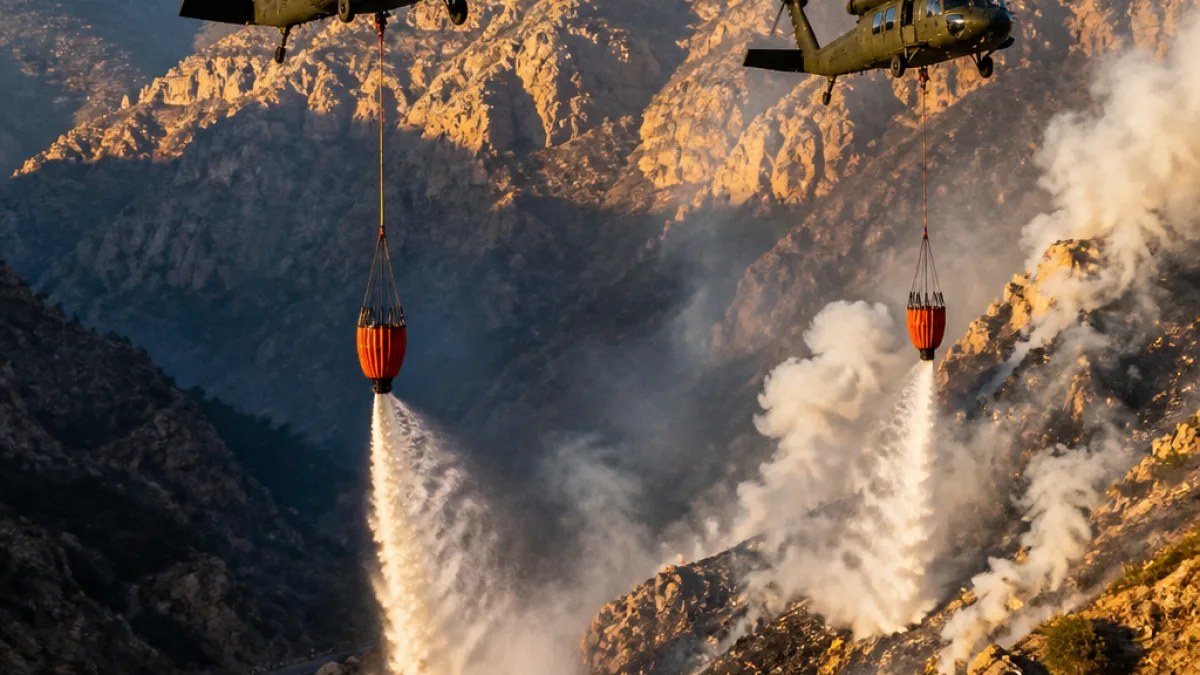
According to the governor’s office, Guard personnel will operate aircraft to perform water drops on sections of the fire located in rugged, remote terrain that ground crews cannot easily reach. The move comes as state and local agencies coordinate to slow the wildfire’s spread and protect nearby communities.
Officials said the blaze was roughly 200 acres in size and about 50% contained. The Williamstown Fire Department posted on Facebook that the fire was not threatening structures at the time of the update.
“Our top priority is keeping people safe and giving our firefighters every resource possible to contain this wildfire,” Gov. Maura Healey said in a statement.
Expanded resources and technology in use
Beyond the National Guard’s aircraft, multiple state offices are engaged in the response. The Executive Office of Public Safety and Security, the Department of Fire Services and the Department of Conservation and Recreation are monitoring the situation and providing assistance.
The Department of Fire Services is also deploying a drone team that streams high-definition and thermal imagery to incident commanders. Officials said those aerial feeds help allocate personnel and equipment by showing where fire activity is most intense and where hotspots may remain.
- Agencies involved: Massachusetts National Guard, Executive Office of Public Safety and Security, Department of Fire Services, Department of Conservation and Recreation, Williamstown Fire Department.
- Current fire size: ~200 acres.
- Containment: ~50%.
- Threat to structures: Reported as none by local fire officials.
Local context and recent history
Wildfires that burn into difficult terrain pose particular challenges in the Berkshires and other western Massachusetts woodlands, where rocky ground and steep slopes can limit access for engines and crews. In those conditions, aircraft water drops and aerial reconnaissance are often decisive tools for slowing or redirecting a blaze.
Western Massachusetts has seen notable wildfires in recent years. In May 2021, a fire in the Clarksburg State Forest burned at least 800 acres, which officials at the time said was the largest such wildfire in the state since 1999. That incident highlighted how quickly fires can expand in the region when weather and fuels align.
What officials are asking of residents
At the time of the most recent updates, local authorities indicated there was no immediate danger to homes. Still, the involvement of multiple state agencies and the National Guard underscores the potential for conditions to change rapidly.
Residents in Williamstown and surrounding communities should continue to watch official channels for evacuation notices or road closures. The use of aerial assets and drones may also produce temporary flight restrictions or activity that could be visible from the ground.
Coordination across state lines
Because the fire originated in New York and moved across the border, response efforts reflect cross-jurisdictional challenges that often accompany multi-state incidents. Mutual aid and interagency coordination are standard practice for large or complex wildfires; the National Guard activation is one example of the additional capabilities states can provide to bolster local firefighting capacity.
Officials did not release a prediction for when full containment might be achieved. For now, fire managers are using a mix of ground crews, aerial water drops and sensor-equipped drones to suppress active flames and identify smoldering areas.
| Item | Detail |
|---|---|
| Estimated acreage | ~200 acres |
| Containment | ~50% |
| Threat to structures | None reported |
| Primary state resources | National Guard aircraft, drone team, state fire agencies |
As the situation develops, the governor’s office and local fire officials are expected to provide updated assessments. For residents seeking the latest information, monitor official municipal pages and state public safety alerts for bulletins and instructions.
Massachusetts’ use of aviation and drone technology in this response illustrates a broader trend in the state’s wildfire strategy: leveraging air assets and real-time imagery to support ground crews in landscapes where access is limited and fires can rapidly change behavior.