
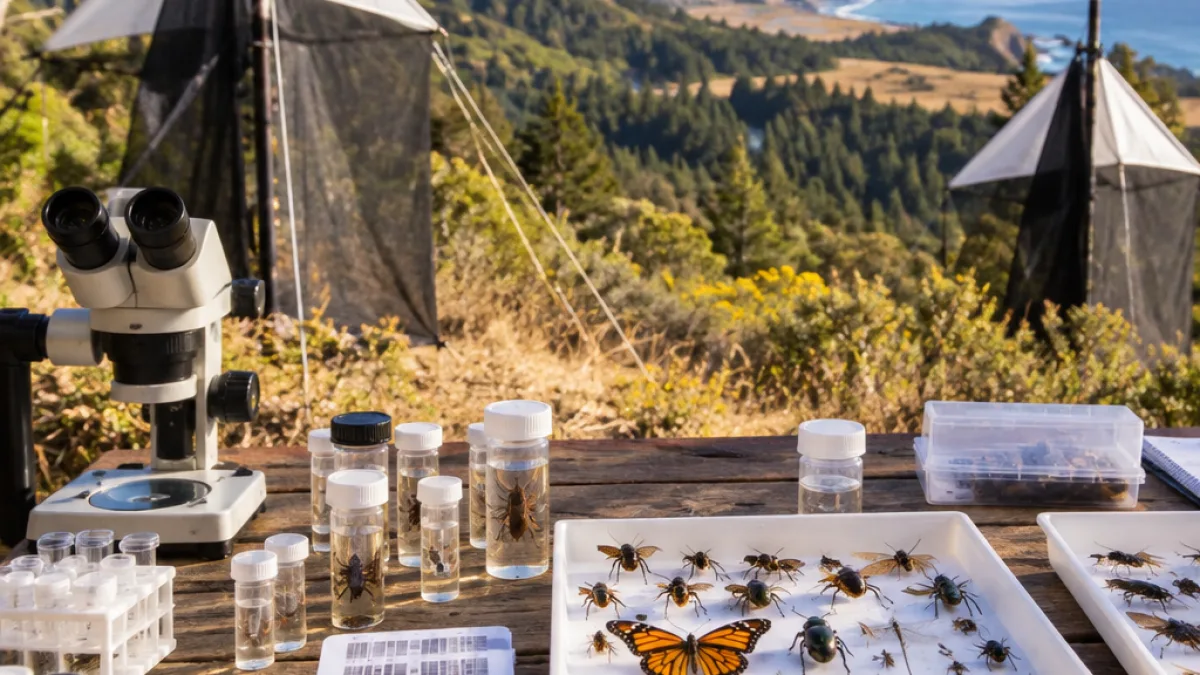
California is home to more than 60,000 insect species, according to a new study that also finds scientists have formally described only about two-thirds of them. The estimate, published in the journal Ecography, dramatically expands the known picture of insect diversity in the state and underscores how much remains to be documented.
Researchers at the Natural History Museum of Los Angeles County led the study as part of the California Insect Barcode Initiative, a statewide effort to collect and identify every insect species in California. The project is designed to address a long-standing gap in biological research: Insects are the most diverse group of land animals, yet they are often missing or underrepresented in broad conservation assessments.
A statewide effort to build an insect library
To assemble the study’s reference collection, researchers combined specimens from museum holdings with extensive fieldwork. They gathered tissue from collections such as those at the Natural History Museum and placed Malaise traps in 72 ecoregions throughout California. Teams also conducted targeted expeditions at 454 additional sites across the state.
Malaise traps collect flying insects passively, but the project still required substantial human effort to maintain the equipment and process what it captured. Researchers ultimately used DNA barcoding on more than 1 million insect specimens. That genetic identification work forms the basis of the newly published estimate and represents the first publication to emerge from the larger initiative.
| Study measure | Reported figure |
|---|---|
| Estimated insect species in California | More than 60,000 |
| Species already described | About two-thirds |
| Specimens DNA barcoded | More than 1 million |
| Ecoregions sampled with Malaise traps | 72 |
| Additional expedition locations | 454 |
Every site added a different piece
One of the study’s central findings is that nearly every location examined had its own distinctive insect community. That pattern suggests that California’s insect diversity is not concentrated in a small number of places. Instead, different habitats and regions contribute their own assemblages of species, making the protection of varied landscapes important to preserving the state’s full biological range.
The researchers also produced a geographic estimate of potential insect richness across California. Their projections were constrained by ecoregions and vegetation types, with the predicted number of species represented for each square kilometer. The approach provides a way to visualize where insect diversity may be greatest, even as the underlying inventory continues to grow.
Why the estimate matters for conservation
The gap between the earlier understanding of California’s insect life and the new estimate carries consequences beyond taxonomy. If many species remain unrecognized, conservation decisions based primarily on better-known animals and plants may overlook important parts of local ecosystems. The study’s finding that individual sites often support unique communities makes that omission more significant: Losing or altering one habitat could affect species not represented elsewhere in the survey.
- More than 60,000 insect species are estimated to occur in California.
- Scientists have identified only approximately two-thirds of that total.
- The statewide project has analyzed DNA from over 1 million specimens.
- Sampling covered dozens of ecoregions and hundreds of additional field locations.
The work also illustrates how modern identification methods can change the scale of a biodiversity question. Rather than relying only on visible traits and existing records, the initiative uses genetic barcodes to connect specimens with species-level information. That expanding library can help researchers distinguish organisms that may look similar and organize discoveries across a large geographic area, while the field collections provide the local context needed to understand where those insects occur.
For California, the result is both an inventory and a warning. The state’s insect fauna is far richer than previous estimates suggested, but much of it remains scientifically unnamed. By documenting that diversity across habitats, the researchers have made the case that insects should receive a larger role in conservation planning—and that the wild places supporting these still-undescribed species warrant greater urgency.