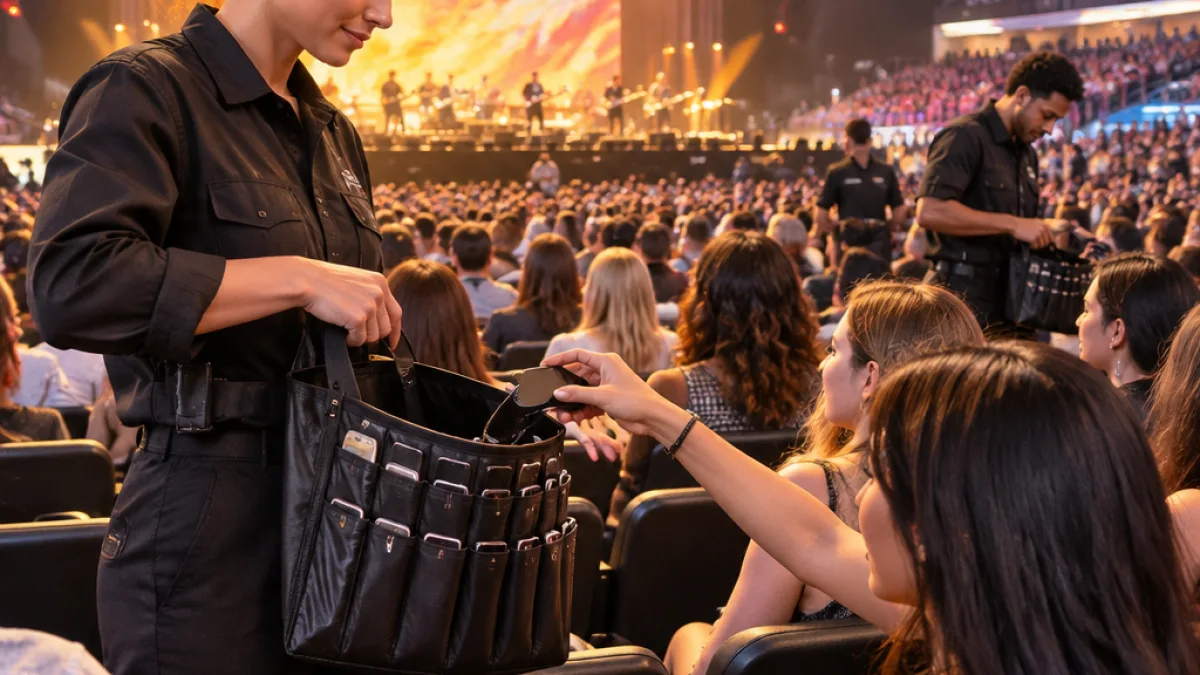
In an era when a concert can become a stream of clips before the opening song ends, Phoebe Bridgers made Friday’s performance at Inglewood’s Intuit Dome deliberately harder to document. Fans entering the arena handed over their phones, which venue employees placed in fabric pouches that remained locked until the audience left. The result was a show built around an increasingly unusual proposition: that a large crowd could experience emotionally exposed music without simultaneously recording, posting or checking the time.
The performance was the first of three hometown dates on Bridgers’ Lost Tour, and the restriction shaped the evening from the moment people arrived. Without cameras, phones and voice recorders, the audience could not instantly preserve every surprise or turn a vulnerable passage into social-media content. Even basic details—such as the concert’s precise start and finish times—became more difficult to verify afterward. That absence of documentation was not a side effect. It was central to the atmosphere Bridgers was trying to create.
A different kind of arena silence
Bridgers made the case for the policy before performing “Still Standing,” a song from her latest album, Lost Weekend. The track addresses the way abuse can shape a person’s understanding of love, and her introduction discussed her difficult relationship with her late father. Her remarks were quiet enough to settle thousands of people inside the arena, creating the impression that the room was listening not merely to a singer but to a person thinking aloud.
“Would have been a TikTok video with someone who doesn’t like my face commenting on it.”
That line captured the tension behind the experiment. Bridgers was not rejecting the existence of online fandom; she was challenging the assumption that every meaningful concert moment must immediately become public material. A phone-free room also changes the performer’s relationship with the crowd. Instead of anticipating a lens or a notification, fans are asked to remain physically present, while the artist receives no instant visual record of the audience’s reaction to consult later.
The music behind the experiment
Lost Weekend gives the concert’s privacy request particular weight. The album deals with the death of Bridgers’ father and the development of her romantic relationship with comedian Bo Burnham, but its emotional directness is balanced by a sharp sense of humor. The opening song, “The Outside,” moves into the subject of her father’s funeral through darkly comic imagery, establishing the album’s combination of grief, anger and wit.
That mixture allows Bridgers to move between painful disclosure and comic deflection without reducing either side. The phone-free format amplified the contrast. In a conventional arena setting, a statement about family trauma might be surrounded by screens raised above the crowd. At Intuit Dome, the same material had fewer distractions competing with it, and the audience’s response remained contained inside the room rather than immediately converted into a digital afterlife.
| Element | What happened Friday |
|---|---|
| Venue | Intuit Dome in Inglewood |
| Tour | Lost Tour |
| Audience policy | Phones were locked in fabric pouches until departure |
| Featured guest | Billie Eilish joined Bridgers for “Savior Complex” |
Even the surprise guest stayed in the room
The evening also included a moment that would ordinarily be guaranteed social-media content: Billie Eilish joined Bridgers for “Savior Complex.” In another concert environment, the appearance could have generated thousands of images and short videos before the song was over. Here, the crowd encountered the collaboration without the usual parallel task of recording it. Bridgers acknowledged the irony herself after reminding fans that their phones were unavailable, adding a literal “ha-ha.”
The policy did not make the show less culturally significant; it changed how that significance circulated. For an artist whose new work is expected to receive multiple nominations at the February Grammy Awards, the decision to limit documentation offered a counterpoint to the machinery of online attention. It also placed more emphasis on memory—imperfect, personal and impossible to fact-check with a camera roll. At a time when live music is often measured by what it produces for the internet, Bridgers’ arena show argued for the value of what remains only with the people who were there.