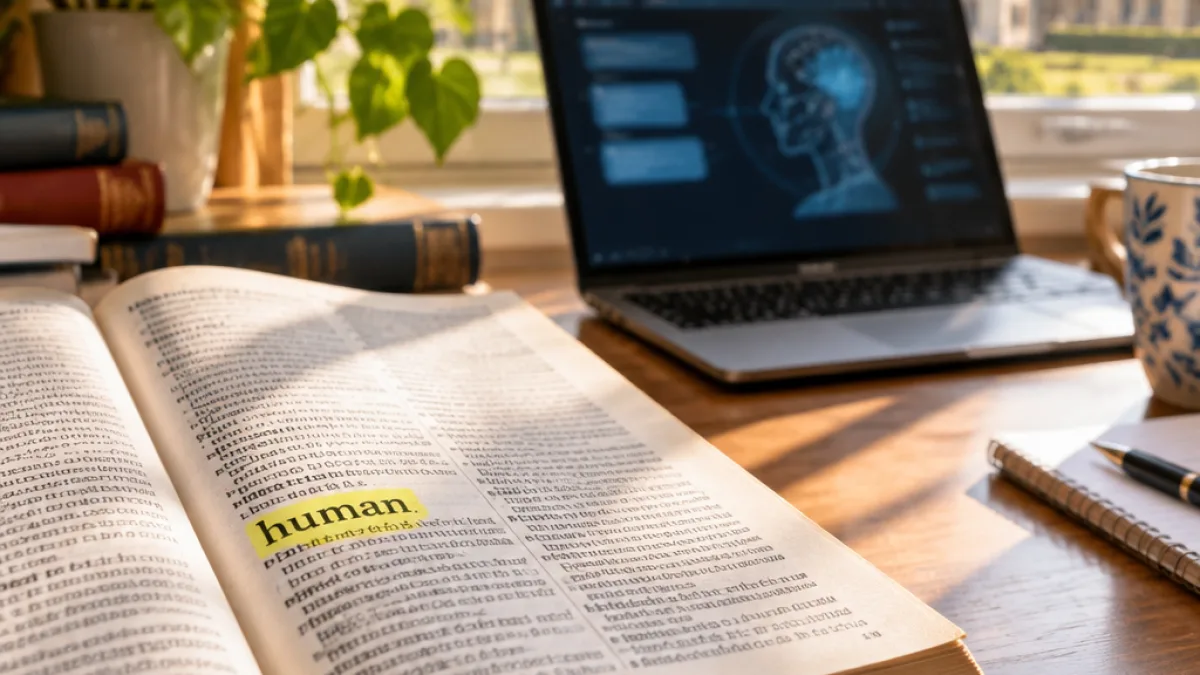
Cambridge Dictionary has chosen ‘human’ as its Word of the Year for 2026, placing an everyday term at the centre of a wider conversation about artificial intelligence, creativity and what separates people from machines.
The selection reflects a year in which AI has continued to influence ordinary discussions about intelligence, authorship and personal connection. The word carries a straightforward meaning as a noun – a person – but its use as an adjective reaches further, describing qualities, emotions and limitations associated with people rather than animals, gods or machines.
A word shaped by the AI era
Cambridge Dictionary’s decision does not suggest that ‘human’ is newly coined or necessarily the most frequently used term of the year. Instead, the choice is intended to capture the atmosphere around language: the concerns, hopes and preoccupations that define a particular moment.
Radhika Dua, English Language and Verbal Reasoning Faculty at Career Launcher, said annual word selections often represent something larger than vocabulary alone. A word can become significant because of its cultural resonance and the way its meaning develops in public conversation, she explained, rather than simply because it is new.
“Every year, dictionaries select a Word of the Year to capture something larger than language itself: the cultural mood, collective anxieties, aspirations and preoccupations of a particular moment in history.”
The choice also follows a sequence of words that tracks changing digital and social concerns. In 2023, Cambridge selected ‘hallucinate’, as AI became a more familiar part of everyday discussion. ‘Manifest’ followed in 2024, reflecting interest in intention and aspiration, while ‘parasocial’ was chosen in 2025 amid increasingly complicated relationships involving celebrities, influencers and AI.
| Year | Cambridge Dictionary choice | Conversation reflected |
|---|---|---|
| 2023 | ‘hallucinate’ | AI entering everyday discussion |
| 2024 | ‘manifest’ | Intention and aspiration |
| 2025 | ‘parasocial’ | Changing relationships with public figures and AI |
| 2026 | ‘human’ | Identity and distinction in an AI-shaped world |
How language marks the boundary
There is an apparent irony in selecting ‘human’ at a time when technology is increasingly capable of completing tasks once associated primarily with people. Dua said that tension gives the word particular force: it brings together debates about ability, emotion, originality and the value placed on human experience.
Colin McIntosh, a lexicographer at Cambridge Dictionary, pointed to the growing use of expressions such as ‘human-made’. The phrase creates a clear distinction between work produced by people and material generated by AI, showing how technological change can alter not only what we do but also the vocabulary used to describe it.
“AI is changing how we talk about being human.”
That shift can be seen in the questions now attached to familiar activities. When a piece of writing, an image or another creative work is produced with the help of a machine, people may want to know where the human contribution lies. The word ‘human’ therefore becomes less a simple description and more a marker of authorship, judgement and feeling.
What the choice invites us to consider
For readers, the selection offers a useful pause in an otherwise fast-moving technology conversation. It does not provide a definition of what AI will become, nor does it settle the question of how people should use it. Instead, it draws attention to the qualities people may want to preserve and recognise as digital tools become more capable.
- Who created the work, and how transparent is that process?
- What part of an experience depends on emotion, judgement or personal connection?
- When a machine can imitate a human result, what still makes the original experience meaningful?
Cambridge Dictionary’s 2026 choice places those questions inside a single, familiar word. As AI becomes more present in work, culture and communication, ‘human’ is being used to describe not only who people are, but also what they value and what they do not want technology to erase.