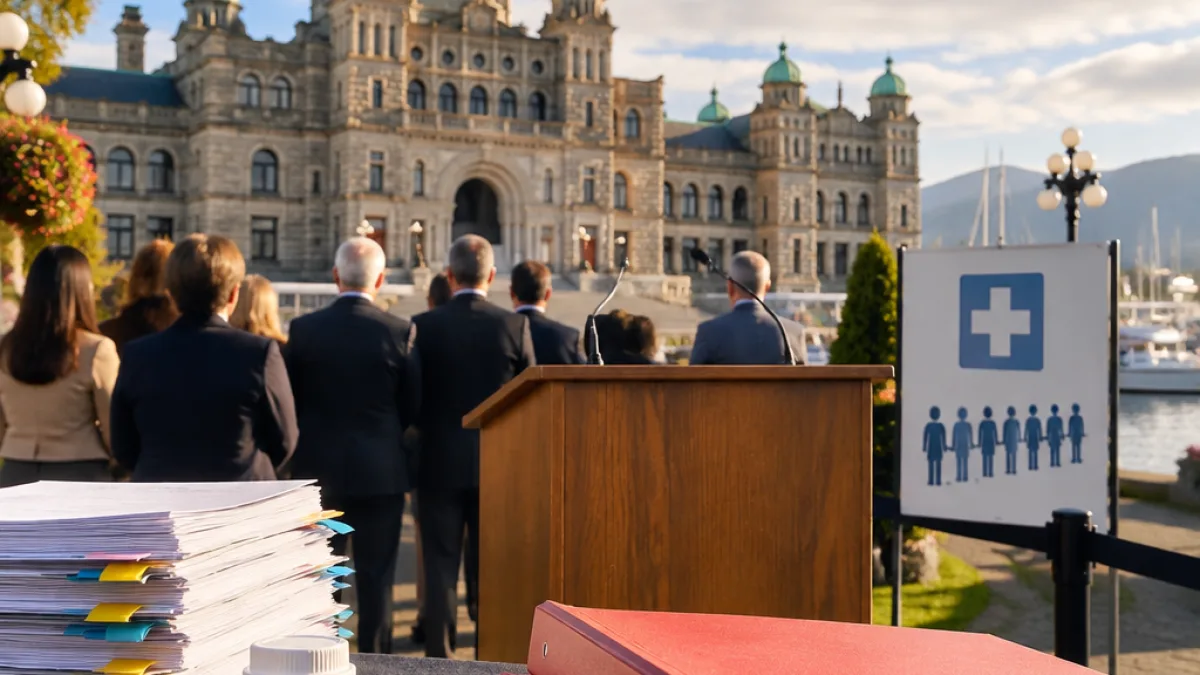
A new government begins its first week
Victoria is entering a new phase of provincial politics after Lorne Doerkson was sworn in as premier this week, following the Conservatives’ victory over the NDP in the Oct. 24 election. His arrival at the legislature comes with a broad set of challenges identified in a discussion about the province’s immediate outlook: economic decline, a worsening drug and mental-health crisis, pressure on health-care delivery, a growing public service and a budget deficit described as historic.
For people living in the capital, the transition will be watched through decisions made at the provincial level and felt through the services those decisions shape. The source material does not outline specific measures from the new government, nor does it provide a timetable for action. Instead, it frames the change in leadership around the questions facing a province that has struggled to respond to several connected pressures at once.
“Get to work from the moment he got the authority to govern the province.”
That commitment, made before Doerkson took office, now forms the backdrop for expectations surrounding the new administration. The central test will be how quickly promises are translated into policy, while also determining which problems receive priority. The issues identified are wide-ranging, and choices in one area could affect the others: health-care strain sits alongside mental-health and drug concerns, while fiscal pressures may limit the government’s room to respond.
Questions for the province’s direction
A conversation featuring Vaughn Palmer, The Vancouver Sun’s provincial politics columnist for more than 40 years, is being presented as an examination of what the new premier’s term may mean for B.C. Palmer was invited to discuss the incoming government’s leadership and the circumstances it inherits. The available information does not report his detailed views or attribute any particular policy proposal to him.
- How the new government will address concerns about the delivery of health care.
- What response it will bring to the drug and mental-health crisis.
- How it will manage a large public service and an historic budget deficit while confronting economic weakness.
Those questions give Victoria residents a way to read the political transition beyond the change in party colour at the legislature. A new government has arrived, but the conditions it faces did not begin with the swearing-in ceremony. The description of the province’s difficulties points instead to accumulated pressures that will require decisions on spending, administration and public services.
| Political development | Information provided |
|---|---|
| Election | Conservatives defeated the NDP on Oct. 24, 2026 |
| Leadership change | Lorne Doerkson was sworn in as premier this week |
| Issues identified | Economy, health care, mental health, drugs, public service and deficit |
What comes next
The transition is also being placed in a wider public discussion through the “Conversations That Matter” series. The event information directs audiences to a video at vancouversun.com/conversations and promotes a live discussion scheduled for Nov. 26 on Western Canada’s energy potential and how to build it. That upcoming topic suggests the new government’s economic direction will remain part of the public conversation, although the source does not connect the event to any specific government plan.
For now, the clearest change is political: B.C. has a Conservative government after the NDP’s defeat, and Doerkson has formally assumed the premier’s office. The more consequential changes for Victoria will depend on what follows—whether the government can improve services, respond to the drug and mental-health emergency, manage its public workforce and confront the deficit without losing sight of the province’s economic condition. Those decisions, rather than the ceremony itself, will define the early measure of the new administration.