A closing address after 18 years
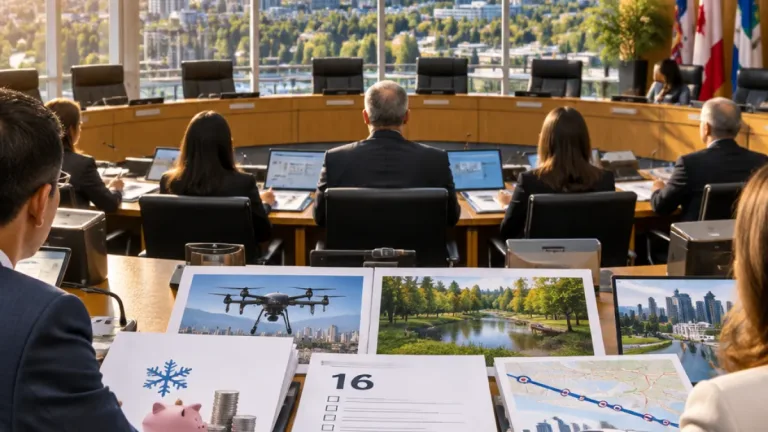
Coquitlam’s municipal political era under Richard Stewart ended with a final council meeting marked by praise, farewells and a warning about the tone of public life. Stewart, who spent 18 years in the mayor’s chair, joined Couns. Dennis Marsden, Brent Asmundson and Trish Mandewo in leaving council at the close of the term.
The departures will give the next council a different political landscape, but Stewart’s final remarks focused less on the transition itself than on the choices that shaped Coquitlam during a period of sustained expansion. He urged elected officials to maintain respectful political discourse and to show empathy toward residents dealing with addiction or mental-health challenges.
“I’ve always been shy but now I’m called outgoing,” Stewart said.
The line brought a light moment to a meeting carrying the weight of several departures. Stewart also revisited the unlikely path that brought him into public life, recalling that a prominent British Columbia politician had once encouraged him to run for office. He said he laughed and replied that someone would have to be an “idiot” to enter politics, prompting Gordon Campbell to politely thank him for the response.
Transit-led growth and a changing city
Stewart’s political career included service as the Coquitlam-Maillardville MLA before he won a council seat and later sought the mayor’s office. He said the goal was to break what he described as a long stalemate over the Evergreen line. The eventual SkyTrain extension became closely tied to a major period of development and population growth in Coquitlam.
Between 2007 and 2020, the city added about 35,000 residents. Stewart argued that rapid transit investment brought an obligation to accommodate the growth around its stations. His comments also reflected a deliberate environmental and land-use concern: he said he opposed meeting demand by cutting down forests or spreading development into agricultural land.
| Issue | Figure or position cited by Stewart |
|---|---|
| Time as mayor | 18 years |
| Population added, 2007-2020 | About 35,000 residents |
| Car ownership when he joined council | About 60 per cent |
Car dependence was another measure Stewart used to describe the consequences of growth. He said car ownership stood at about 60 per cent when he joined council. If another million people had the same rate of ownership, he said, parking them would require paving an area the size of Port Coquitlam. The comparison connected transportation policy to the visible costs of land consumption, rather than treating road and parking demand as an abstract planning issue.
Services, financing and the next council
During Stewart’s tenure, Coquitlam added a recreation centre in Maillardville, the YMCA in Burquitlam and a renovated Mundy Park Pool. Stewart said those projects were largely funded through non-tax revenue and grants from senior governments. He also pointed to the city’s general reluctance to rely on debt financing, framing municipal investment as a balance between building needed facilities and limiting pressure on property taxpayers.
His advice to future councillors included a caution about holding property-tax increases at zero. Stewart said a freeze can ultimately force difficult discussions about cutting services, noting that the consequences of that approach could be seen in a couple of communities. The comment leaves the next council with a familiar municipal tension: residents want affordability, while expanding communities require facilities, transportation connections and programs that must be financed over time.
- Transit: Stewart linked the SkyTrain extension with the need to plan for growth near stations.
- Land use: He argued against replacing forests or agricultural land with outward expansion.
- Municipal finance: He cautioned that frozen property taxes can place programs at risk.
As Coquitlam begins its next political chapter, the outgoing mayor’s final address leaves behind a record defined by growth and the infrastructure needed to support it. It also leaves a policy challenge: how to make room for more residents while protecting the land, services and civic empathy that shape the city’s future.