The Reach Gallery Museum in Abbotsford has received a 2026 Governor General’s History Award for an exhibition that examines how the Canada-U.S. border altered Indigenous life, relationships and responsibilities across the region.
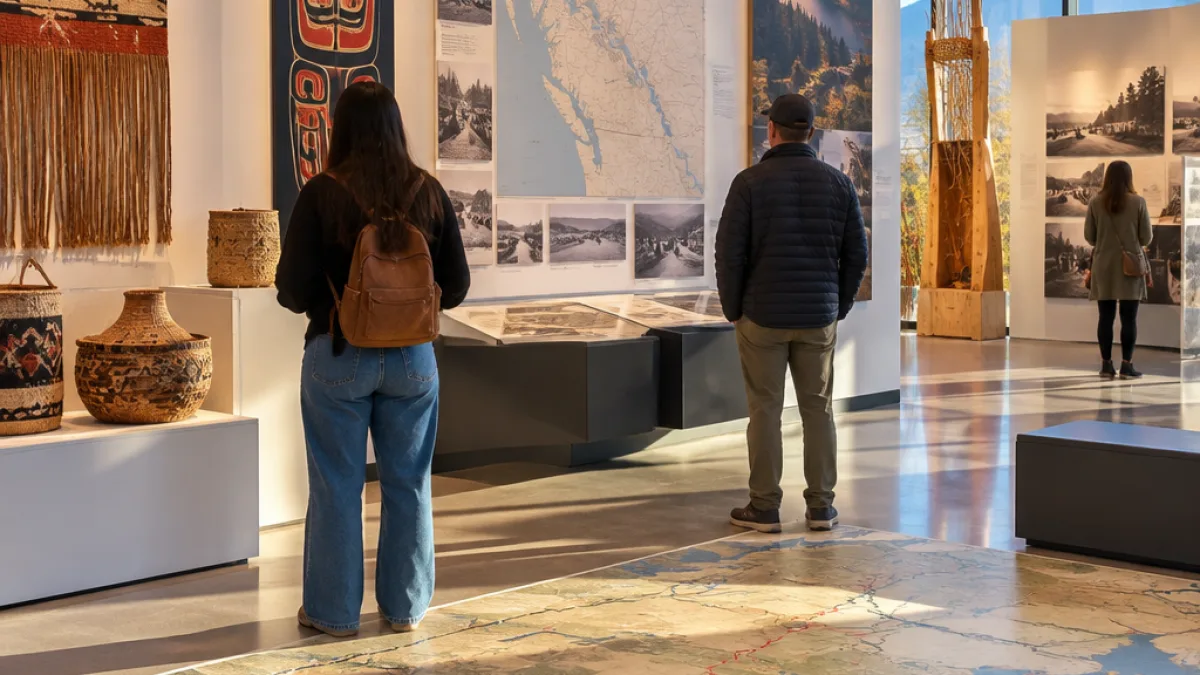
The museum was among the winners of the Governor General’s History Award for Excellence in Museums: History Alive! for Parallax(e): Perspectives on the Canada-U.S. Border. The bilingual exhibition considers the effects of the international boundary on Indigenous kinship networks, cultural practices, trade and ecological stewardship.
A border viewed through Indigenous experience
Rather than presenting the border only as a line between two countries, the exhibition focuses on the communities and connections disrupted by its creation and enforcement. Its subject reaches beyond maps and government boundaries, drawing attention to the cultural and environmental systems that existed across the region.
That approach is particularly consequential in a place such as Abbotsford, where the international border is part of the wider Fraser Valley landscape. The exhibition’s focus on ecological stewardship also connects political history with the land and waterways through which communities have maintained cultural practices and relationships. The museum says the project explores those impacts through a combination of historical material and contemporary artistic work.
| Exhibition | Recognition | Focus |
|---|---|---|
| Parallax(e): Perspectives on the Canada-U.S. Border | 2026 Governor General’s History Award for Excellence in Museums: History Alive! | Border impacts on Indigenous communities |
Seven years of research and collaboration
Parallax(e) is the result of a seven-year research project led by Dr. Julia Lum, an associate professor of art history at Scripps College in California. The project was developed in collaboration with five Indigenous artists and curatorial collaborators, with management at The Reach led by Kelley Tialiou, the museum’s curator of art and visual culture.
The project’s structure is central to the way the museum presents the history. It brings together archival and oral knowledge systems with contemporary artistic practice, while using a collaborative and countercolonial curatorial approach. Those elements are intended to challenge conventional ways of interpreting Canadian history rather than treating official records as the only source of historical understanding.
“Through its transdisciplinary methodology, its countercolonial and collaborative curatorial approach and its integration of archival and oral knowledge systems with contemporary artistic practice, Parallax(e) brings Canadian history into focus,” said Reach executive director Sandra Dyck.
Dyck’s description underscores the policy and public-history questions raised by the exhibition: whose accounts are preserved, how borders are understood, and what is lost when political boundaries interrupt longstanding relationships. By placing Indigenous perspectives at the centre of the work, the museum’s project treats the border as a force with continuing cultural and ecological consequences, not simply a historical marker.
- Institution: The Reach Gallery Museum in Abbotsford
- Exhibition: Parallax(e): Perspectives on the Canada-U.S. Border
- Project length: Seven years of research
- Recognition: 2026 Governor General’s History Award for Excellence in Museums: History Alive!
The national award gives Abbotsford’s museum a prominent role in a broader conversation about how Canadian history is researched, interpreted and shared. It also acknowledges the work of the Indigenous artists and curatorial collaborators whose contributions helped shape the exhibition. For local audiences, the recognition places a complex border history in a setting close to the communities and landscapes that continue to give the subject meaning.